

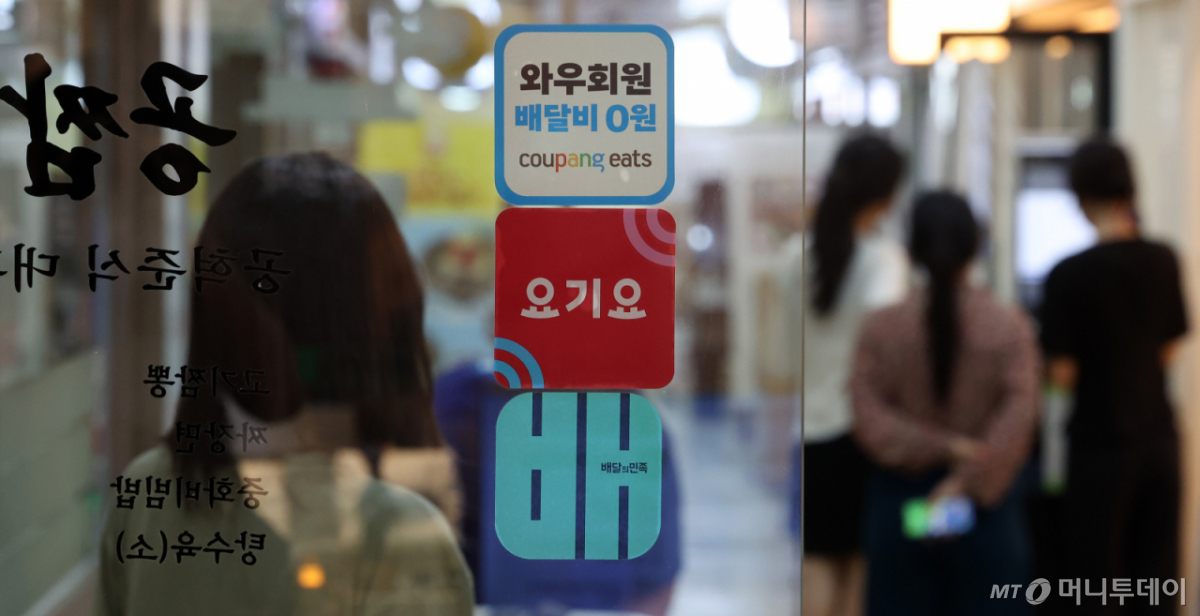
Small business owners, who have long complained about the high fee burden imposed by delivery platforms (delivery apps), are now moving to negotiate directly with platform companies. Since penalties such as fines levied on platform companies by the government do not immediately reach the affected store owners, they plan to establish a privately led council to find immediate alternatives, including reducing fees.
On the 17th, five organizations—the Small Business Federation, National Merchants Federation, Korea Foodservice Industry Association, Korea Franchise Industry Association, and Jeon Guk-ka-pe (President) Cooperative—held a press conference at the Seoul Yeouido SME (small and medium-sized enterprise) Central Association and announced plans to operate the 'Private Coexistence Council for Delivery Platforms.' They intend to set up direct negotiation tables to demand reductions in intermediary fees and delivery charges, as well as improvements in unfair practices such as 'flagging' (forcing stores to display promotional flags).
Go Jang-soo of Jeon Guk-ka-pe (President) Cooperative stated, "The profit margin from selling a single drink or dessert is extremely slim. After bearing high fees and delivery costs, all that remains is accumulating losses and sighs." He added, "Sighs of 'the more you sell, the more you lose' are echoing through every alleyway."
Small business owners have turned to a private council because they believe that relying solely on Fair Trade Commission penalties and subsequent legal battles will not yield immediate benefits. Even if large fines are imposed on platform companies, the funds go directly to the national treasury rather than reaching the affected store owners. Furthermore, if a platform company files an administrative lawsuit against the penalty, it may take considerable time before a final conclusion is reached.

In their joint statement, the five groups said, "What is urgently needed on the ground for small business owners is not 'judicial penalties far in the future' but 'immediate cost reductions and tangible support measures starting tomorrow.'"
It was also pointed out that discussions stalled after the Korea Fair Trade Commission rejected an application for consent approval regarding delivery platforms last June. Go Lee (President) stated, "We have been negotiating with platform companies since early this year, but the decisive reason for the suspension was the rejection of the consent approval. Afterward, both the platform companies and our five groups became focused on how much the fines would be, causing us to lose momentum for negotiations."
However, the five groups clarified that they do not oppose government-led regulation of delivery platforms themselves. While supporting the Online Platform Act currently under discussion in the National Assembly and the cap on delivery fees, they argue that fee burdens should be reduced through direct negotiations between parties even while legislation and penalty procedures are underway.
Specific fee levels are also expected to become part of the negotiation agenda. Go Lee (President) revealed that during past discussions with the Democratic Party of Korea's Euljiro Committee, they had agreed on a rate in the 5th% range. However, this private coexistence council did not specify a particular fee rate it will demand.
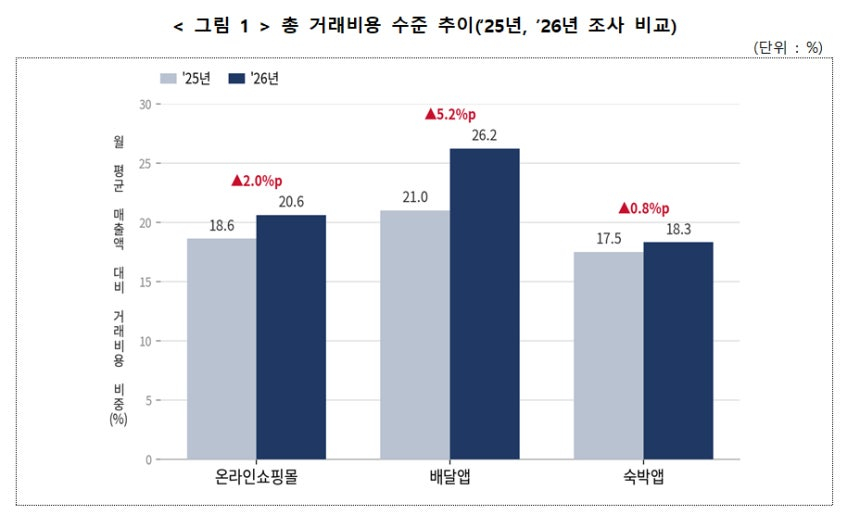
The financial burden on small business owners using delivery apps is increasing annually. According to a recent survey by the SME (small and medium-sized enterprise) Central Association of 1,250 online platform-listed SMEs, the total transaction costs incurred by delivery app-listed businesses—including intermediary fees, delivery charges, advertising fees, and payment processing fees—amounted to an average of 26.2% of monthly sales. This represents a 5.2 percentage point (P) increase compared to last year's survey.
The perceived effectiveness of existing coexistence initiatives on the ground was also low. When asked about the cost-saving effects of the differentiated fee system for delivery apps implemented since last year, 49.4% responded "no change," and 35.4% answered "not helpful." Among areas where delivery app-listed businesses expressed a desire to expand coexistence cooperation, reducing intermediary fee rates was cited most frequently at 47.1%.
The five groups have formally requested participation from major delivery platform companies and asked the government and National Assembly to provide institutional support for private negotiations. If a coexistence plan is not established within a short period, they plan to take additional measures, including legal action. The specific timing will be determined after monitoring developments such as the Korea Fair Trade Commission's decision on fines.

 in LIVING


