

The memory semiconductor supply shortage stemming from AI data centers has squeezed demand for OLED (organic light-emitting diode) panels for smartphones, and lowered the growth outlook for OLEDs in IT products. As production capacity continues to expand, centered on China, concerns over oversupply have grown, and securing utilization rates for Samsung Display’s new facilities has also emerged as a challenge.
According to recent OLED market analysis materials from market research firm Counterpoint Research released on Monday, demand forecasts for smartphone and IT OLED panels for 2026–2030 were revised downward. The analysis suggests that finished product sales of smartphones and laptops may fall short of initial expectations as component prices rise due to surging memory demand for AI data centers.
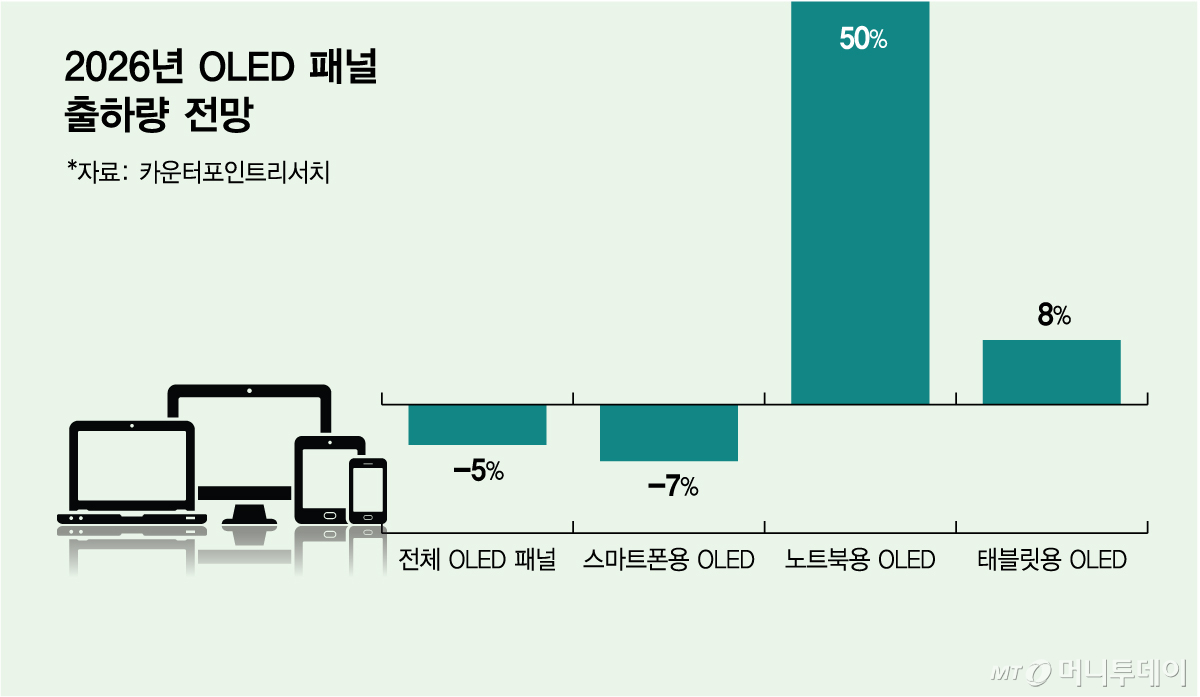
This demand slowdown shows varying degrees across products. Total OLED panel shipments this year are projected to decrease by 5% compared with the previous year. Smartphone OLEDs are expected to shrink by 7% due to sluggish set demand from rising memory prices, while laptop and tablet OLEDs are projected to grow by 50% and 8%, respectively, driven by increased adoption in premium products. However, as the memory supply shortage is predicted to persist beyond 2027, the medium- to long-term demand outlook for IT OLEDs has also been lowered compared with previous estimates.
Meanwhile, China-centered expansion of OLED production capacity continues. The share of Chinese factories in global OLED production capacity surged from 5% in 2017 to 45% last year. This figure includes Korean companies’ factories located in China and is expected to reach a level comparable to that of Korean-based factories by 2028, before surpassing Korea’s production capacity in 2029.
The expansion of Chinese manufacturers’ production capacity is also changing the competitive landscape of the flexible OLED market. Samsung Display’s share of flexible OLED production capacity fell from 40% in 2021 to 28% this year, and China’s BOE is expected to overtake Samsung Display to take first place by 2028. Analysis suggests that by 2030, the gap will widen further, with BOE at 28% and Samsung Display at 26%.
The expansion offensive by Chinese companies is also intensifying in IT OLEDs, a new growth market. While Samsung Display began mass production of 8.7-generation OLEDs to improve mid-size panel production efficiency at its A6 LINE in Asan, Chungnam Province—where it invested 4.1 trillion won—in July last month, China’s BOE also started product production at its B16 LINE in Chengdu in June, a month earlier.
Confirmed investments in 8.7-generation OLED production capacity within the display industry are known to be on the scale of 75,000 sheets per month based on wafer size. However, it is widely predicted that Samsung Display will maintain its advantage in terms of high-difficulty product manufacturing capabilities and actual production volume.
The key question is whether this can translate into actual profits. Industry concerns suggest that utilization rates at individual companies will remain low for the time being, as it will be difficult to fully absorb new production capacity amid sluggish demand.
If order volumes are insufficient, fixed cost burdens per panel will increase, and recovery of investment costs will inevitably be delayed. Price competition resulting from Chinese manufacturers’ expansion is also a variable in terms of profitability. For Samsung Display, it has become crucial to secure order volumes from major customers based on technological superiority and raise the utilization rate of new facilities to convert large-scale investments into profits.
An industry official said, “With AI-driven memory supply shortages suppressing finished product demand, coupled with expansion from China, concerns over supply-demand imbalance are significant,” adding, “Ultimately, if technological superiority is not quickly translated into performance, fixed cost burdens from large-scale investments will inevitably grow.”

 in INDUSTRY
