

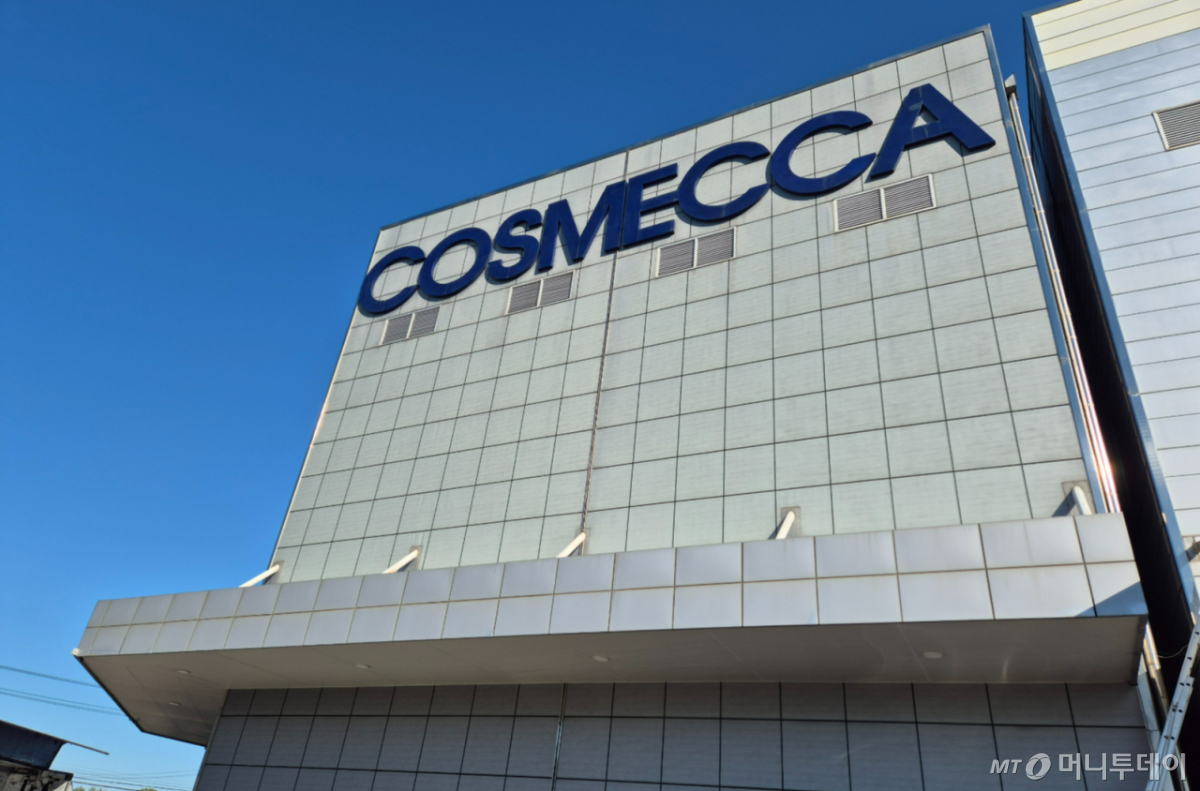
The second factory of Cosmecca Korea in Eumseong, Chungcheongbuk-do, visited on the afternoon of the 14th. Upon entering the first-floor integrated control room, eight monitors covering the wall caught our attention. The screens displayed production performance, inventory status, and sales and revenue figures in real time. These monitors allow for an at-a-glance check on which equipment is operating inside the factory and whether any issues have arisen during the production process.
The numbers on the monitors serve as indicators for managing the complex cosmetics manufacturing process, from raw material blending to packaging, through data. This is why Cosmecca Korea integrates artificial intelligence and robotics into its manufacturing sites: to enhance quality and productivity based on this data.
The factory tour was organized in collaboration between the Osong Bio Promotion Foundation and Cosmecca Korea ahead of the Osong Cosmetics & Beauty Expo, which will be held at OSECON in Chungcheongbuk-do on the 22nd. Cosmecca Korea is a cosmetics research, development, and manufacturing (OGM) company ranked fourth globally in scale, collaborating with over 600 domestic and international clients, including global brands such as Nivea, L'Oréal, and Estée Lauder.
Cosmecca Korea opened its blending room, a core space where approximately 12,000 types of cosmetics are produced annually, to the public. In the second basement floor blending room, silver blenders, appearing to be about 2 meters in height, stood in rows. The mechanical sound of operating equipment filled the space, and steam rose from some blenders as their internal temperatures reached up to 80 degrees Celsius, much like steam rising from a rice cooker. This is where raw material blending, a core process in cosmetics manufacturing, takes place. Formulas designed at the Pangyo Research Institute are realized here as actual products.
Blenders serve to mix cosmetic raw materials according to predetermined ratios and sequences. The largest equipment can process 10 tons of raw materials at once, while smaller units operate in increments of 100 kilograms. There are 17 blenders in the second factory alone, and a total of 29 are operated when including the first factory.
Lim Young-jun, Business Division Head at Cosmecca Korea, explained, "Cosmetics manufacturing is not simply a task of mixing raw materials." He added, "Even with the same raw materials, the texture and quality of the product vary depending on ingredient content, timing of addition, and blending conditions. A single product can contain up to 70 types of raw materials."
Furthermore, since the timing of addition and process conditions differ for each raw material, it is difficult to automate all processes. Additionally, each client has different containers and packaging methods. This highlights the characteristics of the cosmetics manufacturing industry, which faces simultaneous demands for multi-variety small-lot production and rapid delivery times.
Cosmecca Korea is unraveling this complexity through data. The company has database-ized approximately 200,000 cosmetic formulas it holds. This allows new product formulas to be compared with existing ones and similar ingredient compositions to be identified. It is also used to check for process issues that have occurred in the past, thereby reducing the possibility of defects in new products.
In the first basement floor packaging room, automated equipment was moving busily. Serums filled with contents and capped in the filling room passed through a glass door with minimal contact with outside air, moving to the packaging process. Subsequently, a robot resembling a claw machine picked up two serum containers and placed them into a packaging box.
Cosmecca Korea began investing seriously in smart factories in 2019. The company laid the foundation for data collection by installing Internet of Things sensors and subsequently connected production lines to a data-based system through the integrated control room. The company is transforming its production sites so that AI analyzes process materials for quality management, while robots take on repetitive or physically demanding tasks that people tend to avoid.
Research and development capabilities are also a pillar supporting production competitiveness. Approximately 36% of the total workforce consists of research and development (R&D) personnel, and the number of intellectual property registrations and applications stands at 646, placing it at the top level in the industry. A Cosmecca Korea official stated, "As K-Beauty grows, manufacturers' ability to respond quickly and precisely from product development to production has become important." The official added, "We will build a production system that enhances quality and production efficiency through AI and automation, while flexibly responding to client demands."

 in LIVING
