

$1 trillion in exports: K-brands forge an unprecedented path through localization
The Era of "K-Brand 3.0"
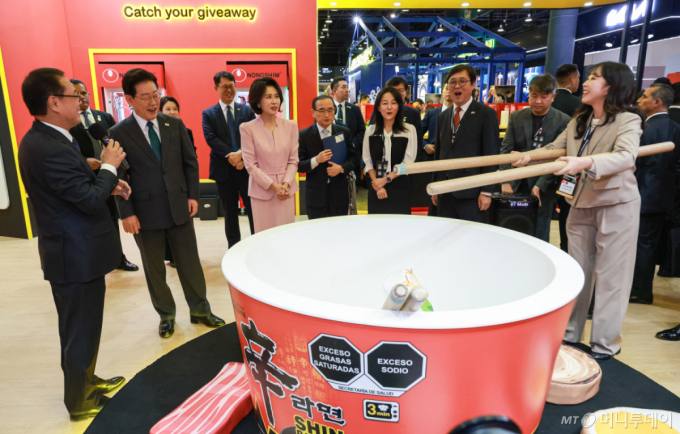
K-brands, centered on K-food and K-beauty, are sweeping the global market and serving as the vanguard of the $1 trillion export era. K-brands have now become a premium lifestyle enjoyed by the entire world. They do not exist as waves crashing in from the periphery, but rather assert their presence as deep-sea currents leading the flow of the vast ocean of global culture. It has become an unstoppable new normal for people worldwide to eat Korean food and consume Korean sensibilities.
The competitiveness of K-brands does not stop at simply "making products in Korea and selling them overseas." They are moving toward the era of "K-Brand 3.0," where they read the tastes and preferences of local consumers, produce locally, and grow together with local companies. The key to the success of the K-Initiative (meaning that Korea leads global standards) lies in "localization."
In the past, the mainstream approach for K-brands entering overseas markets was exporting products produced domestically. However, with rising logistics costs and tariff burdens, as well as growing geopolitical risks and supply chain instability, it has become difficult to target the global market using only the existing method. Consequently, domestic companies are rapidly shifting to a strategy of establishing production bases overseas, producing locally, and supplying local markets.
A representative example is CJ CheilJedang. By acquiring frozen food factories in the U.S. and expanding its local production base, it has built a supply chain connecting major hubs within the United States. Cosmax and Kolmar Korea are also supporting the global spread of K-beauty by nurturing local indie brands based on overseas production facilities.
K-retail is no different. The overseas expansion of domestic large marts, department stores, and convenience stores demonstrates a new export model. In Vietnam, Mongolia, and elsewhere, Korean convenience stores are not merely retail shops selling goods. They are evolving into lifestyle platforms that offer various services such as cafes, courier delivery, and finance, while simultaneously unveiling private brand (PB) products reflecting local consumer preferences.
Localization does not stop at simply "where to produce." The core is aligning what to make and how to sell it with local consumers. Companies are utilizing AI (artificial intelligence) and big data to analyze the tastes and consumption patterns of local consumers, launching country-specific products and brands.
The $1 trillion in exports expected to be achieved for the first time this year, in the second year of the Lee Jae-myung administration, will not happen overnight. While maintaining the export competitiveness of key industries such as semiconductors and automobiles, new export fronts such as K-food, K-beauty, and K-retail must be continuously created. Elevating the status of K-brands in the global market becomes a core task for enhancing national export competitiveness, going beyond simple brand strategy.
Kang Kyung-seong, President of the Korea Trade-Investment Promotion Agency (KOTRA), stated, "As seen in the U.S.-China hegemony competition, tariffs, and the Middle East war, it is important for our companies to utilize opportunities amid uncertainty," adding, "We must devise success strategies from the localization of K-brands unfolding on global battlegrounds."
Expanding overseas production of bibigo and Buldak… K-beauty targets home markets in the U.S. and Europe
- Expanding local production, localization strategy
Domestic companies recognize the K-wave as a "breakthrough" to overcome sluggish domestic demand and are focusing on localization strategies. Beyond exporting domestically manufactured goods, they have chosen a strategy of directly building production facilities overseas and penetrating large distribution networks located in key local positions. This is a move to shift the center of gravity of their business from domestic to overseas, aiming to leap into bona fide global companies. Underlying this is a sense of crisis that sustainable growth is difficult with a domestic-based business structure and that they could be eliminated from the market at any time.
◆ CJ CheilJedang's overseas revenue surpasses 50% for the first time… Nongshim and Samyang Foods expand overseas production of K-noodles
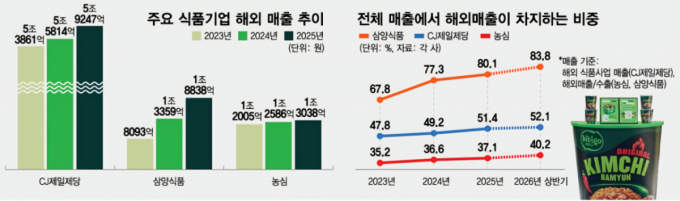
CJ CheilJedang, which has introduced its "bibigo" brand of various convenience foods such as dumplings, seaweed, and chicken to overseas markets, recorded 5.9247 trillion won in overseas food business revenue last year, surpassing domestic revenue for the first time since its founding. Nongshim, which surpassed 3.5 trillion won in revenue last year, has set a goal to raise its overseas revenue share to over 60% by 2030, led by the traditional Shin Ramyun and the overseas strategic product Shin Ramyun Tumba. Samyang Foods, whose overseas revenue share reaches 84% due to the "Buldak" (fire chicken) syndrome, has focused on brand expansion.
Products that have proven popular in overseas markets are being produced by building factories directly locally to boost production capacity. CJ CheilJedang is operating 20 food manufacturing plants in the U.S. alone. Samyang Foods plans to build a dedicated factory in the Zhenjiang area targeting the Chinese market, which accounts for about 40% of its overseas revenue, and will begin full-scale operations starting next year.
Paris Baguette is building a bakery plant in Texas, U.S., aiming for operation next year. CJ Foodville's Turejune has been operating production equipment for frozen dough and cakes supplied to North American franchisees in Georgia, U.S., since January this year.
Sales hubs are also expanding into the daily distribution networks of local consumers. Nongshim became the first Korean noodle brand to enter the main noodle shelf at Woolworths, Australia's largest supermarket chain, rather than the Asian food corner. Samyang Foods' Buldak series is being supplied to all regional stores of Walmart in the U.S. This serves as proof that K-noodles have established themselves not as novelty items, but as global brands frequently sought by locals.
Methods of promoting K-food are also evolving into customized formats tailored to local food cultures. Bibigo dumplings are a case of hitting it big by using chicken and cilantro, ingredients familiar to Americans, as fillings. bhc reflected the "chibap" (chicken rice) culture familiar to local consumers in Vietnam by including piece chicken and white rice in its menu composition. The Buldak series added creamy flavors such as cheese and carbonara for global consumers not accustomed to spicy tastes.
From Thailand's "Thaifex-Anuga," Asia's largest food exhibition, to the "SIAL" International Food Exhibition in Paris, France, K-food company booths or food trucks can be easily found anywhere in the world. Methods of meeting consumers have also diversified, including local music festivals, gaming events, and regional festivals, to establish themselves as familiar brands.
A food industry official stated, "K-food is now at a stage where it must consider more than just exports and grow its overseas business," adding, "Melting local unique cultures into our products and how deeply we enter the market will determine global competitiveness."
◆ K-beauty targets home markets in the U.S. and Europe beyond China… Entering local offline channels
Unlike the past when they focused on China, K-beauty companies are turning their eyes to the North American and European markets, which were considered the birthplaces of beauty. This is a move aiming for medium-to-long-term growth rather than fleeting popularity. Beyond simply increasing export regions, they have chosen methods of broadening consumer touchpoints, such as entering local large distribution networks and expanding offline stores.
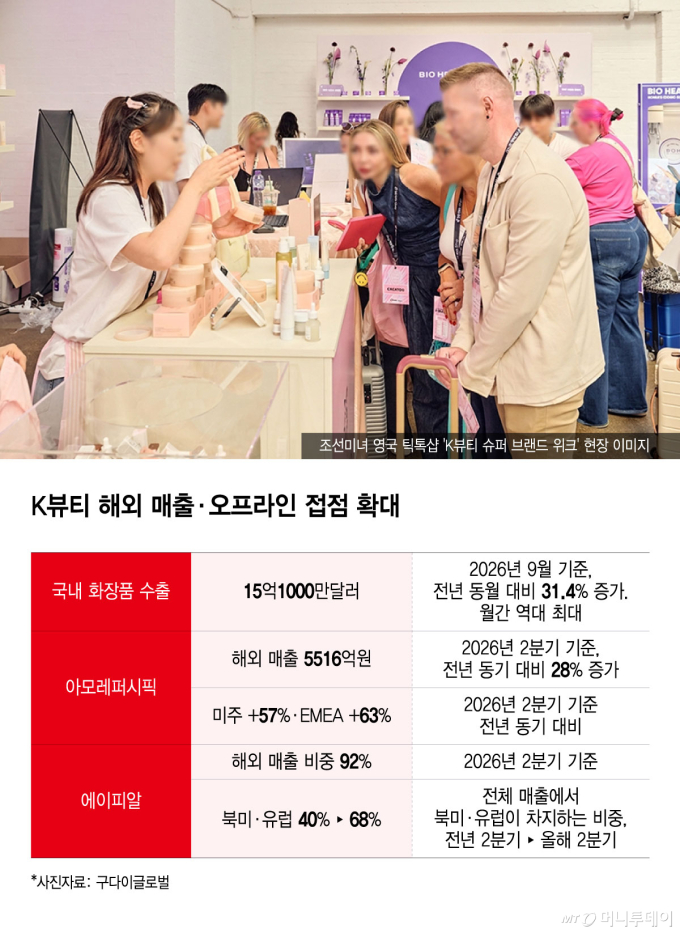
According to the Ministry of Trade, Industry and Energy, domestic cosmetics exports last month were $1.51 billion, a 31.4% increase compared to the same month last year. This is the largest monthly figure on record, surpassing the previous high of $1.35 billion in April and July this year. Exports increased evenly across major regions such as China, the U.S., ASEAN, and the European Union (EU), boosting overall performance.
These efforts led to changes in performance. Amorepacific's overseas revenue in the second quarter of this year was 551.6 billion won, a 28% increase compared to the same period last year. In particular, sales in the Americas increased by 57%, and sales in Europe, Middle East, and Africa (EMEA) rose by 63%, driving growth. Overseas business operating profit doubled to approximately 71.8 billion won.
APR's overseas revenue in the second quarter was 704.2 billion won, a 178% increase from a year ago. The share of North American and European sales rose significantly from 40% in the second quarter last year to 68% this year. After securing consumers online through SNS (social networking services) and other channels, they are expanding sales channels by entering local large distribution networks such as Boots and Sephora. In October, they will also hold their first solo pop-up store in London.
Goodai Global's representative K-beauty brand "Joseon Beauty" has entered 1,263 stores of Boots in the U.K. and approximately 760 stores of Superdrug. Approximately 2,000 people visited the solo pop-up held at Douglas in Germany, and daily average sales at the U.K. TikTok Shop event jumped to four times the average for January to August this year.
◆ K-department stores where K-fashion flags from the U.S. and Japan fly
The department store industry is focusing its efforts on a "global incubating" strategy to discover promising K-fashion and K-beauty brands and expand sales channels in overseas markets.
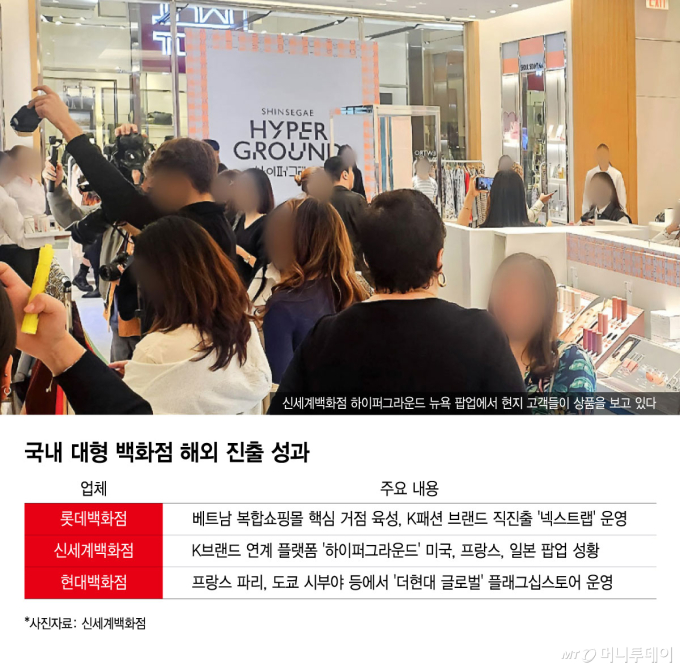
Shinsegae Department Store's K-brand linked platform "Hyperground" recently held a large-scale pop-up event at Hudson Yards, a central commercial district in New York, U.S., following France, Thailand, and Japan. It gathered over 30 beauty, fashion, and lifestyle brands gaining attention in domestic hotspots such as Seongsu, Bukchon, and Hannam, receiving favorable responses from local consumers and buyers.
Lotte Department Store is taking Vietnam as a key hub and successfully operating large shopping malls such as Westlake Hanoi. It has achieved results by building complex spaces for shopping, culture, and leisure targeting the lifestyle of the local elite. Here, it operates the "Next Lab" platform to help promising K-fashion brands enter overseas markets.
Hyundai Department Store is focusing on overseas expansion with planning and pop-up store operation strategies as its weapons. It has gained popularity by unveiling "The Hyundai Global" flagship stores in fashion hubs such as Paris, France, and Shibuya and Omotesando in Tokyo.
An industry official explained, "Recently, domestic department stores are branding themselves as trendy shopping spaces leading overseas fashion and consumption trends," adding, "This is a move that simultaneously considers supporting the entry of promising K-brands and their own global branding strategy."
[Visiting the front lines of the K-Initiative riding the 2026 K-Wave] General Discussion (Part 2)
"No fleeting hits": Survival methods for K-brands that rose thanks to Hallyu… "Take root locally"

 in LIVING


