

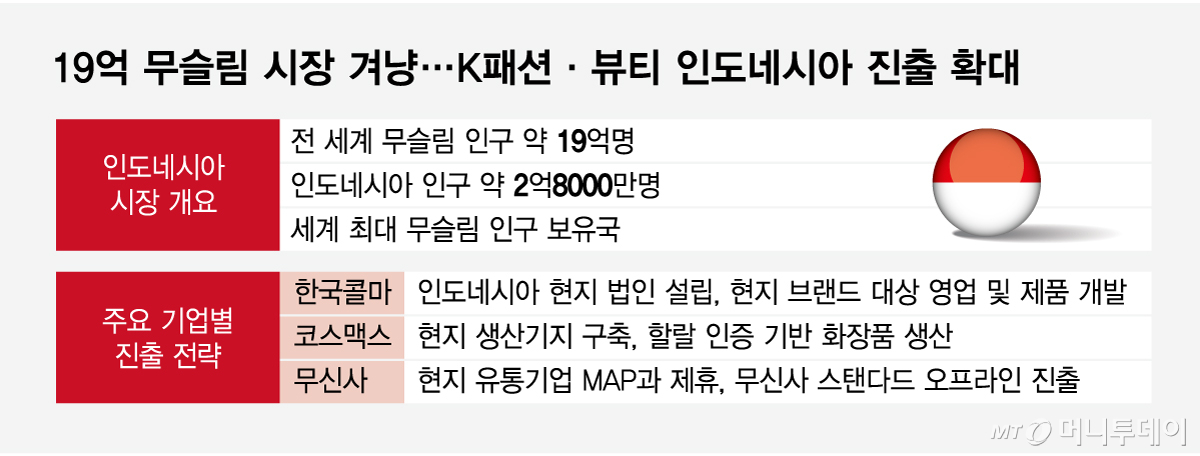
Domestic fashion and beauty companies are accelerating their entry into Indonesia, targeting a global Muslim consumer market of 1.9 billion people. They are positioning Indonesia, which has the world's largest Muslim population, as a hub for penetrating the Southeast Asian market, while securing local distribution networks and localizing products.
According to industry sources on the 19th, Kolmar Korea established a cosmetics wholesale subsidiary, "Kolmar Labs Indonesia," in southern Jakarta, Indonesia, last July. The subsidiary was jointly funded by Kolmar Korea and its affiliate Kolmar Yux with approximately 280 million won, with Kolmar Korea holding a 99.85% stake.
Kolmar Korea plans to fully expand its local business starting next year. First, it will begin developing and supplying products for local online brands and indie cosmetics brands. The company's strategy is to propose products that reflect Indonesia's hot and humid climate and local consumer preferences, while focusing on securing clients.
The establishment of this subsidiary carries significance beyond simply securing a sales hub. Indonesia is not only the largest consumer market in Southeast Asia with a population of approximately 280 million, but also the country with the world's largest Muslim population. For cosmetics, responding to regulations such as halal certification and product approval from the local Food and Drug Authority (BPOM) is crucial. Kolmar Korea has secured personnel to handle local licensing matters and is building systems for client sales and regulatory compliance.
The company has also established a foundation for halal certification. Kolmar Korea obtained halal certification at its Sejong plant and Bucheon plant. In 2022, it also secured certification from the Indonesian Ulema Council (MUI). Although the Indonesian government postponed the mandatory deadline for halal certification of cosmetics to October 2028, companies need to prepare in accordance with certification standards starting from raw materials and manufacturing processes.
Competition with Cosmax, which has already built a production base in Indonesia, is also expected. Cosmax began local production in 2016 and secured halal certification, supplying products to local brands and global cosmetics companies. In the third quarter of this year, sales of Cosmax's Indonesian subsidiary were 28.8 billion won, a 33.9% increase from the same period last year. Cosmax, which has grown its business centered on local production facilities, and Kolmar Korea, which is leveraging sales and product development cooperation, are approaching the market in different ways.
The fashion industry also views Indonesia as a new growth market and is expanding its entry. Musinsa signed an exclusive distribution contract with Mitra Adiperkasa (MAP), Indonesia's largest retail company, last July. MAP is a local retailer operating more than 4,000 stores in over 80 cities across Indonesia. Musinsa plans to open offline stores in major commercial areas, centered on the Musinsa Standard brand, utilizing MAP's distribution network to broaden its touchpoints with local consumers. In the first half of this year, transaction volume for Musinsa Global Store in Indonesia increased by approximately 70% compared to the same period last year.
The industry views Indonesia as a market with significant growth potential, based on demand for K-beauty and K-fashion driven by the spread of Hallyu and a young consumer demographic. An industry official said, "Given differences in religion, climate, and consumption tendencies, it is becoming important to respond to halal certification and local distribution regulations while providing products and brand experiences that reflect local consumer tastes."

 in LIVING
