

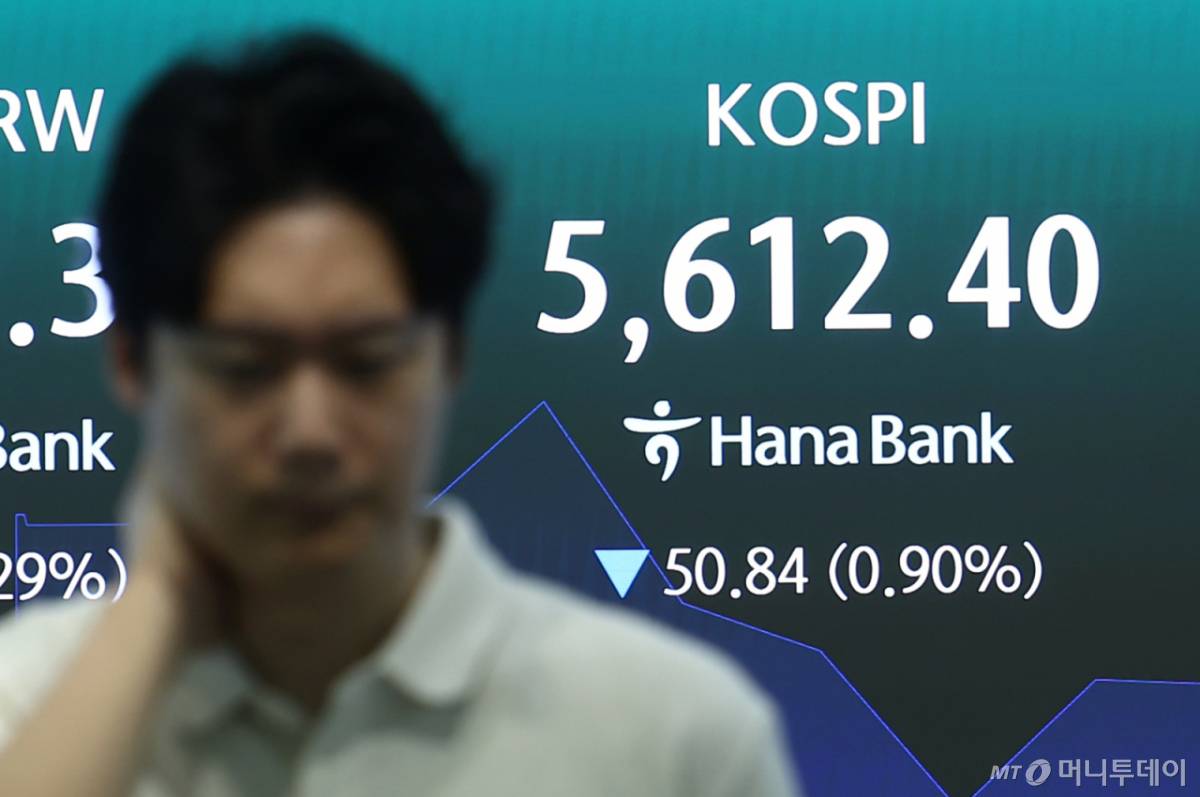
KOSPI fell for three consecutive days, dropping to the 5500s. Despite the influx of bargain-buying orders during trading hours, concerns over a potential U.S. base rate hike, profitability worries regarding AI (artificial intelligence), and geopolitical uncertainties pulled down the KOSPI index.
On the 30th, KOSPI closed down 69.68 points (1.23%) from the previous session at 5593.56. Throughout the day, KOSPI experienced repeated fluctuations. Driven by bargain-buying inflows, it surged more than 5%, reaching as high as 5976.82, but declined again in the afternoon.
This was due to a confluence of negative macroeconomic factors. Overnight, the Federal Reserve System (Federal Reserve·Fed) decided to hold the base rate steady at its July FOMC (Federal Open Market Committee) meeting. Concerns grew that inflation is not being curbed as much as the Fed claims, leading to a decline in U.S. stock markets.
After the close of U.S. markets, Microsoft (MS) reported earnings that exceeded market expectations, while Meta disclosed EPS (earnings per share) below expectations.
Lee Kyung-min, head of FICC Research at Daishin Securities, stated, "We estimate that supply-demand volatility in the semiconductor sector has not yet stabilized." He added, "The domestic stock market turned bearish again, giving up its earlier gains." He continued, "Leverage ETFs (exchange-traded funds) still rank high in trading volume. It remains to be seen whether the planned deposit increase scheduled for the 31st will help stabilize leverage volatility."
In the KOSPI market, retail investors sold net 1.425 trillion won. Foreign investors and institutional investors bought net 1.3389 trillion won and 66.4 billion won, respectively.
Among KOSPI sectors, electrical and electronics fell 3.08%, while medical and precision instruments dropped 2.1%. Manufacturing, entertainment and culture, and construction slipped more than 1%. In contrast, pharmaceuticals rose 3.51%. Chemicals, metals, and transportation equipment and parts gained over 2%.
All of the top four companies by market capitalization in KOSPI declined. SK Hynix fell 5.64%, and SK Square dropped 6%. Samsung Electronics closed roughly flat. Samsung Electronics' stock fell 1.56%. Samsung Electric plummeted 14.58%. It appears that after Samsung Electric announced second-quarter earnings exceeding market expectations, sell orders from high-price holders emerged. In contrast, Hanwha Aerospace and LG Energy Solution rose by over 6%. Celltrion gained 5.56%, and KB Financial Group rose 4.56%.
KOSDAQ closed down 17.9 points (2.7%) at 644.78 compared to the previous trading session.
In the KOSDAQ market, retail investors and institutional investors sold net 110.5 billion won and 143.6 billion won, respectively. Foreign investors bought net 247.6 billion won.
Among KOSDAQ sectors, machinery and equipment closed down 6.62%. Medical and precision instruments, manufacturing, and non-ferrous metals fell more than 3%. Finance rose 2.69%, while publishing/media and paper/wood closed roughly flat.
Among the top companies by market capitalization in KOSDAQ, Jungsung Engineering (-15.33%), PSK (-11.75%), Pharmascience (-11%), and Peptron (-10.72%) all plummeted more than 10%. In contrast, EcoPro and EcoPro BM rose by over 4%, and Samcheon Dang Pharmaceutical gained 2.68%.
On this day, the won/dollar exchange rate closed weekly trading at 1437.4 won, down 9.3 won from the previous session's closing price.

 in STOCK
