


The government is pushing a plan to gradually mandate retirement pensions for all workplaces by 2030. It will newly introduce a fund-based system in which experts manage retirement pensions, and explicitly stipulate the liability for damages of operators.
It is also considering a plan for the National Pension Service to participate in the management of retirement pensions. The limit on risky assets, previously bound by a "70% cap," will also be gradually eased.
The government announced the "Plan to Strengthen the Functions of Retirement Pensions" with this content on the 29th. Previously, in February of this year, the "Labor-Management-Government Task Force (TF) for Strengthening the Functions of Retirement Pensions" agreed on the direction of mandating off-site accumulation of retirement pensions and introducing a fund-based retirement pension system; this measure concretizes the content of that labor-management-government agreement.
Under this measure, off-site accumulation of retirement pensions will be gradually mandated for all workplaces by 2030. This is a measure to prevent non-payment of severance pay by requiring companies to deposit the severance pay they must pay to workers separately with external specialized institutions such as banks and securities firms, rather than accumulating it internally within the company.
The government plans to mandate off-site accumulation of retirement pensions for workplaces with 100 or more employees starting January 2028, after a one-year grace period following legal amendments by the end of this year. It will expand to workplaces with 10 to 99 employees in 2029, and mandate off-site accumulation for all workplaces with fewer than 10 employees from 2030.
To alleviate the burden on employers resulting from the mandatory off-site accumulation, the government plans to support voluntary adoption workplaces with matching of accumulated funds and financing costs for management capital. It will also apply special fee provisions for small-scale workplaces and simplify the employer's obligation to report regulations.
It is also pushing institutional improvements to launch collateralized loan products so that workers can minimize mid-term withdrawals from retirement pensions. At the stage of receiving retirement benefits, if a lump-sum receipt intention is not presented, it will be automatically paid as a pension, and an expansion of the separate taxation limit (15 million won per year) is also under consideration.
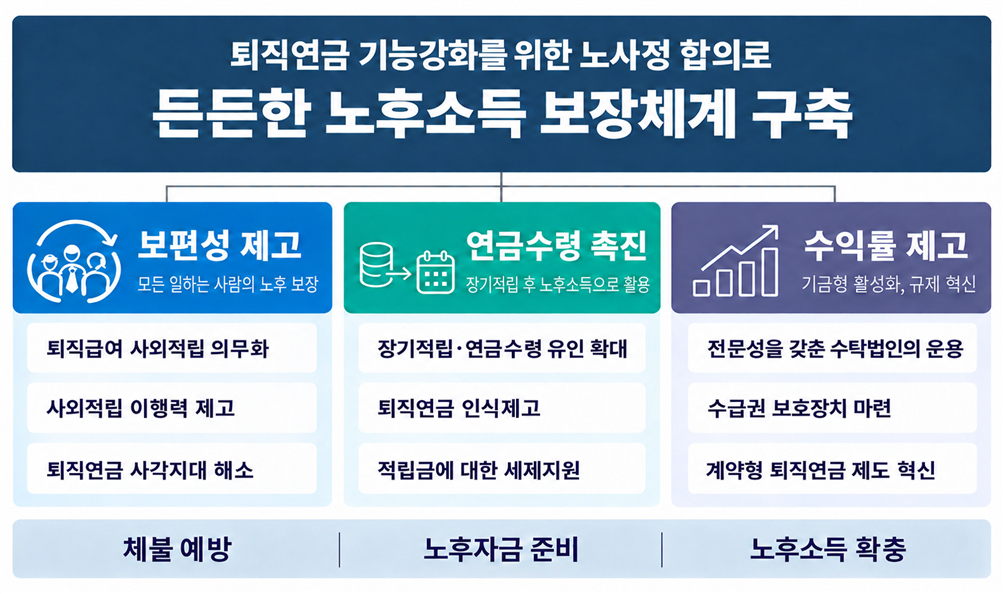
To enhance the expertise in managing retirement pensions, a fund-based system will be newly introduced. Currently, retirement pensions are contract-based, where each individual must directly issue management instructions through individual contracts with retirement pension operators (financial companies).
However, due to participants' lack of interest and expertise, retirement pensions are often neglected; the fund-based system is being introduced to complement this.
While maintaining the existing contract-based system, three types of new fund-based systems will be established: Open type for financial institutions (sole or consortium of financial companies, for-profit joint-stock company); Union type (union of multiple employers or national-level labor-management organizations, non-profit legal entity); and Public institution open type.
The fund-based system applies to Defined Contribution (DC) plans and Individual Retirement Pension (IRP) systems. Multiple contract-based and fund-based retirement pensions can be established within a single workplace, or multiple fund-based retirement pensions can be set up. It is also possible to set a specific fund-based retirement pension as the default value with the consent of the worker representative.
To ensure the safe management of retirement pensions, which are national assets for old age, strong trustee responsibility will be imposed on fund-based trustees.
The law will stipulate the principle of prioritizing participants' interests and explicitly state the liability for damages of the trustee legal entity in case of violation of duties, as well as the right of participants to claim damages. An operational risk reserve (0.25% of accumulated funds), which can be used for participant loss compensation and accident response/recovery, will also be mandatorily accumulated.
For the public institution open type, a plan is being pushed to expand the SME (small and medium-sized enterprise) Retirement Pension Fund (Blue Seed), a fund-based retirement pension currently managed by the Korea Workers' Welfare Service, and establish a separate fund (Retirement Pension Fund). The target for Blue Seed enrollment will be expanded from current workplaces with fewer than 50 employees to workplaces with fewer than 300 employees in 2028.
A plan for the National Pension Service to participate in the public institution open type is also under consideration. However, since there are differences of opinion among labor, management, government, and experts regarding the method and scope of National Pension Service participation, specific content will be determined through deliberation by the National Assembly.
The existing contract-based retirement pension system will also be improved. For IRPs, the current 70% investment limit on risky assets is planned to be gradually eased. The extent and timing of easing are to be finalized later. To ensure high principal protection while improving returns, investments in Integrated Investment Accounts (IMA) and promissory notes will also be permitted within DC plans and IRPs.
Labor Minister Kim Young-hoon said, "The Plan to Strengthen the Functions of Retirement Pensions establishes an institutional foundation that firmly protects workers' old age by balancing the stability and profitability of retirement income."
He said the government will make every effort in legislative promotion so that the amended bill can pass the plenary session of the National Assembly in December.

 in ECONOMY

