

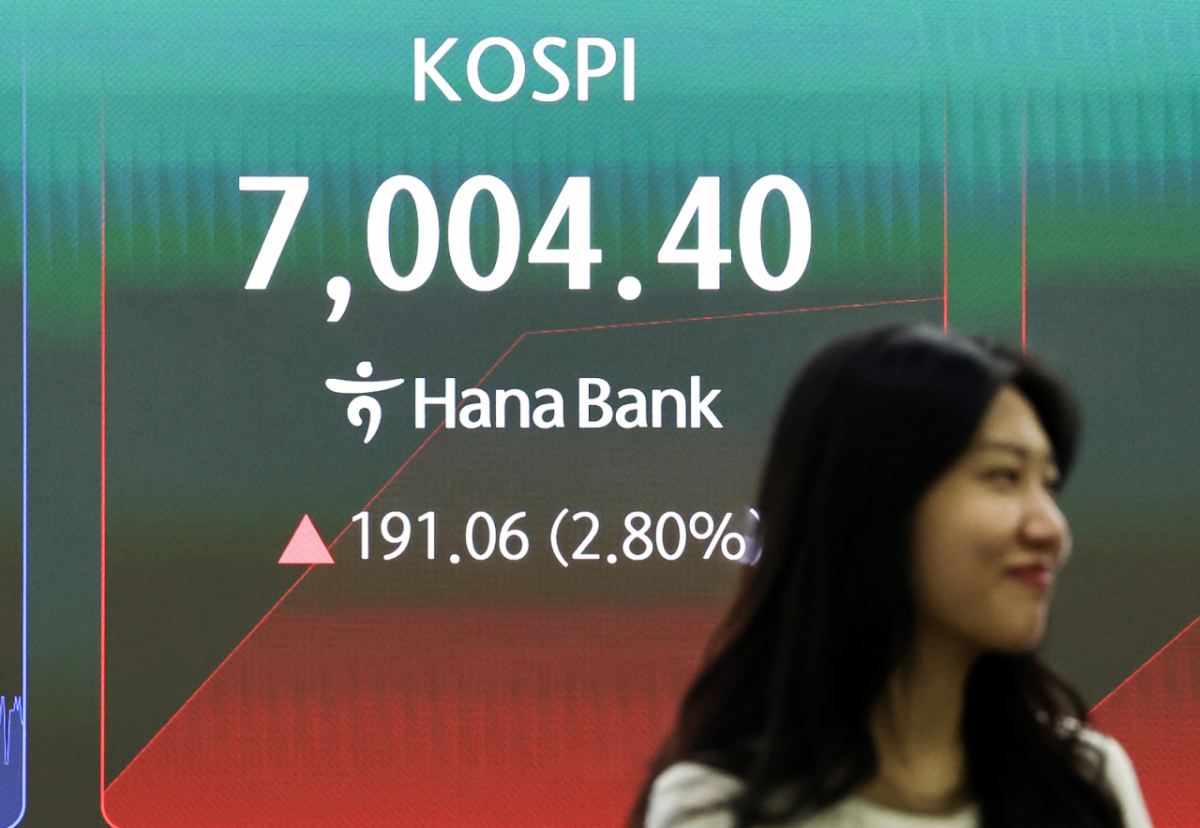
On the 14th, the KOSPI index exceeded 7000 intraday for the first time in 15 trading days. With cooling concerns over inflation due to a slowdown in U.S. producer prices, foreign buying pressure flowed into the market. The index has risen for five consecutive trading days, raising the possibility of profit-taking. Some observers also suggest that if the trend of higher lows continues, a medium-term recovery could be possible.
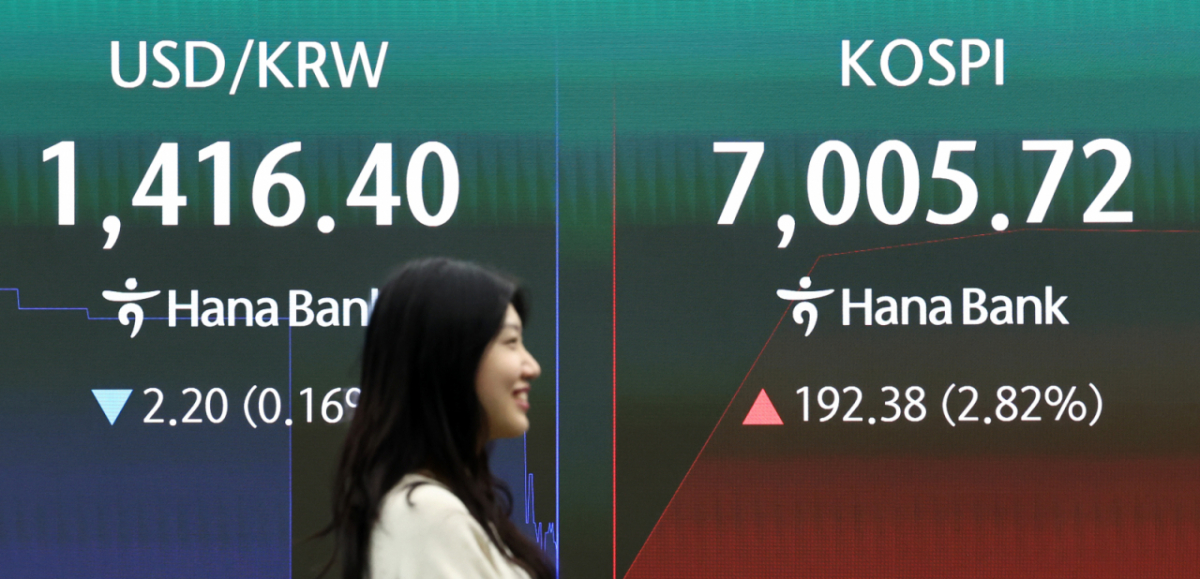
At 10:47 a.m., the KOSPI index stood at 6884.52, up 71.18 points (1.04%) from the previous session. The index opened at 6995.67, up 182.33 points (2.68%), and climbed as high as 7010.86 in the early session, a gain of 197.52 points (2.90%). This marks the first time since last month's 24th that the KOSPI index surpassed 7000 during trading hours. Following this, profit-taking orders emerged, slightly slowing the pace of gains.
By investor type, foreigners were net buyers of 846.7 billion won. Retail investors and institutional investors were net sellers of 636.2 billion won and 183 billion won, respectively.
Samsung Electronics was trading up 0.19% at 268,500 won. SK Hynix rose 2.76% to 1.637 million won.
Other rising stocks included Hyundai Motor (up 6.09%), Samsung Electric (up 2.46%), SK Square (up 2.33%), Samsung Life Insurance (up 1.89%), Samsung Electronics Preferred (up 1.01%), and KB Financial Group (up 0.59%).
In contrast, LG Energy Solution fell 1.09%, and Samsung Biologics declined 1.02%.
Overnight, the New York stock market closed higher, supported by a slowdown in U.S. July producer price index (PPI) and strong performance in semiconductor stocks. On the 13th (local time), the Dow Jones Industrial Average ended trading at 53,839.99, up 69.72 points (0.13%) on the New York Stock Exchange. The S&P 500 index closed at 7798.99, up 50.49 points (0.65%), and the NASDAQ Composite Index ended at 26,803.03, up 214.54 points (0.81%).
The U.S. July PPI rose 4.7% year-on-year, coming in below market expectations of 4.9%. Following the June consumer price index (CPI) that matched forecasts, signs of easing inflationary pressure at the production stage further alleviated concerns about interest rate hikes by the Federal Reserve System.
SanDisk's presentation at an investor briefing, which outlined a medium-to-late double-digit annual revenue growth target for 2028–2030, plans to expand long-term supply contracts, and strategies to improve profit margins, also boosted investor sentiment. SanDisk shares surged more than 13%, with major semiconductor stocks following suit in a broad rally.
With the stock market rising for five consecutive days, there are concerns about potential corrections due to profit-taking. However, given that concerns over interest rate hikes by the Federal Reserve have eased amid slowing U.S. employment and inflation data, and foreign investors have stepped up buying activity, some observers suggest a medium-term recovery trend may emerge.
Han Ji-young, a researcher at Kiwoom Securities, stated, "Considering that the market's resilience and the quality of supply-demand dynamics have strengthened compared to the past, it is appropriate to set the medium-term stock market path as one where lows continue to rise in a recovery trend."
Meanwhile, the KOSDAQ index traded at 852.89, down 8.48 points (0.98%). Retail investors were net buyers of 178.8 billion won, while foreign investors and institutional investors were net sellers of 83.2 billion won and 95.9 billion won, respectively.

 in STOCK

