

Capital inflows into KOSDAQ-related exchange-traded funds (ETFs) have been increasing recently. Analysts suggest that after authorities introduced active regulations on single-stock leveraged ETFs, which had acted as liquidity black holes, at the end of last month, capital flows have become more flexible. In fact, funds are circulating and flowing into KOSDAQ-related ETFs in a rotational buying pattern.
According to the financial investment industry on the 24th, the KOSDAQ ADR (Advanced Decline Ratio) rose by 7.04 percentage points from the previous trading day to reach 107.11% on that day. The ADR indicates the ratio of rising stocks to falling stocks among listed companies.
It shows whether selling pressure or buying pressure is concentrated. When it reaches 100%, it is considered that rising and falling stocks are in balance. Above 120% indicates overbought conditions, while below 70% signals oversold conditions.
Since single-stock leveraged ETFs were launched at the end of May until government measures were announced at the end of July, the KOSDAQ ADR remained mostly in the oversold range of 40 to 80 for about two months. As market funds concentrated only on certain semiconductor stocks and related ETFs, KOSDAQ also faced difficulties with drying liquidity.
However, it is argued that since the announcement of measures regarding single-stock leveraged ETFs, capital has shown a rotational buying pattern (sequential movement of buying pressure) for about a month, providing some relief to KOSDAQ as well.
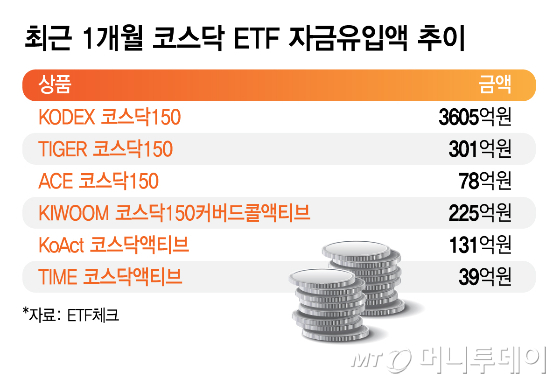
In fact, over the past month or so, funds have been flowing into KOSDAQ ETFs, creating expectations for a reversal in supply and demand. Specifically, as of the 21st, 360.5 billion won in new capital flowed into KODEX KOSDAQ150, which has the largest net asset value among KOSDAQ ETFs.
This amount is considered substantial even when compared to TIGER US S&P 500, which ranked first in total ETF capital inflows during the same period with 1.289 trillion won. Additionally, 30.1 billion won flowed into TIGER KOSDAQ150, and 7.8 billion won into ACE KOSDAQ150.
Not only passive ETFs like these, but capital inflows into KOSDAQ active ETFs, which made their debut in March this year, are also significant. KOSDAQ active ETFs had previously faced difficulties in launch due to the market's high volatility and low liquidity, making it hard for related products to generate stable excess returns.
As policies to revitalize KOSDAQ have become more concrete this year, investor interest in growth stocks has increased, and expectations for policy funds such as the National Growth Fund have risen, leading to a series of launches.
Over the past month or so, 22.5 billion won flowed into KIWOOM KOSDAQ150 Covered Call Active, 13.1 billion won into KoAct KOSDAQ Active, 3.9 billion won into TIME KOSDAQ Active, 2.2 billion won into DS KOSDAQ Active, and 500 million won into TIGER Technology Transfer Bio Active.
The KOSDAQ index also surged by more than 25% recently from a closing price of 644.78 on the 30th of last month. On that day, while the KOSPI index fell, KOSDAQ rose by 1.42%, showing positive performance for 11 out of 15 trading days in August.
The securities industry is closely watching whether the details of the upcoming up-down system introduction to be revealed next month will act as a lubricant to further smooth capital flows into the KOSDAQ market. There is an opinion that with the introduction of the up-down system, stocks selected for the upper market representing high-quality companies will become beneficiaries across the board.
Yoon Jae-hong, a researcher at Mirae Asset Securities, stated, "Following the regulation on single-stock leveraged ETFs, volatility has decreased, and ETF supply-demand is expanding beyond semiconductors to other ETFs." He added, "The key variable for the second half is the KOSDAQ up-down system. Since the policy direction focuses on 'large-cap high-quality stocks,' we can expect supply-demand effects through funds and linked products (such as ETFs) for included stocks."

 in STOCK
