

Financial Services Commission Chair Lee Eog-weon said Thursday that regarding reports of a NASDAQ listing for Solidigm, a U.S. grand-subsidiary of SK Hynix, it is “subject to dual listing guidelines,” and that “the boards of directors of parent companies SK Hynix and SK Square must fulfill five obligations based on the duty of loyalty to shareholders.” This implies that if Solidigm lists on NASDAQ, both companies must each adhere to the five obligations.
Regarding the disclosure of a list of companies with low price-to-book ratios (PBR) pointed out by ruling and opposition Political Affairs Committee members, as well as issues with delisting criteria centered on market capitalization and stock prices, the authorities stated they would “review improvements.”
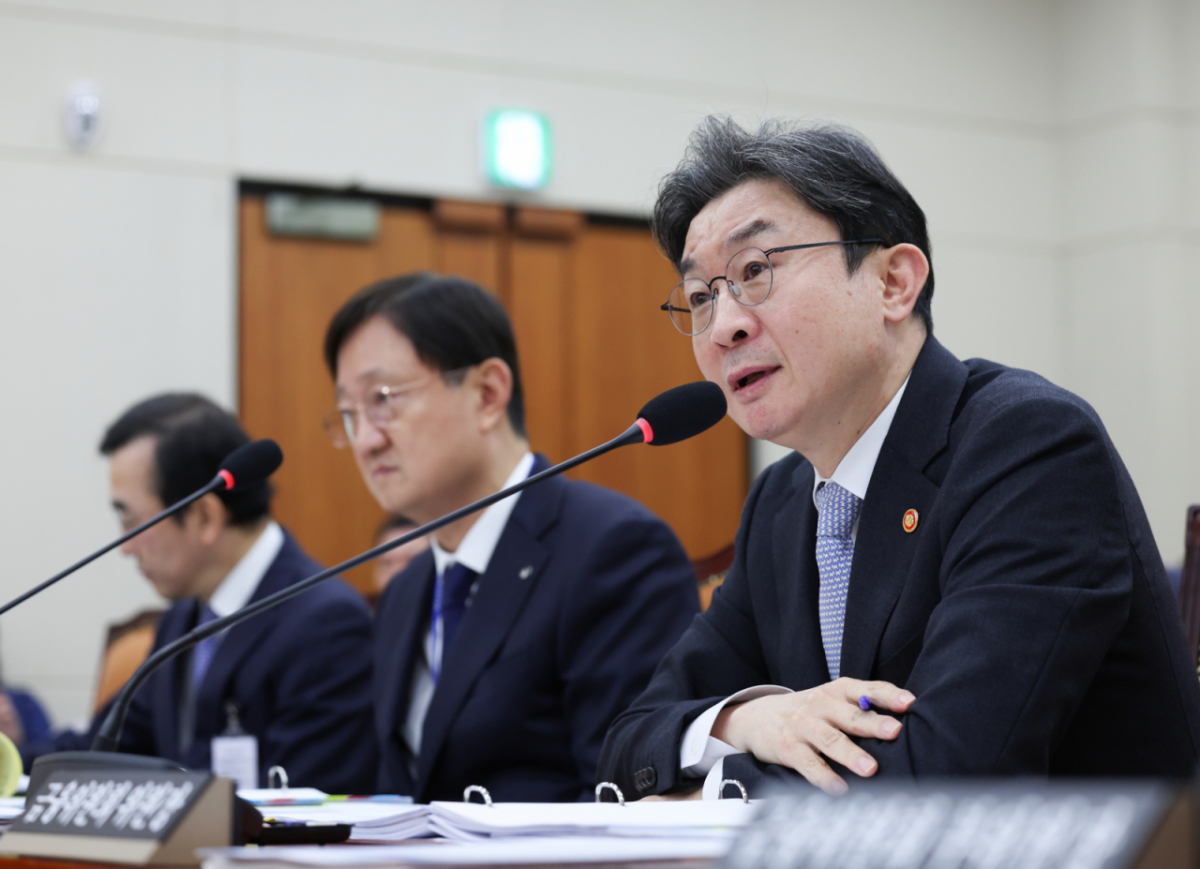
On the day, during the comprehensive audit targeting the Financial Services Commission and the Financial Supervisory Service held at the National Assembly in Yeouido, Seoul, by the Political Affairs Committee, Lee said, “Solidigm is an affiliate under the vertical control structure of SK Hynix and SK Square, and SK Hynix and SK Square must fulfill five obligations based on the duty of loyalty to shareholders as parent companies.”
Lee explained, “On August 3 this year, we have already implemented guidelines for dual listings that include a principle of prohibition with exceptions,” adding, “Dual listing guidelines apply to both domestic and overseas listings.” This clarified that the five obligations of the parent company’s board of directors apply equally when listing on an overseas exchange.
Accordingly, if Solidigm lists on NASDAQ, the boards of SK Hynix and SK Square must bear five obligations: △assessing the impact of the dual listing on general shareholders of the parent company, △establishing shareholder protection measures, △confirming shareholder communication or consent, △making a final vote for or against and notifying the subsidiary, and △disclosing related information.
However, since Solidigm is listing on an overseas exchange, domestic financial authorities or the Korea Exchange do not have the authority or basis to determine whether to allow the dual listing by recognizing an exception.
Political Affairs Committee members from both ruling and opposition parties pointed out that the government’s capital market revitalization policies should be improved in a direction that minimizes side effects. Financial authorities stated they would review improvements to the disclosure of low-PBR company lists and delisting systems for companies failing to meet market capitalization requirements.
Financial authorities plan to publish a list of companies with low PBRs over a cumulative three-year period (bottom 25% of KOSPI, bottom 10% of KOSDAQ) on November 2. According to the Korea Exchange’s May simulation, up to 220 companies could be subject to publication.
In this regard, Democratic Party of Korea lawmaker Lee Kang-il cited as issues the possibility that companies might formally disclose “false” corporate value enhancement plans to avoid being included in the list, and the fact that a system for evaluating how much improvement companies have made after disclosure has not yet been specifically established.
Lee stated, “Companies should not be evaluated solely on low PBR,” and presented alternatives: examining how much companies with insufficient growth potential invest in R&D costs or new business ventures, providing an exit route to allow for the decisive restructuring of low-return businesses with low capital efficiency, and requiring companies with weak governance structures to restore shareholder trust.
Criticism also emerged regarding raising market capitalization delisting criteria in the second half of this year and newly establishing a delisting requirement for stocks trading below 1,000 won.
People Power Party lawmaker Park Seong-hoon emphasized, “Korea’s unreasonable raising of standards could lead to a wave of lawsuits challenging delisting decisions, and the damage could be passed directly to minority shareholders.”
He added, “Even when applying market capitalization criteria, we must establish exceptions or grace periods for companies with good profitability and cash flow over a certain period, while also revising listing regulations to prevent harm to minority shareholders by guaranteeing opportunities for explanation.”
While stating that “the swift and strict exit of insolvent companies is the most urgent task to be resolved for the normalization of KOSDAQ,” Lee (Chairman) clarified that “various issues in the operational process will be addressed.”
Regarding the stewardship code, opinions were raised that the Financial Supervisory Service should inspect the fiduciary duty activities of institutional investors. Democratic Party of Korea lawmaker Park Hong-bae argued, “When institutional investors actually take action to actively engage in shareholder activities, they must bear various legal costs and significant burdens,” adding, “Supervisory institutions must not leave this unchecked.”
Regarding the single-stock leveraged ETF (Exchange-Traded Fund) incident, which was the biggest topic of this national audit, criticism from opposition lawmakers and apologies from financial authority heads continued.
On the issue of responsibility for the single-stock leveraged ETF, Lee said, “Despite the policy necessity and intent behind its introduction, it has led to various outcomes, which weighs heavily on my mind,” adding, “We will pay more careful and precise attention from the perspectives of investor protection and market stability.”
Financial Supervisory Service Governor Lee Chan-jin apologized, saying, “I always feel a heavy burden and sincerely apologize to the public,” and added, “I will take this as an opportunity to deeply reflect on the role and responsibility of the financial supervisory agency going forward.”

 in STOCK
