

Even after reports of a market crash, foreign firms offer bold forecasts... Has the rebound signal already appeared?
Despite global geopolitical instability, the unveiling of OpenAI's next-generation artificial intelligence (AI), "GPT-6 Astra," has reaffirmed the supercycle and investment sentiment in South Korea's leading sector, semiconductors. As signs of an upward trend in the KOSPI have emerged since September, global institutional investors' outlook on the KOSPI remains positive. Their more proactive stance compared to cautious domestic securities firms has drawn attention to whether the KOSPI can achieve a genuine rebound.
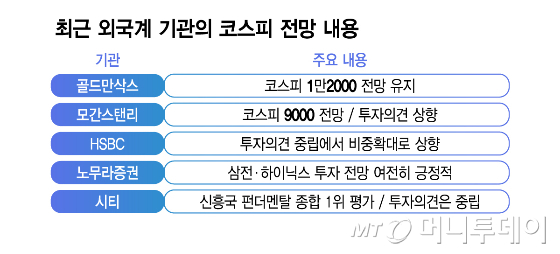
◆ Foreign institutional investors project KOSPI at 9,000 to 12,000; majority of investment ratings are "increase weight"
According to the financial investment industry on the 8th, Timothy Mo, senior equity strategist at Goldman Sachs Asia-Pacific, stated in an interview with Bloomberg that he maintains his previous KOSPI target of 12,000 points. Goldman Sachs raised its KOSPI forecast from 9,000 to 12,000 on June 3, when the KOSPI index was above 8,000 and heading toward 9,000.
The content of this strategist's interview is noteworthy for maintaining an optimistic outlook even after experiencing extreme domestic market volatility following the launch of a single-stock leverage ETF in July and enduring a rotating trading pattern in August. In particular, last July, the KOSPI fell to just above 5,000 — less than half of Goldman Sachs' target level — due to the worst liquidity concentration and foreign investor outflows.
Goldman Sachs' projection of the KOSPI index reaching 12,000 is based on the possibility of a supercycle in domestic leading sectors (semiconductors) driven by semiconductor supply shortages. A strategist stated, "We are maintaining our target price because we believe the results we expect will be supported by semiconductor stocks," and added, "The market has not fully reflected how long this earnings cycle will last."
Goldman Sachs was not alone; Morgan Stanley also raised its KOSPI target to 9,000 in early last month, characterizing the July plunge as a "reset" that had already priced in much of the negative news. Moreover, it upgraded its investment rating from neutral to overweight. At the same time, it noted that outflows by retail investors occurred due to the impact of single-stock leverage ETFs and subsequent regulatory tightening, weakening domestic supply capacity. Consequently, it forecasted that inflows by foreign investors could determine KOSPI's direction in the second half of the year.
HSBC, a Hong Kong-based investment bank, also upgraded its investment rating on the domestic stock market from neutral to overweight last month, citing reduced volatility and significant resolution of excessive leverage risks. In addition, Nomura Securities released a report on the 4th maintaining high investment outlooks for Samsung Electronics and SK Hynix, among others, issuing positive evaluation reports on leading stocks that significantly influence fluctuations in the KOSPI index.
However, Citi showed a cautious stance by maintaining a neutral investment rating despite ranking Korea's fundamental score first among 12 countries in its emerging markets asset allocation report last month.
◆ Foreigners sold net 170 trillion won from January to August, yet bought net 1 trillion won in September... The direction of foreign investment is crucial
The domestic capital market is paying close attention to the increasing inflow of foreign investors into the KOSPI since September. Morgan Stanley had identified foreign investor inflows as a key indicator for the direction of the KOSPI in the second half of the year, and since this month, foreign investors have net-purchased more than 1.4 trillion won worth of KOSPI stocks based on exchange data. On the 8th alone, foreigners net-purchased 709.2 billion won. Institutional investors net-purchased 425.1 billion won, other corporations net-purchased 1.7658 trillion won, while retail investors net-sold 2.8844 trillion won.
On the 7th alone, foreign investors net-purchased 2.5137 trillion won on the Korea Exchange, driving the KOSPI to rise by nearly 5%. This stands in contrast to August, when foreign investors net-sold approximately 1 trillion won across the entire market amid a cyclical trading pattern that had softened volatility. From January through the end of August this year, foreign investors showed a trend of exiting the market, having net-sold about 170 trillion won on the KOSPI.
Domestic experts expect that changes in foreign capital flows, positive outlooks from foreign institutional investors, the continued semiconductor supercycle led by key stocks, and large-scale shareholder return initiatives could serve as signals for a KOSPI rebound in the second half of the year.
Na Jeong-hwan, a researcher at NH Investment & Securities, said, "Although domestic stock trading volume exceeded 150 trillion won on June 1 across KOSPI, KOSDAQ, and Next Trade, it contracted to 35 trillion won by the second day, indicating a decline in domestic stock trading. This could lead to increased short-term stock price volatility depending on the directional trend of foreign investors' cash-and-carry trades."
Regret selling the 'blue light account'? ... "Hit 8,000 points this month, 10,000 by year-end"
Domestic securities firms have expressed optimism that the KOSPI will recover to 8,000 this month and rise to 10,000 by year-end. In particular, with the demand for AI semiconductors and the resulting stability of profits coming to the fore, it is forecast that semiconductor leading stocks will rise despite variables such as U.S. interest rates and midterm elections.
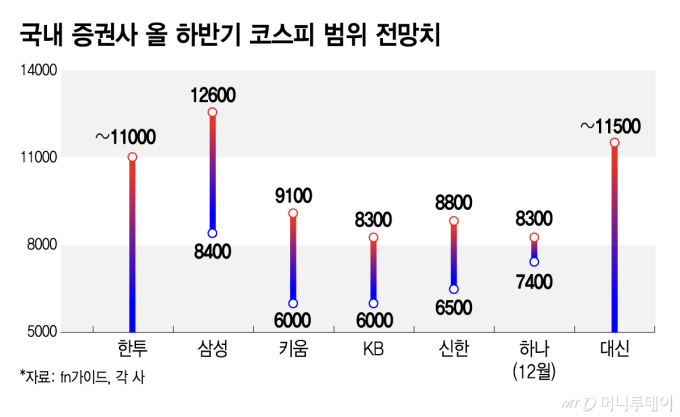
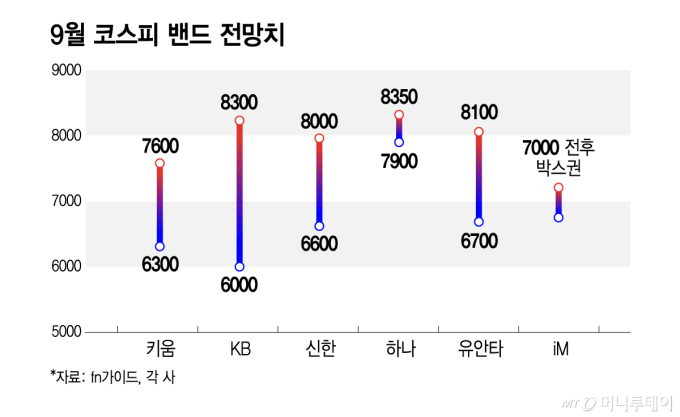
According to the domestic financial investment industry on the 8th, domestic securities firms including KB, Shinhan, Hana, and Yuanta have projected the KOSPI upper limit at over 8,000 this month, lending more strength to a rebound rather than maintaining a box range. KB Securities stated in a report released last month that "while fiscal concerns and high interest rates are undoubtedly difficult problems to resolve, there is no need to view the current market solely pessimistically" and added, "investors also need to be mentally prepared to increase their stock allocation at any time in September."
Shinhan Investment Corp, which projected the KOSPI ceiling at 8,000 this month, forecasted that shareholder returns from Samsung Electronics and SK Hynix will support the KOSPI index. In its September domestic stock market strategy report, Lee Dong-gil, a researcher at Shinhan Investment Corp, stated, "The 8.5 trillion won spent on share buybacks by Samsung Electronics and SK Hynix from the 24th to the 28th of last month is equivalent to foreign investors' net selling of KOSPI stocks." He further analyzed that "as volatility and leverage ETF (exchange-traded fund) burdens ease, confirmed buying will fill the foreign investor gap and establish a floor."
Other securities firms also anticipated a stepwise rise after the fourth quarter as major semiconductor stocks recovered. Kim Yong-gu, a researcher at Yuanta Securities, said, "The KOSPI in September will move within a 6,700 to 8,100 band with a neutral-to-positive trend," and added that it would gradually normalize along a stepwise rise path in September and October.
Domestic securities firms are also projecting that the KOSPI will exceed 10,000 by the end of this year, citing AI semiconductor supply and demand, or what is known as the "semiconductor supercycle." Among major securities firms, Korea Investment & Securities has set its upper target at 11,000, while Samsung Securities has opened its target up to 12,600.
The core argument is that as the profitability stability of semiconductor companies increases, their market value will rise. Yang Il-woo, a researcher at Samsung Securities, stated, "The market has assumed only low-level semiconductor price increases starting from the third quarter, and current market estimates are already sufficiently conservative." He further projected that the 12th-month forecast net profit scale for Samsung Electronics and SK Hynix will be 2.5 times and 1.9 times that of TSMC, respectively, serving as factors for valuation premiums.
There are also forecasts that the market will continue in a trading range. Kim Jun-young, a researcher at iM Securities, stated in a report on the 1st that "there is insufficient material to break through the upside due to stagnation in semiconductor profit estimates, and the accumulated retail selling pressure above 7,500 is clearly acting as a resistance line," predicting a trading range around 7,000 for the time being.
Views among securities firms diverged on the impact of the U.S. midterm elections, a political event, on the domestic stock market. Kim Jae-seung, a researcher at Hyundai Motor Securities, stated that "with two major events—the October Anthropic listing and the November U.S. midterm elections—coming to an end, investment sentiment in both domestic and global markets could recover rapidly after November." In contrast, Kim Dae-jun, a researcher at Korea Investment & Securities, noted in a June report that "as the fourth quarter approaches, investment sentiment may weaken due to uncertainty surrounding the U.S. midterm elections and supply-demand instability," adding that "existing leading sectors may also see their upward momentum slow down."
Even retail investors who wavered due to interest rates, exchange rates, and war... Obstacles blocking KOSPI from reaching "10,000"
The KOSPI index neared 7,000 as expectations for semiconductor earnings revived, yet there are many hurdles to overcome before reaching the 10,000 mark. Amid sharp fluctuations in interest rates and exchange rates that have heightened macroeconomic instability, the exodus of retail investors who led the market rally in the first half is weakening the stock market's momentum. The seemingly endless U.S.-Iran conflict and risks surrounding the U.S. midterm elections also remain factors weighing down the KOSPI.
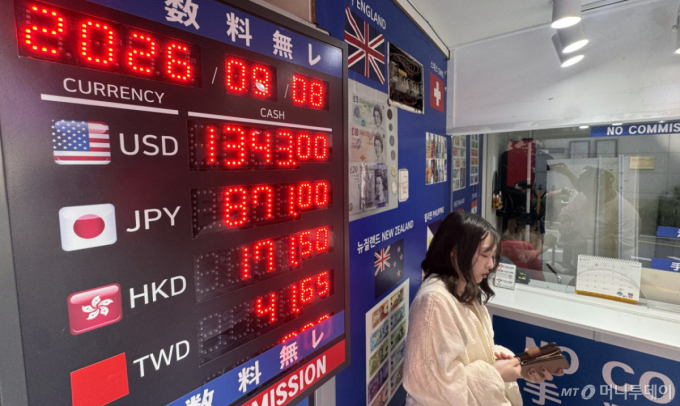
According to Investing.com and others on the 8th, the yen/dollar exchange rate fell as low as 153.17 yen. Following the sharp decline in the won/dollar exchange rate, the yen exchange rate also plummeted (yen value rose), increasing risks related to exchange rate volatility. In particular, with the Bank of Japan's interest rate hike now seen as certain, memories are being revived of past stock market crashes triggered by concerns over the unwinding of the yen carry trade.
Heo Jae-hwan, a researcher at Eugene Investment & Securities, said, "The Bank of Japan's interest rate hike and the sharp appreciation of the yen recall concerns about unwinding the yen carry trade in August 2024," adding that "uncertainty in financial markets is unlikely to be resolved soon." However, it is assessed that since the financial market is stable and there is a high possibility of intervention by the United States and Japan, the likelihood of leading to a major shock is low.
There are also concerns that corporate profits converted into won will decline due to the sharp drop in the won/dollar exchange rate (won appreciation) since July. In particular, it is pointed out that this could have a somewhat negative impact on the domestic stock market, which has been led by export-sensitive and economy-sensitive stocks. While the pace may slow down, there is also a possibility of further declines.
Park Sang-hyun, a researcher at iM Securities, said, "The recent trend of a strong yen is likely to affect the value of the won as well," adding, "With the correlation between the won and the yen strengthening, there is a high possibility that the won/dollar exchange rate will also fall if the yen exchange rate continues to decline." Interest rate movements are also acting negatively on the stock market. The yield on 30-year U.S. Treasury bonds rose by 33.3 basis points (1 bp = 0.01%) in just over two months, moving from 4.903% at the end of the second quarter to surpass the 5.2% level. This reflects ongoing concerns about inflation due to factors such as the prolonged Iran conflict keeping oil prices high, as well as the possibility of base rate hikes driven by U.S. fiscal issues and strong economic growth.
Amid major central banks moving toward interest rate hikes, domestic base rate increases are expected to push up market rates, and global interest rates are projected to continue their upward trend. Additionally, the prolonged U.S.-Iran conflict and potential trade and tariff tensions with China ahead of the U.S. midterm elections could have a negative impact. Domestically, the possibility of retail investors exiting the stock market may slow down KOSPI's full-scale recovery.
Since the beginning of this month, foreign investors have turned to net buying in the KOSPI market with a purchase of 1.1 trillion won, while retail investors continue to sell off holdings totaling 980 billion won. Analysts suggest that recent increased market volatility and fluctuating indices have led to a contraction in investor sentiment. Investor deposit balances have also fallen to around 93 trillion won, maintaining the lowest level since January.

 in STOCK


