

There is a saying that bargain sales make money during economic downturns. This is because manufacturers and distributors whose warehouses are overflowing with unsold goods try to offload their inventory at rock-bottom prices, while consumers with thinner wallets seek out places selling the same items for less. From the perspective of those who buy cheaply and sell cheaply, both the suppliers providing the goods and the customers coming to purchase them increase simultaneously.
On the surface, the current U.S. economy appears far from that description. Driven by increased spending among wealthy individuals whose assets have grown due to rising stock prices, consumer expenditure in the second quarter increased by 3.8 percent on an annual basis. Fueled by a boom in artificial intelligence (AI) investment, corporate capital expenditures also rose by 9 percent annually. However, the underlying situation is different. As energy prices surged, the September consumer price inflation rate climbed to 3.7 percent. To curb inflation, the Federal Reserve raised its base rate by 0.25 percentage points on the 16th of last month, marking the first increase in three years, bringing the rate to a range of 3.75 to 4.00 percent.
The University of Michigan Consumer Sentiment Index for October stood at 46.3, down 13.6% from a year earlier. This indicates that households have less disposable income as the cost of living and loan interest rates rise simultaneously. The changes on the corporate side are even more pronounced, with store closures following one after another. In September 2024, the large discount retailer Big Lots filed for bankruptcy protection. According to data from U.S. retail research firm Coresight Research, apparel company Cato announced plans to close 120 stores within the past month alone. Pool supply company Leslie's decided to shut down 76 locations alongside its bankruptcy filing.
Price competition has also intensified. Global investment information analysis firm One Research diagnosed that price wars and market share battles among retailers have ultimately led to the creation of clearance inventory. The firm explained that competitors' inventory liquidation sales this year were far more aggressive than in the past. The buying side has changed as well. Walmart increased the number of items subject to price cuts in the second quarter from approximately 7,000 in the first quarter to 11,000.
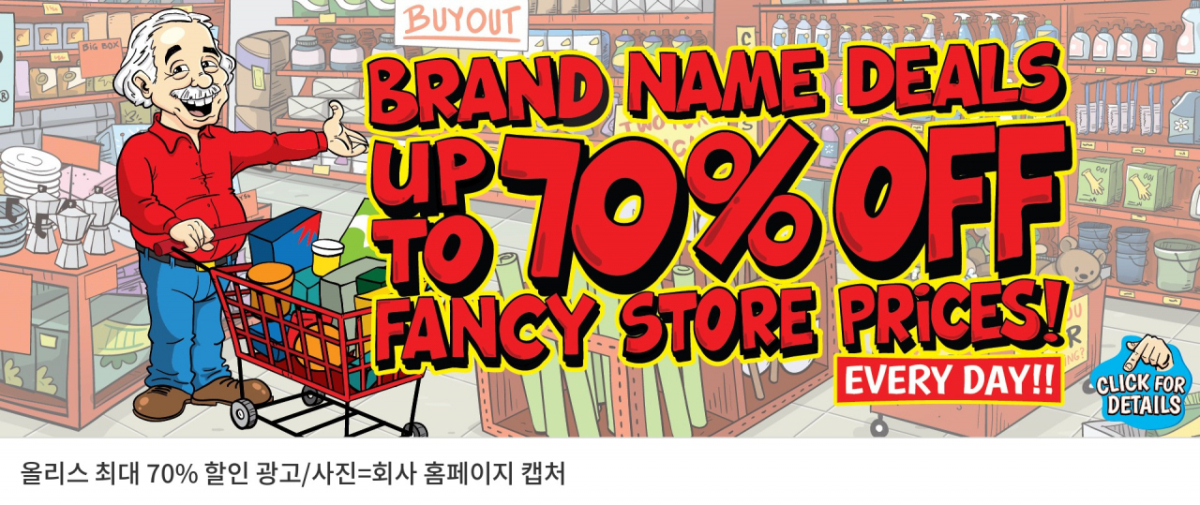
The growing trend of downtrading, in which even high-income households with annual incomes of $100,000 or more are shifting to cheaper retailers, is also creating opportunities for other companies. Ollie's Bargain Outlet, the largest discount retailer in the United States, is one such company that has ridden this shift in consumer behavior and is drawing attention from Wall Street investors. Ollie's buys up inventory, discontinued items, and products with changed packaging that manufacturers and distributors want to dispose of all at once, selling them at prices up to 70% lower than those at regular retail stores.
In the industry, such products are referred to as closeout (or clearance) items. As of August 1, the company operates 686 stores across 36 states. When the economy deteriorates, customers seek out cheaper options, and inventory accumulates in other companies' warehouses looking for a buyer. This is why Offprice is considered a beneficiary stock in a downturn. The structure means that as the economy weakens, opportunities to purchase goods at lower prices increase.
On the 14th (local time), shares of Ollie's Bargain Outlet (OLLI) on the New York Stock Exchange closed at $93.12, up 5.4% in a single day. On that day, the company announced that its board of directors had approved an additional share buyback program worth $500 million (662.3 billion won). The stock price rose to $95.77 intraday on the 15th before entering a consolidation phase, closing at $87.72 (116,194 won) on the 23rd. Even so, this level is 45% higher than the intraday low of $60.29 recorded on July 9. Based on the midpoint of the current year's earnings per share (EPS) forecast, the price-to-earnings ratio (PER) stands at approximately 19 times.
The company has significantly expanded its scale over the past year. During fiscal year 2025 (February 2025 to the 20th Lots), it opened a record-high 86 new stores, of which 63 were acquired from vacant locations left by the bankrupt Big Lots. The company plans to open another 75 stores this year. This marks its transformation from an Eastern discount retailer into a nationwide discount distribution network.
From a clearance store opened after watching "Building 19" to expansion to 686 locations through private equity acquisition and IPO
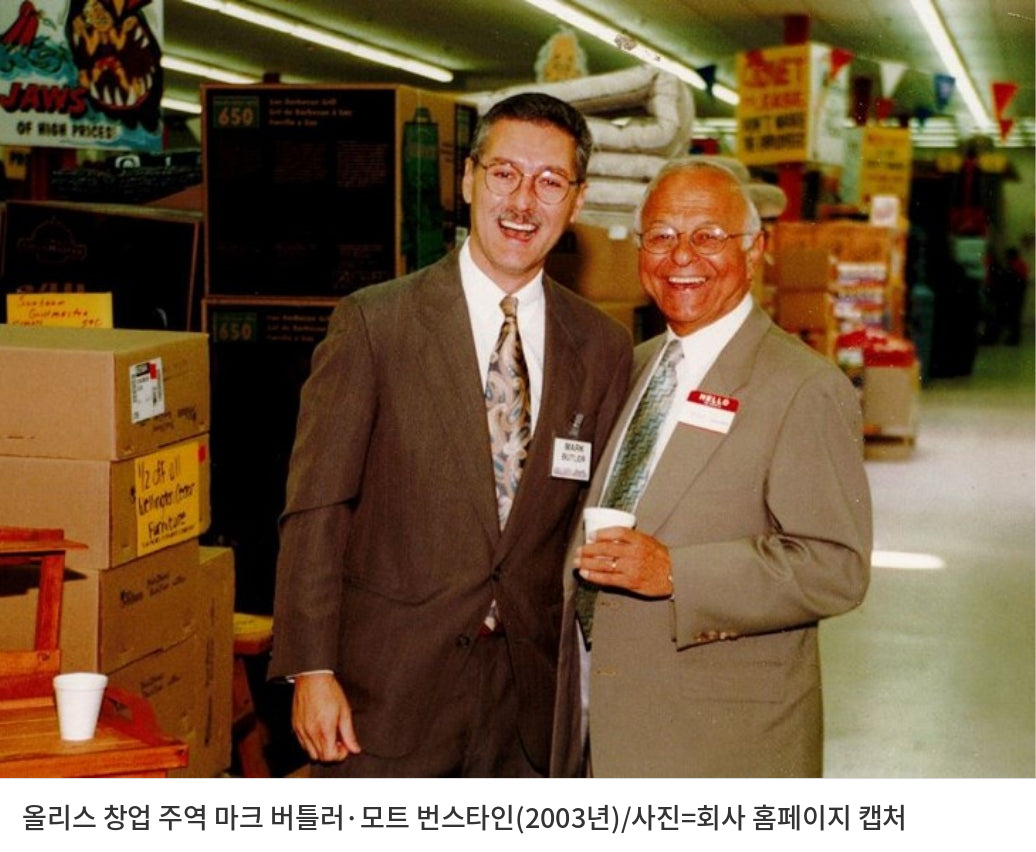
Olleys began as a struggling lumberyard. Mort Bernstein, who ran a lumber store in Pennsylvania, decided to change his business line when sales declined. After touring Building 19, a discount store selling overstock goods in Boston, he resolved to open a similar shop. Local businessmen Harry Koverman and Mark Butler introduced him to investment expert Oliver Rosenberg.
The first store opened on July 29, 1982, on the site of a former lumber mill in Mechanicsburg. The store name was derived from "Ollie," a nickname for Rosenberg, who provided the funding. From its first year, advertisements featured a comical cartoon caricature of his face. The slogan is "Good Stuff Cheap."
The person who handled the first customer's bill was Butler. He took over management in 2003. At that time, the company had only 27 locations across three states. By February 2005, it operated 36 stores with annual sales of $150 million (199.5 billion won). The company's growth accelerated after it encountered a private equity firm. In September 2012, private equity firm CCMP Capital acquired the company along with Butler and the management team.
The company listed on the NASDAQ on July 16, 2015, with an initial public offering price of $16, which exceeded the target range of $13 to $15, raising $143 million (190.2 billion won). The opening price on the first day was $22.68, a 42% premium over the IPO price. At the time of its listing, the company operated 181 stores, and in 2017, its revenue surpassed $100 thousand won (1.3303 trillion won) for the first time.
There were moments of crisis as well. On August 29, 2019, the stock price plunged 27.3% intraday after second-quarter same-store sales declined by 1.7% and the company lowered its annual outlook. The company attributed this to new stores cannibalizing customers from existing locations and placing a burden on logistics. On December 1 of that year, Butler passed away. The company immediately appointed John Swiger, who had been in charge of finance since 2004, as CEO.
During fiscal year 2020, which was hit by the novel coronavirus pandemic, revenue increased by 28% to $1.888 billion (2.4063 trillion won), and earnings per share (EPS) surged to $3.68. However, the subsequent reaction was significant. Revenue decreased by 3.1% in fiscal year 2021, and EPS fell to $1.64 in fiscal year 2022, dropping to less than half of its level from two years prior. The company seized a new opportunity as a wave of bankruptcies continued in the retail industry. This was because it was able to secure vacant stores and clearance inventory while other companies were closing their doors.
Brand products up to 70% cheaper, treasure hunt stores: Oris army reaches 18.1 million members
The primary reason consumers choose Olis is price. The company has set a goal of becoming the retailer that offers any product at the lowest price. Store price tags list competitors' selling prices alongside Olis's prices side by side, making it immediately clear how much customers can save. Nevertheless, the store focuses on well-known brand products familiar to consumers. Its strength lies in offering affordable yet trustworthy goods.
Second, the store is like a treasure hunt where the merchandise changes every time. The clearance inventory varies in items and quantities with each new shipment, and many products are unlikely to be available again if missed, which is why customers visit frequently. This is also the reason crowds gather despite the fact that the store rarely holds regular sales, excluding year-end inventory clearance or member events. Third, it has loyal customers. The free membership program, known as the Ollie's Army, has 18.1 million members, a 12.7% increase over the past year. Member spending accounts for more than 80% of total sales, and members spend approximately 40% more per transaction than non-members. In 2024, the company also launched a co-branded credit card exclusively for members.
The customer base is also expanding. Customers aged 35 to 55, particularly those between 35 and 45, are increasing in number. Meanwhile, while low-income households with an annual income of $65,000 or less have reduced their visit frequency, the trend of high-income consumers trading down has begun to offset the consumption contraction among lower-income groups. The product range covers various aspects of daily life. In fiscal year 2025, sales were composed of 31.9% from consumables such as detergents, food, and health products, and 28.3% from household goods like kitchenware and furniture. Seasonal items, including fans, heaters, and toys, accounted for 19.1%, while other categories such as books, small electronics, and clothing made up 20.7%. Because consumables represent the largest share of sales, customer traffic does not easily drop off even during economic downturns.
What makes such pricing possible is the company’s purchasing power and low costs. Olis’s merchandise buyers are specialized by department and have the authority to make contract decisions on the spot. Manufacturers that need to quickly clear inventory can only welcome a trading partner that makes fast decisions. The company sources products from manufacturers, wholesalers, brokers, and other distributors, keeping its dependence on any single supplier low.
The stores are warehouse-format locations averaging approximately 2,970 square meters in size. By moving into vacant buildings left behind by other large retailers at low rents, the company saves on interior decoration costs. This approach is also why it was able to take over all 63 Big Lots stores at once. Four logistics centers in Pennsylvania, Georgia, Texas, and Illinois supply goods to the stores. Expansion of the Texas center has been completed, and expansion work has begun on the Illinois center.
The competitive landscape is shifting. The company identified discount stores, off-price retailers, discount outlets, big-box supermarkets, grocery stores, and pharmacies as its competitors. Among them, Big Lots, which had been the most direct competitor, filed for bankruptcy in 2024, leading to clearance sales at its 869 locations. In effect, the company has absorbed both the vacant store spaces and the customer base left behind by its rival. The company believes it can expand its store count to more than 1,300 locations across the United States, meaning its current number of stores slightly exceeds half of that target.
Tariff Refunds and $500 Million in Share Buybacks: Year-End Peak Season to Be the Turning Point
Based on its performance trajectory, Olis is a company growing through new store openings. Revenue increased from $1.827 billion in fiscal year 2022 to $2.2717 billion in fiscal year 2024. In fiscal year 2025, revenue rose by 16.6% to $2.6492 billion (3.5242 trillion won). Over the same period, operating profit increased by 19.3% to $297.7 million (396 billion won), and earnings per share (EPS) rose from $3.23 to $3.89. The average revenue per store was $4.325 million.
This year, profits stood out more than revenue. First-quarter (February–April) revenue rose 14.2% to $658.9 million (876.5 billion won), while same-store sales increased by 1.7%. Second-quarter (May–July) revenue grew 9.1% to $741.3 million (986.2 billion won), but same-store sales declined by 1.8%. In contrast, operating profit surged 41% to $108.5 million (144.3 billion won), and earnings per share (EPS) rose 43.4% to $1.42, significantly exceeding the market forecast of $1.12.
The boost in profit was driven by tariff refunds. The gross profit margin rose by 3.6 percentage points to 43.5%, of which 3.8 percentage points were attributable to the refund effect. Excluding the refunds, the profit margin stood at 39.7%, slightly lower than a year earlier (39.9%). This indicates that the company maintained its profit margin despite spending on price cuts.
The company lowered its full-year revenue outlook to $2.928 billion to $2.941 billion (3.8951 trillion won to 3.9124 trillion won) and cut its same-store sales growth forecast from approximately 2% to 0% to 0.5%. However, it raised its adjusted earnings per share (EPS) outlook to $4.57 to $4.65 to reflect the refund amount. This is higher than the $4.40 to $4.50 range presented at the beginning of the year. The company expects same-store sales in the third quarter to be flat and a 1% increase in the fourth quarter.
The performance of the new stores opened in place of Big Lots is also a point of interest. As these stores enter their second year of operation, same-store sales growth has settled into the low to mid single digits. The company expects fourth-quarter revenue to rebound, driven by year-end events such as Black Friday and Allis Legion Night, an event exclusive to members. Historically, Allis has recorded its highest revenue and profits in the fourth quarter.
The company's financial structure is solid. It holds $507.1 million (674.6 billion won) in cash and investment assets, with no significant long-term debt. This year's share buyback plan has been increased to approximately $175 million (232.8 billion won), and following an additional approval in October, the remaining purchase limit stands at approximately $561 million (746.3 billion won). Since 2019, the company has returned approximately $679 million (903.3 billion won) to shareholders through share buybacks.

A company's character is reflected in its workforce composition. The firm employs more than 13,000 people, over half of whom are regular employees, and it has no labor union. More than 65 percent of district managers are internal promotions. Management is staffed by veterans with extensive experience in clearance and discount retailing.
Wall Street's outlook is turning positive. Thirteen of 17 analysts recommend buying the stock, with an average target price of $103.50. While some firms have downgraded their investment ratings and target prices, a larger number are focusing on increased clearance inventory during economic downturns and the company's capacity to close stores. It is expected that whether profit margins can be maintained after the one-time benefit from tariff refunds ends will become clear in year-end holiday season earnings. This is because three factors are converging: vacant store spaces created by competitors' closures, an abundance of clearance inventory, and a $500 million share buyback program.
◇ Key milestones of Olis Bargain Outlet
July 1982: Four people, including Mort Bernstein and Mark Butler, opened the first store in Mechanicsburg, Pennsylvania.
2003: Mark Butler assumed leadership (27 locations across three states)
September 2012: Joint acquisition by private equity firm CCMP Capital and management
July 2015: NASDAQ listing, IPO price of $16, opening price on the first day of $22.68
2017: Annual revenue surpasses $100 thousand won
December 2019: Mark Butler passes away; John Swigert assumes the role of CEO
September 2024: Competitor Big Lots files for bankruptcy protection
February 2025: Eric van der Valk appointed as CEO; Big Lots secures cumulative lease rights for 63 stores
January 2026: A record-high 86 new store openings in fiscal year 2025; total of 645 stores
February 2026: Federal Supreme Court rules IEEPA tariffs invalid
September 2026: Q2 EPS up 43.4%, annual EPS forecast raised
October 2026: Approval for additional share buyback of $500 million


 in STOCK


