

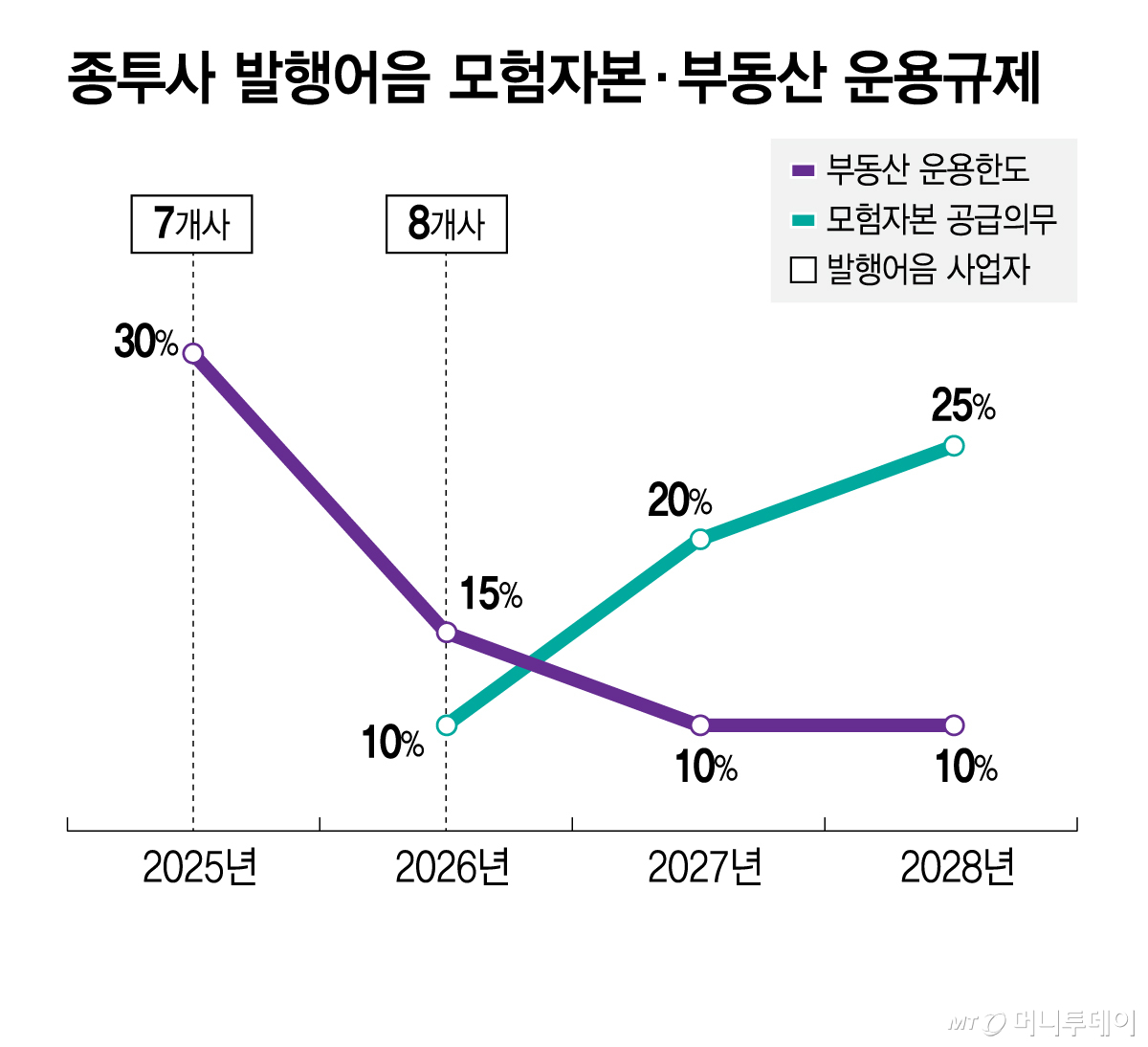
The competitive focus in the issued notes market is shifting from fundraising to securing investment opportunities. With the number of securities firms classified as comprehensive financial investment companies (CFICs) authorized to issue notes following Samsung Securities' approval for short-term financial business now reaching eight, the mandatory venture capital supply requirement is expanding while the real estate investment limit is being reduced. As the issued notes market is projected to reach a scale of 60 trillion won in the future, the ability to identify target companies such as innovative and startup enterprises is becoming increasingly important. Whether massive funds can flow into growth capital for innovative companies will test the 'real IB (investment banking)' capabilities of securities firms.
According to financial authorities on the 14th, the fundraising amount from issued notes by the existing seven CFICs in the first quarter of this year reached 54.4274 trillion won, an increase of 3.1433 trillion won (6.1%) compared to the previous quarter. With Samsung Securities now authorized to handle issued notes business, the market scale is expected to move closer to 60 trillion won.
Issued notes are principal-and-interest-guaranteed instruments with a maturity of less than one year, issued by CFICs with own capital of at least 4 trillion won. The problem lies in the rapid changes to operating rules for the raised funds. The mandatory venture capital supply ratio relative to the issued notes fundraising amount will rise from 10% this year to 20% in 2027 and 25% in 2028. Conversely, the asset management limit for real estate-related assets under issued notes has been reduced from a previous 30% to 15% this year, and will be lowered further to 10% by 2027. From the perspective of CFICs, they must seek more new investment opportunities in corporate finance instead of the familiar real estate sector.
The quantitative start is not bad. The venture capital supply amount from the seven CFICs in the first quarter of this year totaled 13.492 trillion won. Among this, the regulatory recognized amount, reflecting limits applied to mid-sized company and A-rated bond investments, was 9.8753 trillion won, accounting for 17.3% of the issued notes and IMA (comprehensive investment account) fundraising amount. This exceeds the mandatory ratio of 10% for this year.
However, in terms of supply by investment target, mid-sized companies accounted for the largest share at 4.5 trillion won, followed by primary collateralized bond obligations (P-CBOs) issued with corporate bonds from small and mid-sized companies as underlying assets at 2.3 trillion won, and investments in small and venture companies at 2.1 trillion won. The government recognizes only up to 30% of the mandatory venture capital supply amount for investments in A-rated bonds and mid-sized companies. This makes it difficult to meet the mandatory ratio using only relatively stable assets.
The financial investment industry views identifying investment opportunities as a core challenge for CFICs going forward. In May, the Financial Services Commission publicly acknowledged field opinions that it is difficult to find demand sources for venture capital. With the number of recently authorized issued note issuers increasing to eight, concerns have grown further about whether sufficient investment opportunities can be found. A financial industry official stated, "Securities firms lack substantial experience in identifying startups or accelerating them, and there are worries that funds may not flow into places chasing blind money."
Due to these concerns, the importance of joint investments and information sharing between securities firms and VCs (venture capital firms) is also increasing. When the mandatory venture capital ratio reaches 20% in 2027—double this year's level—it will be necessary to consider not only meeting the supply amount but also the quality and recoverability of investment targets. Whether securities firms can develop capabilities beyond fundraising competition to identify high-quality investment opportunities is expected to determine the success or failure of the issued notes business.

 in STOCK
