

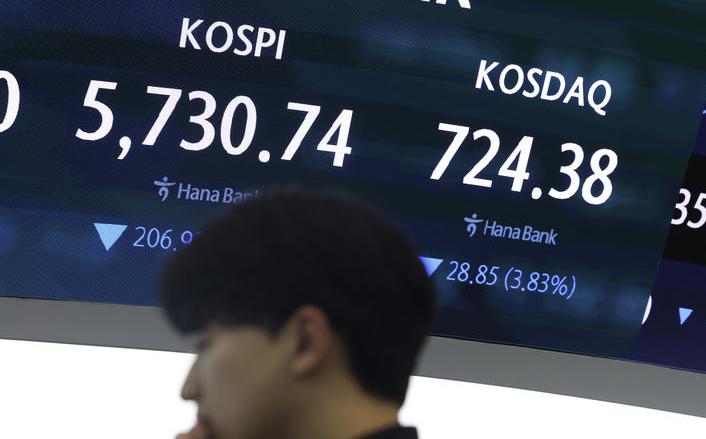
The KOSPI plunged more than 3 percent, falling to the 5,730 level. Concerns about the sustainability of AI investment intensified following earnings reports from major U.S. tech companies, prompting foreign investors to sell more than 1.8 trillion won worth of shares and triggering a sell-sidecar during the session.
However, some analysts advise investors to look for opportunities in companies with solid earnings, noting that the sharp correction has eased valuation pressures.
On Friday, the KOSPI closed at 5730.74, down 206.92 points (3.48%) from the previous trading day. The index opened at 5760.35, down 177.31 points (2.99%), and widened its decline during the session. At one point, the KOSPI 200 futures index fell by more than 5%, triggering a selling sidecar.
The KOSDAQ also closed at 724.38, down 28.85 points (3.83%) from the previous trading day. The index opened at 737.76, down 15.47 points (2.05%), and continued its weak performance throughout the day.
Foreign investors exited both major markets. In the KOSPI regular market, retail investors and institutional investors made net purchases of 871.3 billion won and 716.9 billion won, respectively, while foreign investors made net sales of 1.8254 trillion won. In the KOSDAQ market, retail investors made net purchases of 167.8 billion won, but foreign investors and institutional investors made net sales of 30.7 billion won and 136.1 billion won, respectively.
The domestic semiconductor sector showed weakness on this day. Concerns over the sustainability of AI investment expanded following earnings reports from big tech companies.
Samsung Electronics recorded a decline in the 3% range, while SK hynix fell in the 7% range. Stocks linked to these companies by equity stakes or business ties also declined: Samsung Electro-Mechanics dropped in the 8% range, SK Square in the 6% range, and Samsung C&T in the 3% range.
The securities industry analyzed that investor sentiment was dampened as doubts grew over whether big tech companies could sustain the pace of AI capital expenditure with cash flows generated from their core businesses. It was also noted that disappointment regarding the growth of U.S. big tech companies' core businesses overnight may have had a negative impact.
Researcher Jo Ah-in at Samsung Securities said, "Whether this correction will remain a temporary slump in investor sentiment or lead to downward revisions in earnings forecasts for AI-related companies is a key variable that will determine the future direction of the market."
However, she added, "The valuation burden on the domestic stock market has been significantly eased due to the recent sharp correction."
Jo noted, "While volatility may continue in the short term, considering current earnings levels and performance outlooks, medium- to long-term investment appeal is judged to be higher than before. A strategy of gradually seeking investment opportunities centered on sectors and stocks with solid fundamentals appears appropriate."
Events that could impact the stock market will continue next week. On Nov. 2, the Korea Exchange's low PBR (price-to-book ratio) company disclosure system will take effect, and the Ministry of Trade, Industry and Energy will release its "October Import-Export Trends" report. The U.S. midterm elections are scheduled for November 3, and global semiconductor company AMD is set to announce its earnings on Nov. 4.

 in STOCK
