

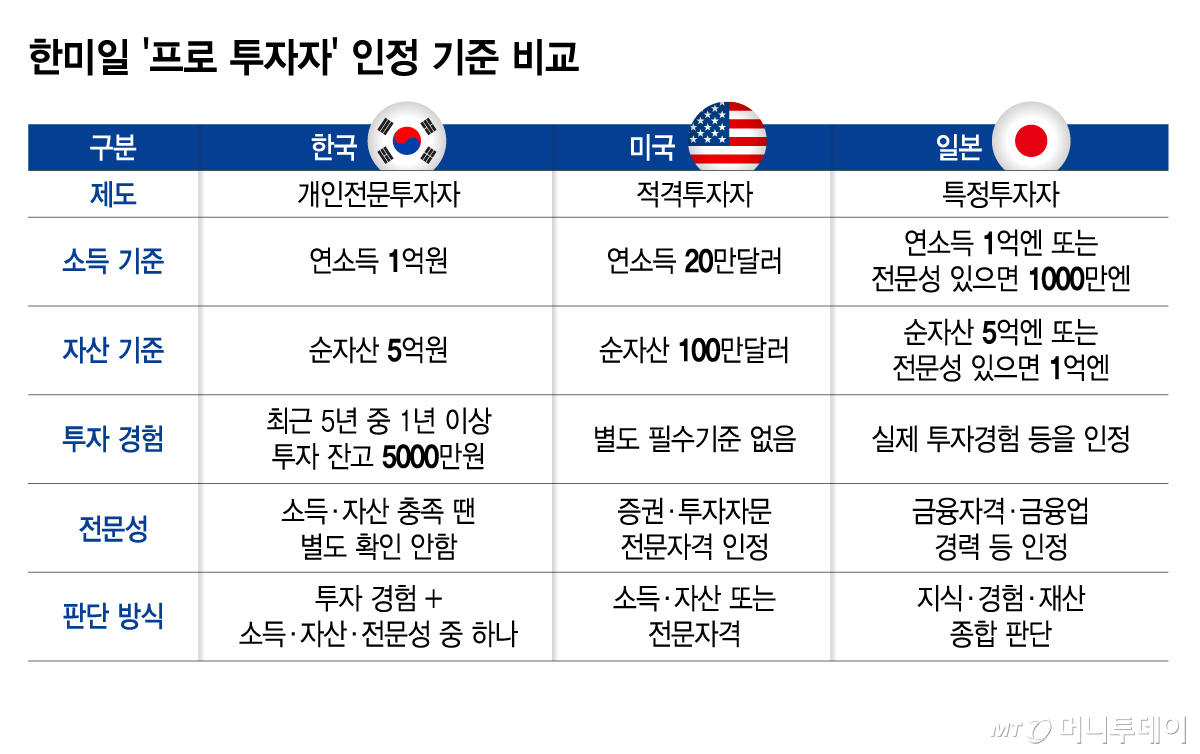
Critics argue that current standards recognizing individuals as 'pro' (individual accredited investors) based solely on assets and income do not guarantee the expertise needed to understand investment risks. Although the system was designed with lowered thresholds to foster venture capital, it is argued that financial capacity alone cannot ensure the ability to comprehend the risks of complex financial products. Some also contend that while investment opportunities should be expanded, actual risk comprehension abilities—including investment experience and expertise—must also be considered.
With 0.5 billion won in investment experience and an annual salary of 100 million won, one qualifies as a 'pro'
According to the financial investment industry on the 14th, individual accredited investors are those recognized for their ability to bear investment risks, gaining broader investment opportunities than general investors but losing certain protective measures such as suitability and appropriateness principles and disclosure obligations. The number of individual accredited investors reached 26,282 by the end of July this year, a 16.8% increase from the end of last year.
Basic eligibility requires having opened a securities account for over one year and maintaining an average month-end balance of at least 0.5 billion won in financial investment products during at least one of the past five years. Additionally, applicants must meet at least one of the following: annual income of 100 million won or more, net assets of 500 million won or more, or relevant professional qualifications or experience in finance. They may then apply to their securities firm for designation as an individual accredited investor.
Securities firms verify investment experience, income, assets, or expertise through supporting documents. At the time of initial designation, identity is confirmed via in-person meeting or video call, and the validity period for individual accredited investor status is two years. However, there are no requirements to separately assess financial knowledge or risk comprehension abilities for investors who meet income or asset criteria.
In 2019, the government lowered the threshold for financial investment product balances from 500 million won to 0.5 billion won to expand venture capital supply to innovative companies. The number of individual accredited investors rose to 26,672 by the end of 2022 but declined to 28,200 by the end of 2024; however, it has been increasing again since last year.
The core issue is that financial capacity to absorb losses does not guarantee expertise in understanding risks. A prime example is contracts for difference (CFD), which became problematic during the SG Securities stock price crash incident in 2023. In 2021, individual accredited investors accounted for 97.8% of CFD trading volume. Following the incident, financial authorities maintained the basic eligibility criteria for individual accredited investors but introduced additional investment experience requirements specifically for over-the-counter derivatives like CFDs.
Recent controversies surrounding SpaceX's housing subscription have once again placed the entire process of recognizing individual accredited investors under scrutiny. While general investors were excluded from participating in the housing subscription, funds from individual accredited investors flowed into it. The Financial Supervisory Service is now examining Mirae Asset Securities' registration of accredited investors and the actual state of investor protection. It is also investigating whether the firm encouraged general investors to register as accredited investors. This situation highlights a critical problem: if firms induce conversions to accredited investor status to sell products restricted from general investors, the very qualification distinction established for investor protection could be rendered ineffective.
Limitations of judging 'pro' status by money alone…Need to reflect investment expertise
In the financial investment industry, there are calls to design more sophisticated criteria for distinguishing accredited investors. Hwang Se-woon, a senior research fellow at the Korea Capital Market Institute, stated, "The accredited investor system is designed to assess whether individuals possess expertise in investing in risky assets." He added, "It may be worthwhile to consider recognizing expertise through financial qualifications such as CFA (Chartered Financial Analyst) or practical experience in asset management." This implies that both loss-absorption capacity verified by asset size and the expertise to understand and judge investment risks must be evaluated together.
Overseas markets are also addressing the limitations of distinguishing 'pro' status based solely on income and assets. The U.S. Securities and Exchange Commission (SEC) added specific financial qualifications to its accredited investor criteria in 2020, operating on the judgment that high income or assets do not necessarily equate to investment expertise.
Japan has recently refined its system to lower thresholds for certain investors while expanding growth capital supply to startups, requiring simultaneous evaluation of knowledge and experience. Criteria now include financial industry work experience, relevant financial qualifications, and investment experience. Financial institutions also assess whether treating an investor as a 'certain investor' is appropriate based on a comprehensive review of their knowledge, experience, financial situation, and investment objectives.
South Korea too must maintain investment opportunities for venture capital supply while more faithfully reflecting individual accredited investors' ability to understand risks. Proposals include refining recognition criteria to ensure that expertise—such as relevant financial qualifications or work experience—is substantively verified even when individuals qualify as accredited investors based on income and asset thresholds.

 in STOCK
