

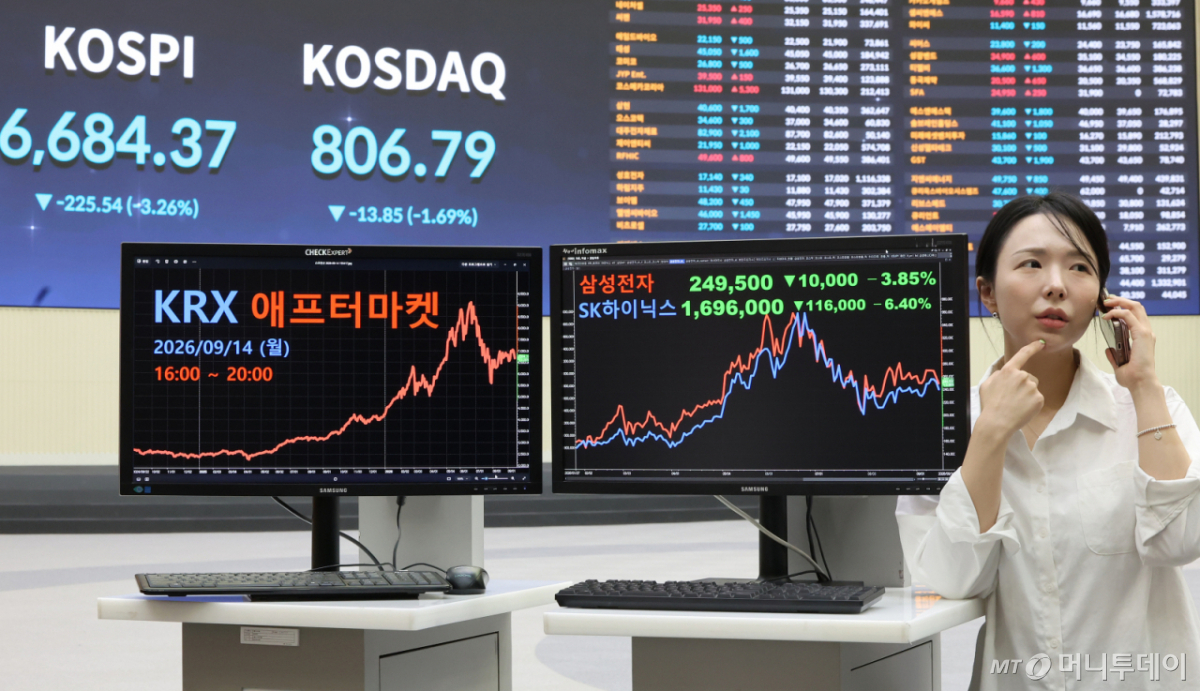
On the first day of the KRX Aftermarket, Samsung Electronics and SK Hynix continued their downward price trend. As arguments for slowing down AI (artificial intelligence) development spread, losses incurred during regular trading hours carried over into the evening session, but no additional losses have appeared within the first hour and 30 minutes after the market opened. The new stock exchange, launched to improve accessibility and secure stable supply and demand, is drawing attention as to whether it will bolster the value-up program.
As of 5:28 p.m. on the 14th, Samsung Electronics, the leading stock of KOSPI in the Aftermarket, was trading at 248,000 won, down 11,000 won (4.24%) from the closing price of the previous trading day (the 11th). SK Hynix, which along with Samsung Electronics holds a large share of the stock market as one of the two top semiconductor stocks, was also showing a decline of 1.685 million won, down 127,000 won (7.01%) from the previous day's closing price at this time.
The price trends of Samsung Electronics and SK Hynix reflect the market conditions during the regular session today. Their stock prices fell by 4% to 6% during regular trading hours, and the KOSDAQ index closed at 806.79, down 13.85 points (1.69%) from the previous day's close. However, in the Aftermarket, there has been no significant volatility, as the declines seen during regular trading for Samsung Electronics and SK Hynix have been fully reflected.
Supply and demand trends are also showing patterns similar to those of the regular session. At this time, individual investors are net buying KOSPI stocks worth 4.2039 trillion won on their own. Foreign investors and institutional investors are net selling stocks worth 3.9387 trillion won and 1.7373 trillion won, respectively. The volume of purchases by individuals has increased by about 1 trillion won compared to the regular session, while the sales volumes of foreign investors and institutional investors show only negligible changes.
The Aftermarket today opened at 4 p.m. for the first time and is drawing attention. The Aftermarket will operate until 8 p.m.
The Aftermarket was launched with the goal of improving three key keywords of the Korean stock market: accessibility, liquidity, and stability. It is interpreted as aiming to create a virtuous cycle effect that leads to boosting the stock market.
Regarding accessibility, it has been decided to adopt the same order method as in regular trading hours. Instead of the single-price order method in 10-minute intervals used previously for after-hours trading, real-time connection trading will be utilized. The number of stocks traded in the Aftermarket is also around 2,700. Previously, only about 600 stocks could be invested in through the NXT Aftermarket (selected quarterly based on liquidity, market capitalization, etc.).
Regarding liquidity, the exchange expects it to increase naturally as trading hours have been extended. This is because not only individual investors' stock trading after work but also foreign investors' trading time has increased by about two hours compared to before.
Regarding stability, measures were taken to exclude stocks with investment warnings or abnormal sharp price increases from the list of tradable items. Securities products such as ETFs (exchange-traded funds), ELWs (equity warrants), and ETNs (exchange-traded notes) are also excluded. Due to issues related to product price management, difficulties in calculating net asset value during the buy/sell quote process by LPs (liquidity providers), and potential increased burdens on risk management, they were initially excluded.

 in STOCK
