

Retail investors have been betting on a decline in the KOSPI over the past month by selling ETFs tracking the KOSPI 200 index and purchasing inverse ETFs. In the last month alone, retail investors' net selling of KOSPI-listed stocks reached 18.3816 trillion won.
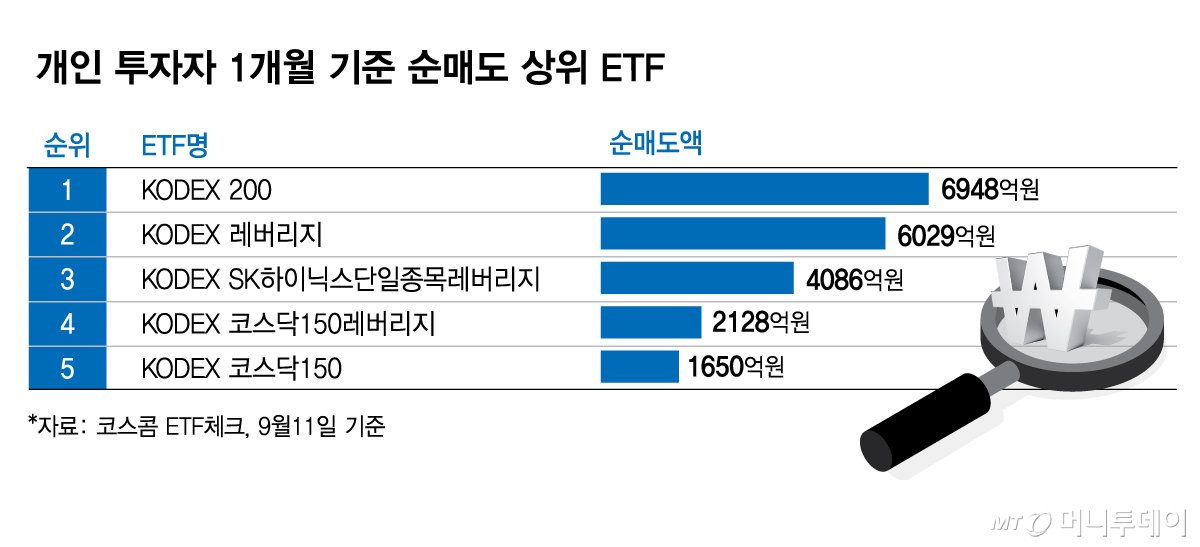
According to KOSCOM's ETF Check report as of the 11th, the ETF with the highest net selling by retail investors was 'KODEX 200,' with net sales totaling approximately 694.8 billion won. The second most-sold ETF was 'KODEX Leverage,' recording net sales of about 602.9 billion won.
In contrast, retail investors made net purchases of 'KODEX 200 Futures Inverse 2X' and 'KODEX Inverse'—ETFs that profit when the KOSPI falls—in amounts of 200.1 billion won and 130 billion won, respectively. This indicates they believe a decline in the KOSPI is more likely.
During the same period, retail investors continued their net selling spree in the KOSPI market, offloading stocks worth 18.3816 trillion won. Notably, as the KOSPI index approached the 7,000 level, the tendency to sell intensified. On the 7th alone, retail investors executed net sales totaling 6.8374 trillion won in a single day, when the KOSPI closed at 6,995.39. Over the past month, the KOSPI touched the intraday range of 6,900–7,000 on 11 trading days, and retail investors recorded net selling on 7 of those days.
Lee Sang-yeon, a researcher at Shinhan Securities, stated, "Many retail investors have an average purchase price in the early 7,000 range, so as the KOSPI approaches 7,000, selling pressure emerges primarily from them. Additionally, heightened risk-aversion sentiment ahead of recent U.S. inflation data releases and the September Federal Open Market Committee (FOMC) meeting has also contributed."
Experts in the financial investment industry forecast that range-bound trading between 6,000 and 7,000 will continue for some time due to major upcoming events such as the FOMC and escalating tensions between the U.S. and Iran. Foreign investors have also not shown positive supply-demand trends, with net selling of 6.8362 trillion won over the past month. Analysts suggest that the KOSPI is likely to remain sluggish until third-quarter earnings momentum picks up.
However, given that the September FOMC meeting scheduled for the 15th–16th (local time) may alleviate external uncertainties and that earnings momentum could begin afterward, experts advise against indiscriminate selling and recommend monitoring the situation closely.
Kim Jae-seung, a researcher at Hyundai Motor Securities, said, "In the short term, supply gaps and caution over macro events are expected to persist through mid-month. However, starting next month, as expectations regarding the U.S. midterm election results become clearer, a market rebound driven by reduced uncertainty from the midterm elections is anticipated." He added, "September and October should be used as opportunities to restructure portfolios and re-enter the market in preparation for the year-end rally."

 in STOCK
