

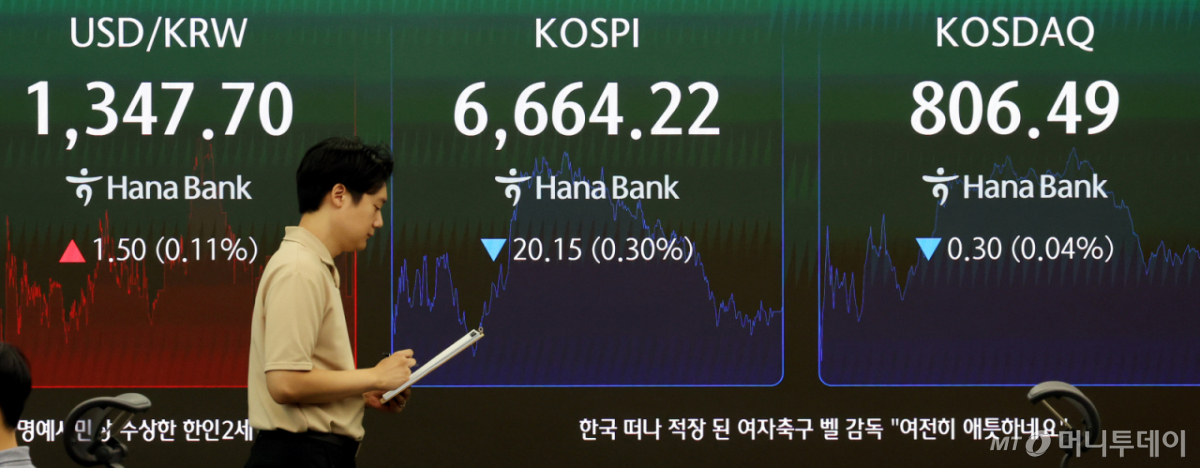
The KOSPI index showed mixed trading on the morning of the 15th. With the shock from the previous day's sharp decline still lingering, U.S.-origin interest rate pressures once again weighed on the market.
At 11 a.m. that day, the KOSPI was calculated at 6,679.46, down 4.91 points (0.07%) from the previous trading session. The index fluctuated within ±1% after the opening, repeatedly switching between gains and losses. The intraday high-low spread was 83.12 points.
Based on cumulative data from Korea Exchange and NextTrade, individuals purchased a net amount of 875.2 billion won, while other corporations bought a net 541.1 billion won. Foreign investors sold a net 882.1 billion won, and institutional investors sold a net 536.9 billion won. Other corporations reflect the on-exchange share buyback amounts of Samsung Electronics and SK Hynix.
Samsung Electronics and SK Hynix managed only a weak rebound near flat, slowing the index's movement. Among top market capitalization stocks, LG Energy Solution showed strong gains in the 1st% range, while Samsung Life Insurance and KB Financial Group dipped around 2%, and Samsung C&T fell about 1%. Across the broader market, 342 stocks rose while 526 declined.
As market direction became unclear, sectoral performances diverged. The KOSPI Medical Precision index surged over 3%, while IT services, electrical and electronics, chemicals, pharmaceuticals, manufacturing, entertainment and culture, construction, and textiles and apparel moved into weak-to-flat territory. In contrast, insurance and transport equipment fell about 2%, while transport warehousing, finance, retail, securities, machinery, food and tobacco, and electric power and gas declined around 1%.
Overnight, U.S. market rates that fluctuated alongside international oil prices were identified as a burden factor for both domestic and foreign stock markets. Since the war between the United States and Iran, Saudi Arabia's "East-West Pipeline," a major alternative route for crude oil, halted operations due to the aftermath of an attack, triggering a rise in oil prices. On the 14th (based on U.S. Eastern time), the yield on the 10th-year U.S. Treasury bond broke through 5% during trading.
With the September Federal Open Market Committee (FOMC) approaching and inflation signals persisting, financial markets are treating a base rate hike as a foregone conclusion. The Chicago Mercantile Exchange (CME) FedWatch Tool, based on interest rate futures market trends, estimated a 92.4% probability that rates will be raised by 0.25 percentage points (25 basis points) at this FOMC meeting.
Kim Kwang-rae, a researcher at Samsung Futures, stated, "The risk of Red Sea transportation has increased, and the number of ships passing through the Strait of Hormuz over the weekend has dropped to single digits per day, significantly below the recent 10-day average of 14 vessels, raising concerns about crude oil supply." He added, "With August core consumer price index (CPI) rising 0.3% month-on-month and West Texas Intermediate (WTI) crude prices once again exceeding $100 per barrel, expectations for further tightening have strengthened."
Against a backdrop of continuing unfavorable macroeconomic conditions, the "AI speed control" narrative, initially raised around U.S. big tech companies, has dampened investor sentiment by raising concerns about reduced infrastructure investment. Following Anthropic CEO Dario Amodei's blog post on the 12th calling for "adjusting the pace of frontier (cutting-edge) development," OpenAI CEO Sam Altman and SpaceX CEO Elon Musk have expressed support, accelerating related discussions.
Han Ji-young, a researcher at Kiwoom Securities, noted, "The fact that the leading digits of the 10th-year U.S. Treasury yield have changed is acting as a psychological burden, but the U.S. stock market closed after recovering a significant portion of its early-session losses." She added, "What matters more than simply breaking through the 5th% level is whether further gains at current levels will lead to multiple derating for stock prices."
She continued, "It appears we need to watch whether the Federal Reserve (Fed) confirms its resolve to combat inflation after a 25-basis-point hike while also signaling caution on further increases. Once market rates stabilize, it may be necessary to adjust positions."
Lee Jun-young, a researcher at Eugene Investment & Securities, said, "The AI speed control narrative appears to be cyclical sentiment noise surrounding computing demand. The focus lies in improving the learning capabilities of frontier models and their recursive self-improvement speeds. Amodei's blog post explicitly clarified that it does not mean a complete halt to technological progress or learning itself, nor does it constrain inference demand for AI services."
The researcher added, "We judge that the wait-and-see sentiment ahead of the FOMC has heightened both sensitivity and volatility regarding AI infrastructure demand. Stock price declines driven by weakened investor sentiment appear excessive relative to fundamentals, suggesting an approach of taking advantage of short-term volatility through phased purchases with a long-term horizon."

 in STOCK
