

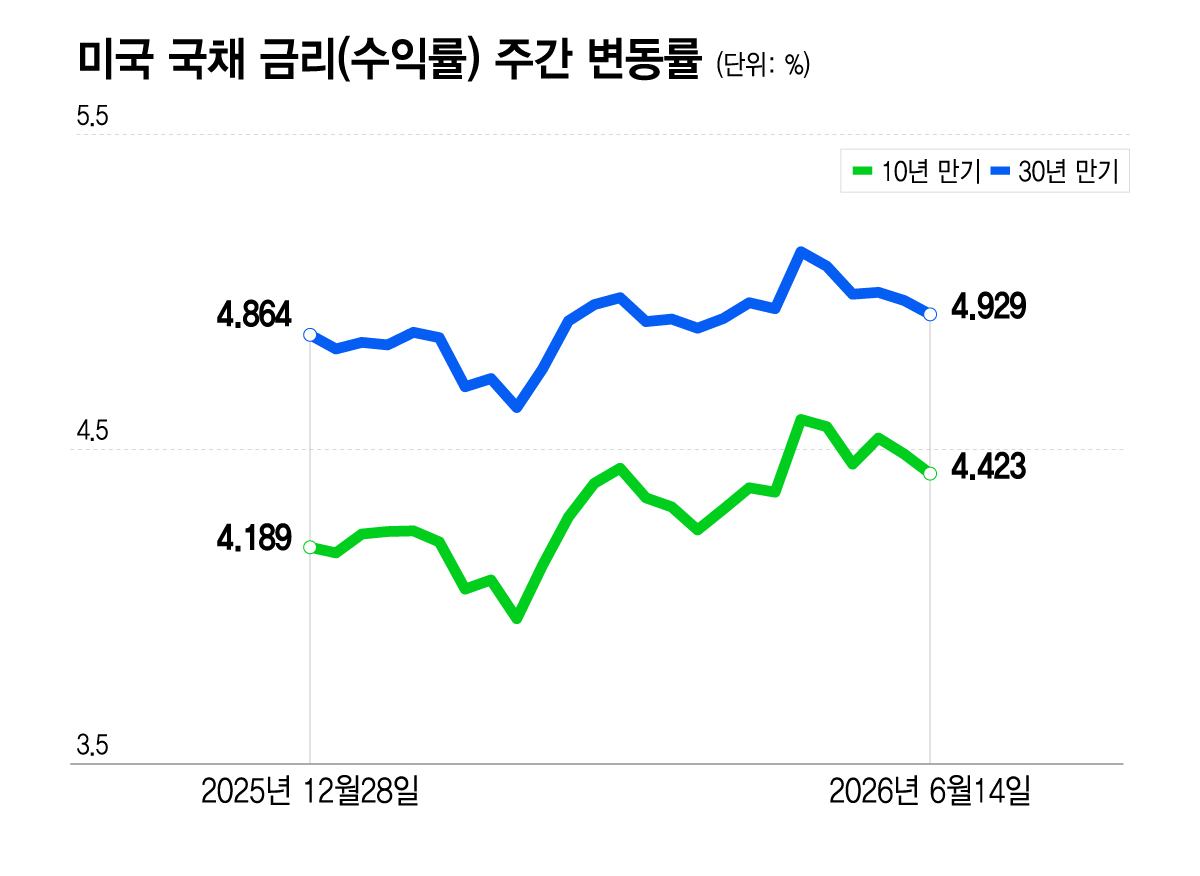
With the U.S. 10-year Treasury yield, a global benchmark for market interest rates, surpassing 5%, domestic corporate bond yields have also risen, indicating that companies' cost of capital is increasing. If holding safe assets like U.S. Treasuries alone generates an annual return of 5%, investment appeal in risky assets such as stocks declines, and companies issuing corporate bonds face pressure from rising interest rates.
According to the financial investment industry on the 15th, the yield on the 10th-year U.S. Treasury bond rose to 5.014% during trading on the 14th (local time), marking its highest level since October 2023.
The U.S. 10-year Treasury yield exceeding 5% for the first time since October 2023 is also the second time since just before the global financial crisis in 2007.
The U.S. 10-year Treasury yield has risen by 80 basis points (1bp = 0.01 percentage point) year-to-date, putting upward pressure on domestic bond yields as well. According to the Korea Financial Investment Association's Bond Information Center, the previous day's yield on 3-year AA- rated corporate bonds stood at 4.690%, up 123.1 basis points (1bp = 0.01 percentage point) from the beginning of the year. The yield on 3-year BBB- rated corporate bonds reached 10.493%, a rise of 119.0 basis points from the start of the year. The 3-year Treasury bond yield stood at 4.025%, up 109.0 basis points.
The U.S. 3-year Treasury yield was 4.74% on the 14th (local time), meaning the U.S. government's borrowing cost is higher than that of domestic high-quality corporate bonds, raising concerns that domestic corporate yields will face continued upward pressure.
Rising interest rates have led companies to focus more on refinancing rather than business expansion through capital investment. According to the Korea Financial Investment Association's Bond Information Center, net issuance of corporate bonds from January 1 this year through the 15th of this month totaled 4.7256 trillion won, an 81.9% decrease compared to 26.367 trillion won in the same period last year. Most of this year's corporate bond issuance was used to repay maturing bonds, with little left for new capital raising such as equipment investment or working capital. With new issuance shrinking due to rising interest rates, if the scale of maturity repayment increases further, there is a possibility that companies may face a "maturity cliff" where refinancing fails.
An IB (investment bank) industry official stated, "Even if demand in the domestic credit (corporate bond) market is supported, domestic corporate bonds will likely face upward pressure in an environment of rising global interest rates." The official added, "Demand is falling primarily for lower-rated bonds, which could lead to a polarization among companies in terms of capital raising, and more firms may seek alternative funding methods such as bank loans instead of issuing corporate bonds."
The U.S. Federal Reserve will hold its regular Federal Open Market Committee (FOMC) meeting on the 15th-16th (local time). Market analysis suggests that concerns over inflation driven by a sharp rise in international oil prices are increasing the likelihood of the Federal Reserve raising its base rate, which could add upward pressure to bond yields. According to the Chicago Mercantile Exchange's FedWatch tool, the probability of a 0.25 percentage point increase in the federal funds rate this month exceeds 90%.
Companies with positive business outlooks may see their corporate bond demand supported, but firms receiving negative assessments on business conditions or cash flow generation face greater difficulties in capital raising, raising the possibility of polarization. Daishin Securities received orders totaling 1.59 trillion won—more than ten times the target amount of 150 billion won—in its corporate bond demand forecast issued on the 1st. This is interpreted as securities firms enjoying relatively favorable conditions for issuing corporate bonds due to expectations regarding the securities industry's prospects. In contrast, construction materials company Dongwha Corporation received no orders in its May 400 billion won demand forecast, resulting in a full unsold status.
Cha Ju-hee, a researcher at Shinhan Investment Corp., stated, "Rising interest rates this year have weakened overall sentiment in the credit market, and improvements in individual industries' performance are not being reflected in credit spreads (interest rate differentials)." She added, "With numerous credit events occurring in lower-rated segments this year and upside interest rate risks remaining, a significant narrowing of credit spreads by year-end appears unlikely."

 in STOCK
