

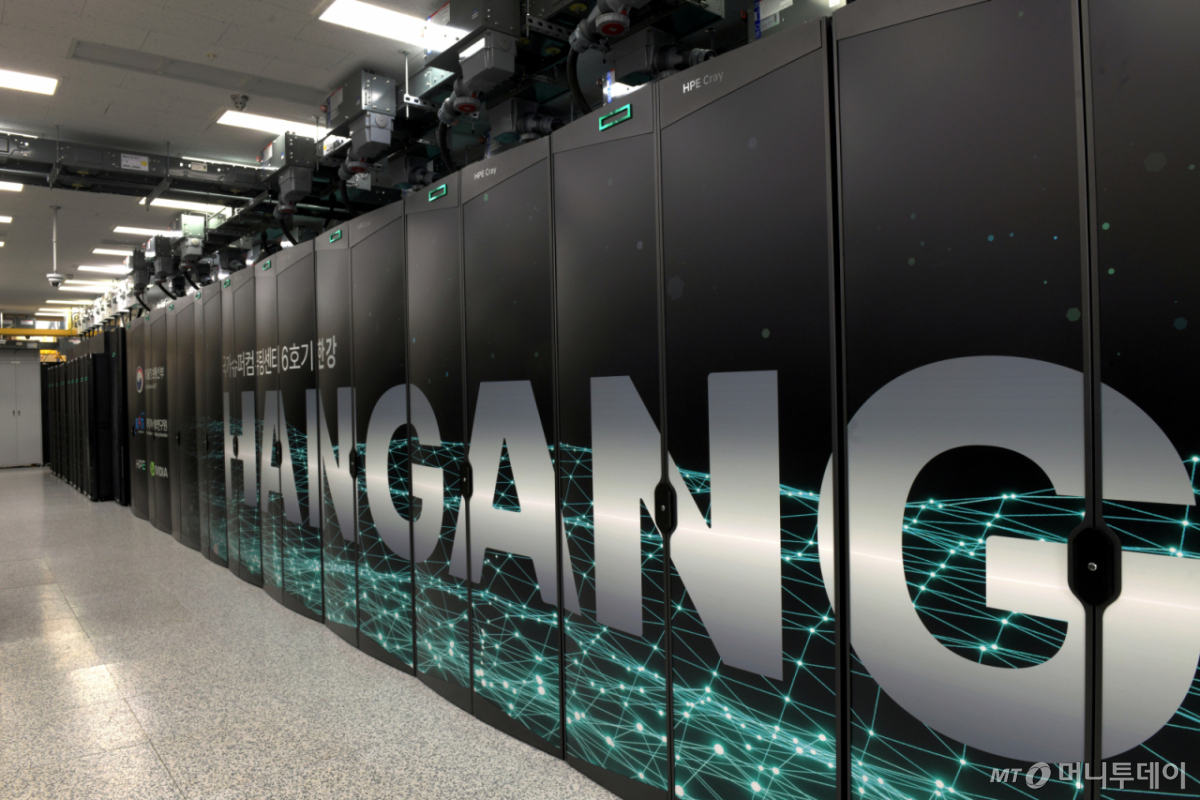
South Korea's sixth national supercomputer, dubbed Hangang (Han River), was unveiled for the first time after more than four years of delays.
On Monday, at the Korea Institute of Science and Technology Information (KISTI) headquarters in Yuseong-gu, Daejeon, officials and representatives from major domestic and international industry, academic and research institutions gathered around the sixth-generation supercomputer installed on the second floor of the National Supercomputing Center.
As soon as the doors opened, attendees, regardless of rank, took turns posing for commemorative photos beside the machine. The scene reflected how long the research community had been waiting for this moment.
Hangang officially began operations on Monday. A supercomputer is a system capable of analyzing and processing massive amounts of data at extremely high speeds, performing calculations hundreds to thousands of times faster than ordinary computers. It is a key research infrastructure that supports large-scale computing and data analysis beyond the capabilities of individual researchers.
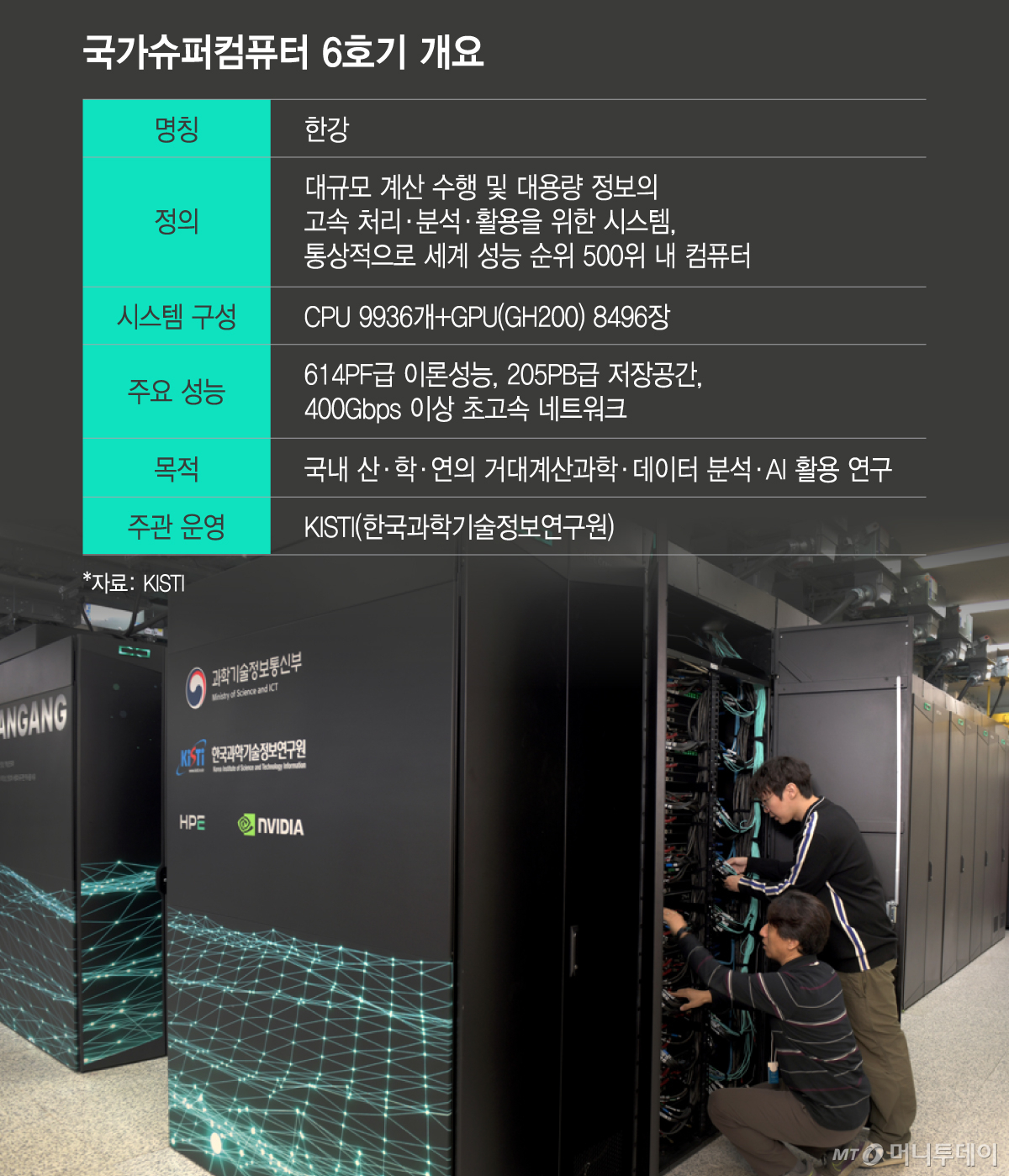
The sixth-generation system succeeds Nurion, the fifth-generation supercomputer that has supported science and technology research and development for the past eight years. Hangang is equipped with 9,936 central processing units (CPUs) and 8,496 Nvidia GH200 graphics processing units (GPUs).
While CPUs are used for large-scale computational science, GPUs are optimized for large-scale AI research. The system is designed to handle a wide range of tasks, from complex multiphysics calculations and precision simulations to AI model development.
In terms of performance, Hangang is expected to rank among the world's top 10 supercomputers. It has a theoretical performance of 614 petaflops (PF), with 1 PF representing 1 quadrillion calculations per second. Its storage capacity reaches 205 petabytes (PB), equivalent to 205 million gigabytes.
One of its key strengths is its world-class interconnection network, which links the CPUs and GPUs so they can divide and process computing tasks together.
If this network is inadequate, the speed at which computing results are exchanged slows down, preventing even the latest GPUs from operating at full capacity. Hangang provides network speeds of more than 400 gigabits per second. According to KISTI, among the world's top 10 supercomputers, only the U.S. system Eagle has adopted comparable network bandwidth.
Supercomputer No. 6 Faces Challenges Amid 'AI Boom'… When Is the Official Launch?
The system faced numerous hurdles before reaching operation with such high performance. The project passed a preliminary feasibility study in August 2022 with a total budget of 292.9 billion won, but four bidding rounds failed during procurement. The rapid rise of generative AI drove up GPU prices, leaving companies unwilling to bid within the original budget.
In November 2024, following a project review, the total budget was revised to 448.2 billion won. Hewlett Packard Enterprise (HPE) subsequently submitted a bid and signed a final contract worth 382.5 billion won in May 2025.
Hangang will begin providing services to industry, academia and research institutions in December. About 55 percent of its available computing resources will go to researchers working in computational science, AI and data analysis, while 30 percent will be allocated to organizations selected for national strategic R&D projects. The remaining 15 percent will support product and process development at medium-sized and small and medium-sized companies.
Before its official launch, a pilot service is being provided to 189 projects across 64 institutions through Nov. 22.
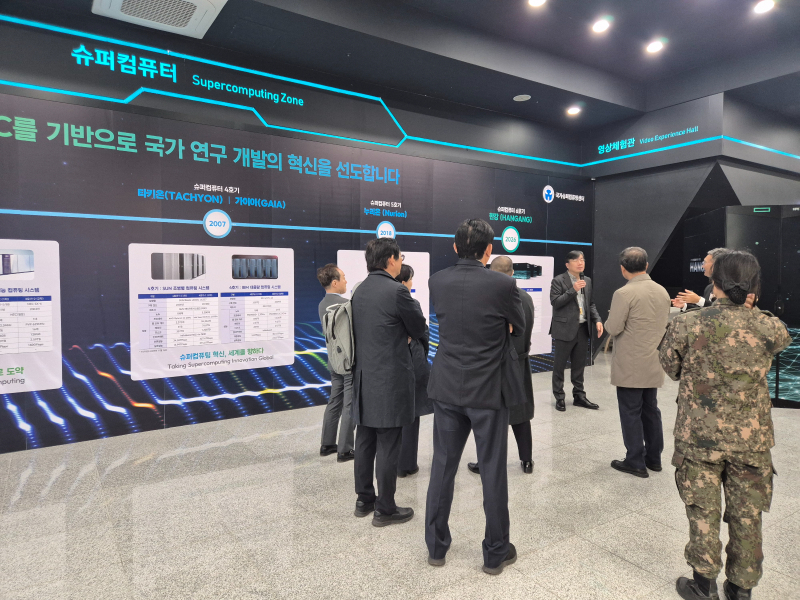
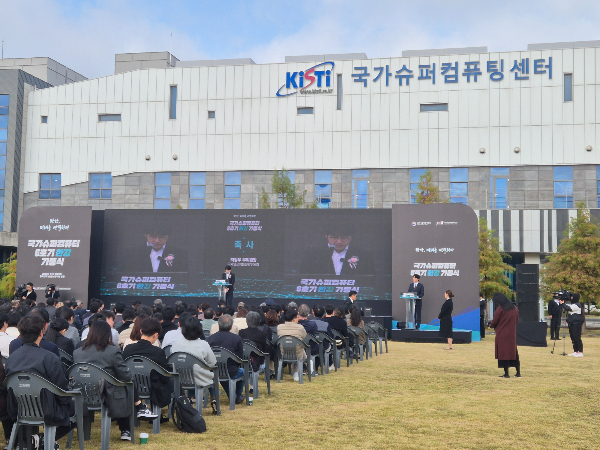
Ha Jeong-woo, vice chair of the National AI Strategy Committee, who attended the opening ceremony on this day, said, "Supercomputer No. 6 will serve as the foundation for the 'K-Moonshot Project,' which uses AI to solve difficult challenges tied to the nation's future, such as advanced bio, future energy, and space. We will ensure that students and researchers nationwide can use computing resources without burden."
Lee Sik, director of KISTI, said, "Based on our experience in operating supercomputers thus far, we will support users so that it can serve as a foundation backing the challenging research of domestic researchers."

 in TECH


