

Although brokerages recorded record-breaking earnings amid a booming stock market in the first half of the year, the prevailing assessment is that poor performance in the second half is inevitable due to slowing transaction volumes. Stock prices of major brokerages have already begun to decline, and brokerage firms are also lowering their target prices. However, despite the drop in transaction volume, current levels remain twice as high as last year’s figures. In addition to qualitative shifts beyond simple brokerage (brokerage) services—such as WM (wealth management), retirement pension, and digital asset businesses—there are also signs of shareholder return initiatives, leading some analysts to argue that revaluation is possible.
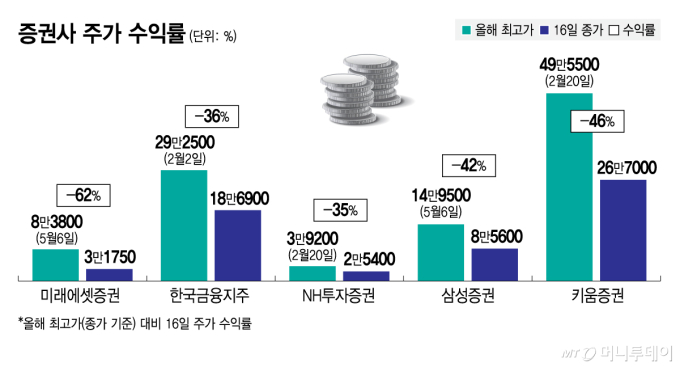
According to data from the Korea Exchange and others on the 16th, stock prices of major brokerages have fallen by more than 60% from their year-to-date highs. On this day, Mirae Asset Securities closed at 31,750 won, down 62% from its yearly high of 83,800 won on May 6. Similarly, Kiwoom Securities fell 46%, Samsung Securities 42%, Korea Financial Investment 36%, and NH Investment & Securities 35%.
Yuanta Securities, which released brokerage analysis reports this month, lowered its target prices. Kiwoom Securities’ target price was adjusted downward by approximately 14% from the previous level; Korea Financial Investment by 6%; NH Investment & Securities and Mirae Asset Securities each by 18%; and Samsung Securities by 14%.
Yuanta Securities researcher Woo Do-hyung stated, “Combined third-quarter net income attributable to controlling shareholders of Samsung, Mirae, NH, Korea Financial, and Kiwoom Securities is expected to reach 1.5 trillion won, falling 29% short of market expectations.” He added, “Declining transaction volumes are anticipated to result in poor brokerage profit-and-loss performance, while rising interest rates and a sluggish stock market are expected to reduce trading gains and losses.”
Analysts predict that as stock market transaction volumes have declined since the second half of the year, major revenue sources for brokerages such as brokerage services will face significant headwinds. In fact, the average daily transaction volume (including ETFs) last month was 67.2 trillion won, down 32% from 99.5 trillion won in the previous month. LS Securities researcher Bae Bae-seung remarked, “The sharp decline in transaction volumes, weakness in the KOSPI index, and falling stock prices in AI (artificial intelligence) and semiconductor sectors will likely result in reduced brokerage and asset management fee revenues and weaker investment returns in the third quarter.” He further noted, “Earnings for the brokerage sector in the third quarter are expected to see a significant decline compared to the second quarter.”
However, despite slowing profits in the second half of the year, analysts expect annual earnings to significantly exceed historical averages. Although transaction volumes are on a downward trend, they remain at twice the level of last year’s average daily volume. Additionally, deposit balances such as commercial paper and IMA (comprehensive investment accounts), along with IB (corporate finance) and trading profit-and-loss scales, continue to expand.
Brokerages are accelerating structural transformations beyond brokerage services, including expanding WM businesses, strengthening functions for issuing commercial paper and accepting IMA deposits, and attracting long-term customer assets centered on retirement pensions. These developments, along with shareholder return initiatives, are viewed as positive factors.
Hyundai Motor Securities researcher Kim Sung-hoon stated, “While brokerage services depend heavily on transaction volumes and market direction, WM—a business focused on financial product sales and asset management—has relatively lower sensitivity to market conditions and can grow based on long-established customer networks and capabilities in supplying financial products.” He added, “If sustainable profit levels rise and stable shareholder returns are supported, revaluation of valuations (stock price relative to earnings) is likely to follow.”
He continued, “Competitiveness in securing customer assets through digital asset brokerage and sales capabilities, such as STO (security token offerings), and growth potential in transaction volumes via integrated foreign investor accounts will become key differentiators for brokerages going forward.”

 in STOCK
