

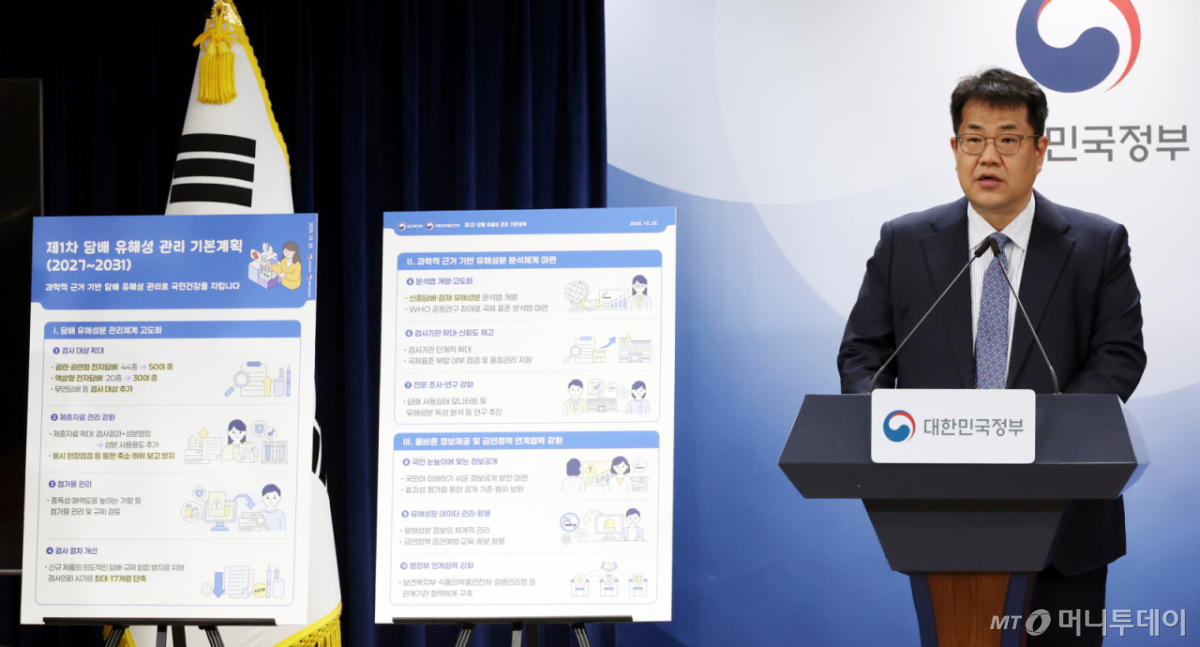
"The inevitable has finally arrived. If it is stated that tobacco contains carcinogens, public fear regarding tobacco will likely intensify."
On Thursday, relevant government agencies, including the Ministry of Health and Welfare and the Ministry of Food and Drug Safety, disclosed the test results on harmful components in 465 tobacco products sold domestically, following a review by the Tobacco Harm Management Policy Committee. The tobacco industry is in a state of shock.
In particular, after it was revealed that 11 Group 1 carcinogens, including formaldehyde, benzene, and cadmium, were detected in conventional cigarettes (cigarettes) sold domestically, officials from tobacco companies such as KT&G, Philip Morris, BAT, and JTI expressed concerns about revenue declines due to falling sales volumes.
An official from a tobacco company said, "We have no specific stance on the government's announcement, but internally, there are many voices expressing concern about this release," adding, "Consumers will inevitably view all products negatively, including cigarettes and heated tobacco products, and fear is bound to grow."
However, because this government announcement marks the first disclosure of harmful component test results, some express concern over whether the investigation was conducted with sufficient scientific fairness. This is because there are differences across product categories when examining the test results by component in the materials released by the government.
In fact, among the 11th Group 1 carcinogens newly presented as benchmarks by the government, heated tobacco products detected a majority (7 types) at trace levels that were unmeasurable, and even for measurable substances, detection levels were significantly lower than those in conventional cigarettes. Looking at all 11 types combined, the measured levels in heated tobacco products were on average 97% lower than those in conventional cigarettes based on maximum measurement standards.
An official from another tobacco company pointed out, "There is a regret that when conveying test results to the public, it would have been helpful to explain precisely what differences exist by product category alongside the fact that 'carcinogens were detected.'"
He added, "Since numerical values for components in 465 products have been disclosed, sufficient explanation is needed on what these numbers specifically mean and how they should be interpreted so that the public can properly judge the significance of this disclosure."
The official further added that it is important that this information is conveyed objectively and in a balanced manner based on sufficient explanations of scientific evidence and test conditions.
Additionally, some within the industry analyze that the government's announcement may be used as justification for future cigarette price hikes, including reforms to the tobacco taxation system. This is because a system in which the government directly manages harmful component information has been established, which could serve as a basis for future tobacco regulation policies.
Another industry official said, "From the government's perspective, raising cigarette prices is a significant burden because they must also consider public opinion," adding, "If the government extensively announces the harmfulness of tobacco as it did this time, it will likely be able to implement price increases among various tobacco regulation measures with little resistance."

 in LIVING
