

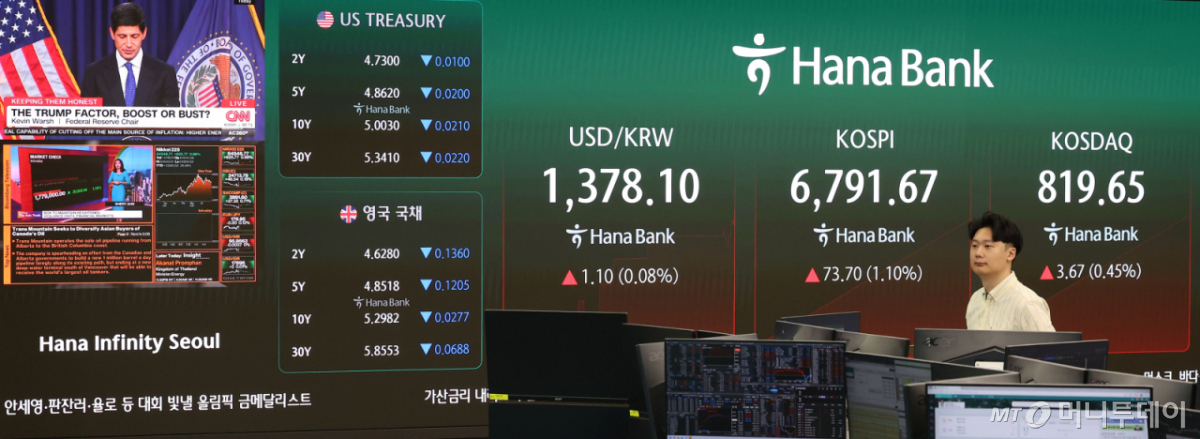
As expected by the market, an interest rate hike was implemented at the September Federal Open Market Committee (FOMC) meeting of the U.S. Federal Reserve. This marks the first rate increase decision in three years since 2023. The possibility of additional interest rate hikes within the year has also risen significantly. With the dot plot moving upward and the statement wording becoming more hawkish, analysts predict that financial market shocks are inevitable. It is forecasted that market volatility will remain high for some time and demand for safe-haven assets may increase.
On the 16th (local time), the Federal Reserve System raised its target range for the federal base rate by 25 basis points from 3.50% to 3.75% to 3.75% to 4.00% at the September FOMC meeting. Given that the probability of an interest rate hike stood at 93.5% based on FedWatch just before the meeting, the rate increase itself was a predictable outcome. However, with unanimous support for the hike and a hawkish revision to the statement, expectations for further increases have strengthened. The dot plot, which indicates the level of base rates that FOMC participants expect in the future, was also revised upward from 3.8% to 4.1%.
Securities firms generally agree that this FOMC meeting will weigh on the stock market. This is because it negatively affects the valuations of technology and growth stocks, which have recently led the market, and could deliver a direct blow through liquidity contraction. Jung Da-won, a researcher at LS Securities, stated, "As AI (artificial intelligence) infrastructure investments actively utilize leverage, liquidity has become a key variable," adding that "the effect of liquidity contraction cannot be positive for risk assets." He further assessed that "the risk of a decline in the stock market has increased in the short term."
Concerns also arise regarding uncertainties stemming from policy divergence between the U.S. administration's fiscal policy and the Federal Reserve's monetary policy, as well as the gap between the official Federal Reserve dot plot and Chair Kevin Warsh's contradictory stance. Kim Ho-jeong, a researcher at Yuanta Securities, predicted, "The fundamental risk faced through this meeting is not simply the direction of monetary policy, but uncertainty regarding the credibility of the entity communicating it," and added that "it will act as a mechanism to raise financial market volatility premiums until the October meeting."
In the long term, if high interest rates persist, the key issue will be their impact on the economy and corporate earnings. High interest rates could pressure consumption and investment, leading to economic slowdown and deteriorating corporate performance. In such cases, the effect on the market is expected to be fundamental and direct. Han Ji-young, a researcher at Kiwoom Securities, noted, "More important than the absolute level of interest rates is the speed of increase; the key lies in whether profit momentum is maintained during the rate hike process." She added, "If earnings slow down due to the shock of rapidly rising interest rates, it could lead to stock market corrections."
However, opinions differ on whether this interest rate hike is a temporary and preemptive measure against inflation or the start of an increase cycle. Some argue that since the prolonged U.S.-Iran conflict has directly caused inflation, price trends could shift depending on Middle East developments, and if there is only one additional hike within the year, it would not constitute a continuous increase cycle. Others believe that trends in key indicators such as growth rates, inflation, and employment are likely to push up the possibility of rate hikes next year following this year's trajectory, leading markets to perceive a "tightening cycle."
In particular, there is a view that if interest rate hikes remain one-off measures due to price stability, they could have a positive effect on the market. Na Jeong-hwan, a researcher at NH Investment & Securities, advised, "As geopolitical risks subside and expected inflation is contained, long-term rates may revert, leading to valuation normalization and potential stock price increases," adding that "in this scenario, growth stock premiums could expand again."
Meanwhile, the KOSPI index closed down 2.56 points (0.04%) at 6,715.41 on the 17th compared to the previous day. It is analyzed that the market had already priced in FOMC caution, and despite the U.S. base rate hike, there was little volatility in market interest rates, resulting in limited impact on the stock market.

 in STOCK
