

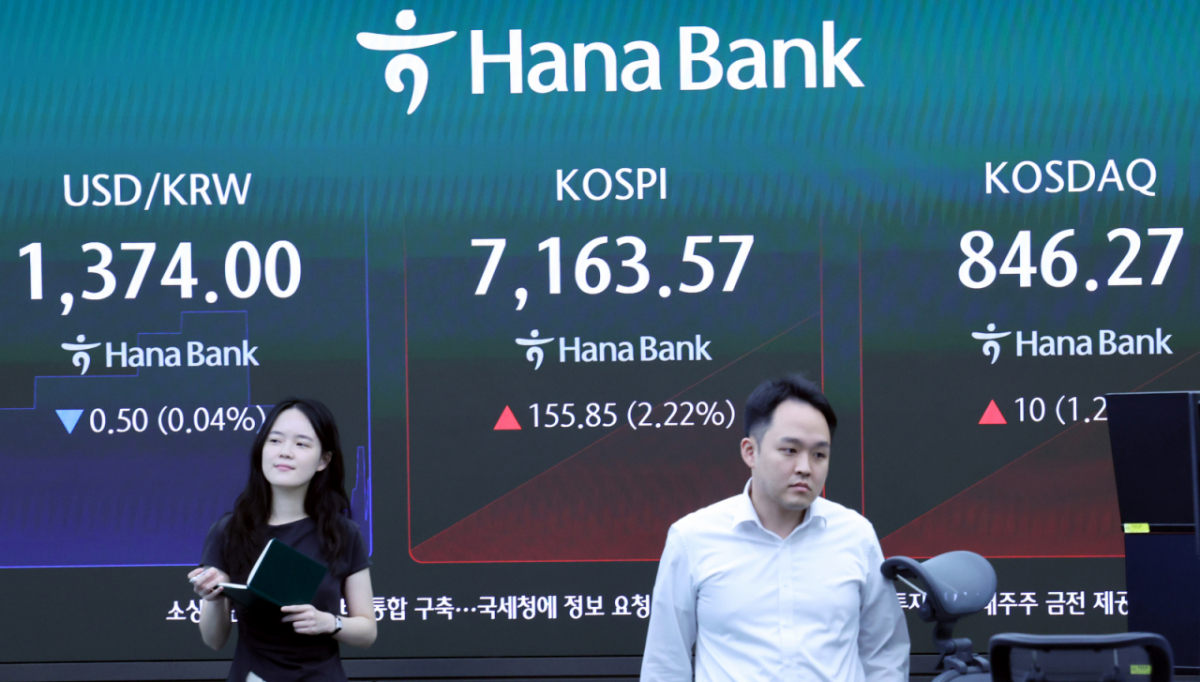
Riding a rally in U.S. semiconductor stocks, KOSPI rose more than 2% on the 22nd, breaking through 7,160. KOSDAQ also started with gains of over 1%, showing a synchronized rally across both major markets.
As of 9:11 a.m., KOSPI stood at 7,165.26, up 157.54 points (2.25%) from the previous trading day. Having recovered above the "7,000 level" the previous day, KOSPI opened at 7,161.61, up 153.89 points (2.20%), and continues its upward trend of over 2%.
Overnight in New York, a surge in major technology stocks pushed the NASDAQ index to an all-time high. At one point during trading, it climbed to 27,111.22, surpassing the previous closing high of 27,093.90 recorded on June 2. The S&P 500 closed up 1.49% at 7,764.70, while the NASDAQ Composite finished at 27,096.00.
In particular, a synchronized rally in U.S. semiconductor stocks continued. The Philadelphia Semiconductor Index (PHLX), composed of major semiconductor stocks, rose 4.1%. Meta surged 11.43%, and Intel rose more than 10%. AMD broke through 1 trillion won in market capitalization for the first time in its history.
Han Ji-young, a researcher at Kiwoom Securities, said, "A rally in semiconductor stocks was driven by expectations of eased U.S.-Iran tensions leading to lower oil prices, a decline in 10-year bond yields, and positive news on Meta's AI success." He added, "WTI (West Texas Intermediate) crude oil, which had been trading above $100 for some time, fell to as low as $91, easing macroeconomic burdens and increasing stock market sensitivity to positive developments."
A researcher noted regarding the domestic market on this day, "The market is expected to rise, benefiting from the rally in U.S. AI stocks triggered by Meta within a favorable macroeconomic environment." He pointed out, "Even after experiencing multiple sharp declines since August due to a rapid rise in U.S. interest rates and adjustments in AI development speed, the market has been raising its lows."
Looking at supply and demand, net purchases by foreign investors and institutional investors are driving KOSPI's rise. As of 9:22 a.m., foreign investors purchased 201.3 billion won and institutional investors bought 173.8 billion won on a net basis at the Korea Exchange, while retail investors sold 483.3 billion won on a net basis.
Most top market capitalization stocks are also rising. Samsung Electronics is trading up 6,750 won (2.46%) to 280,750 won compared to the previous day, and SK Hynix is trading up 57,000 won (3.05%) to 1.925 million won. Samsung Electric surged over 6%, SK Square rose over 2%, and Hyundai Motor, Samsung C&T, and Samsung Life Insurance each gained over 1%. Samsung Biologics and Shinhan Financial Group showed roughly flat performance, while KB Financial Group fell over 1%.
In industrial sectors, securities firms were up over 4%, while electrical & electronics, manufacturing, and IT services showed strong gains of over 2%. Construction, machinery & equipment, and finance rose over 1%. Telecommunications, transport equipment, retail, insurance, electricity & gas, and medical & precision instruments remained roughly flat. Textiles & apparel, real estate, pharmaceuticals, entertainment & culture, food & tobacco, and chemicals showed slightly weak performance.
At the same time, KOSDAQ stood at 845.40, up 9.13 points (1.09%). After opening at 846.14, up 9.87 points (1.18%), the gain narrowed.
Unlike KOSPI, retail investors are buying in KOSDAQ. As of 9:22 a.m., retail investors bought 83.8 billion won on a net basis, while foreign investors sold 68.7 billion won and institutional investors sold 15.7 billion won.
Among the top market capitalization stocks in KOSDAQ, semiconductor-related stocks are showing strength. Simtek surged over 14%, and ISC rose over 7%. Rino Industrial rose over 2%, and Rainbow Robotics gained over 1%. AlteoGen, EcoPro, and EcoPro BM remained roughly flat. iOTech and Robotis showed slightly weak performance, while HLB fell over 1%.
In KOSDAQ, retail and electrical & electronics sectors were up over 2%, and non-metals rose over 1%. Finance, construction, machinery & equipment, manufacturing, IT services, textiles & apparel, and chemicals remained roughly flat. Pharmaceuticals, telecommunications, metals, and food & tobacco showed slightly weak performance, while transport & warehousing fell over 1%.
On this day at 9:00 a.m., the won/dollar exchange rate in Seoul's foreign exchange market recorded 1,387.30 won.

 in STOCK
