

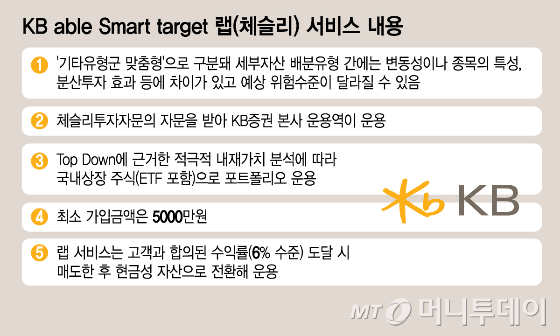
KB Securities has come under fire after selling target-conversion wrap products in units of billions of won that are supposed to be redeemed in cash once a target return is reached, yet some accounts were not redeemed even after meeting the conversion target. As returns and redemption eligibility varied among customers depending on the sell order, industry observers have pointed to mismanagement in operations. It has been confirmed that some investors filed complaints with the Financial Supervisory Service.
Target-conversion wrap products are “downside-open” instruments similar to ELS (equity-linked securities) that sparked controversy over incomplete sales, meaning they can result in principal losses. With ELS, if the underlying asset price falls below the knock-in level, investors may suffer a loss of principal at maturity; with target-conversion wraps, if stock prices or indices drop before the target return is achieved, investors incur losses.
According to the financial investment industry on the 23rd, more than 10 accounts enrolled in the “Chesley Advisory Target-Conversion Wrap” product, which began operations on June 1, did not receive redemption despite reaching the target return rate. These accounts reached the target return (6%) on June 19, when the KOSPI index climbed intraday to 9,385.59, but were unable to lock in profits. As the stock market subsequently declined, these accounts are now reporting unrealized losses exceeding 20% of their principal.
Consequently, some investors who subscribed to KB Securities’ product have filed complaints with the Financial Supervisory Service. According to complainant A, no single share of any individual stock was sold in A’s wrap account at the time the target was reached. On that same day, only one purchase and one sale transaction each were executed in the MMDA (money market deposit account). As of July 15, A’s account return rate stood at -20.61% relative to principal.
The failure to redeem some accounts is believed to stem from KB Securities’ sequential selling method. KB Securities calculated returns up to June 18, one day before the target return achievement date (June 19), and proceeded with redemption sales in order of highest return first. However, during the selling process, the KOSPI index plummeted to 8,831.72, causing the returns of more than 10 accounts waiting for redemption to fall below 6%. In response, KB Securities halted redemption for those accounts.
The financial investment industry attributes the failure to redeem some accounts to the securities firm’s operational practices. Had the stock holdings across all accounts been sold in small, proportional slices, such an incident could have been avoided. For example, if 100 enrolled accounts each held 10% of a particular stock, the firm could have repeatedly sold 1% from each account until the full 10% was disposed of. Given the high market volatility at the time and the ability to anticipate the sharp decline, critics argue that preparatory measures were necessary.
An industry insider in the wrap account sector stated, “Stock exposure must be managed by splitting positions into 1–5% increments per customer to avoid unfairness among clients.” He added, “If accounts worth tens of billions of won are sold on a single day, returns will inevitably lag; initially, only around 100 billion won should have been sold to ensure proper management and control.” He further noted, “If all holdings in an account are liquidated before moving to the next account, later-assigned accounts may be disadvantaged, raising fairness concerns. Everyone anticipated that large-scale selling into the market could drive stock prices down.”
In response to Complainant A’s inquiry, KB Securities stated, “We determined that redeeming at a return rate below the target would disadvantage customers, so we did not liquidate more than 10 accounts still awaiting redemption. To prevent market shocks caused by price volatility from large-scale stock disposals, we are selling in groups.”
KB Securities sold approximately 2 trillion won worth of target-conversion wrap products in June and about 160 billion won in July. The Chesley Advisory product, at the center of the redemption controversy alone, accounted for 470 billion won in sales during June. As of the closing price on the 22nd, the KOSPI had fallen 23% from its June high and 15% from its July high. Based on sales volume, estimated losses amount to 460 billion won for June’s sales and 24 billion won for July’s sales. It is presumed that unrealized losses have accumulated primarily among accounts that failed to reach the target return during this period. Some voices are calling for an urgent review of how these target-conversion wrap products, sold in amounts reaching tens of billions of won, were actually managed.

 in STOCK
