

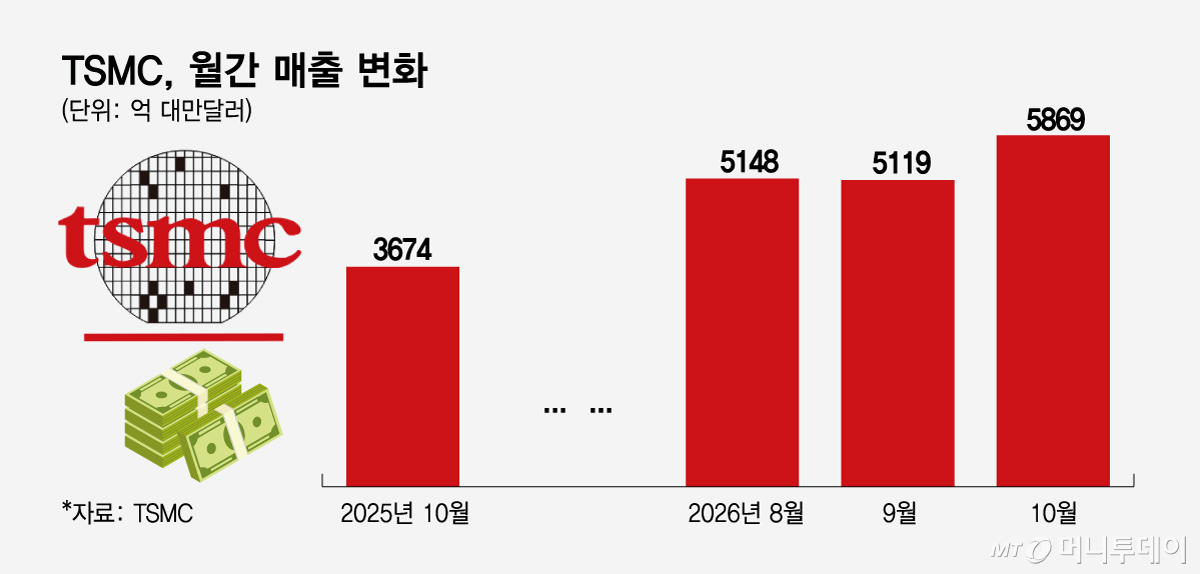
Taiwan's TSMC, the world's largest foundry (semiconductor contract manufacturing) company, has recorded its highest-ever monthly revenue and is now pushing forward with a new investment of 55 trillion won. As demand for AI (artificial intelligence) semiconductors translates into actual revenue growth and expanded capital expenditure, momentum is building for a prolonged semiconductor boom cycle. This is a positive signal not only for the memory semiconductor market (hereinafter referred to as "memory") led by Samsung Electronics and SK hynix, but also for Samsung Foundry, which has been increasing orders for advanced processes.
According to semiconductor industry sources on the 11th, TSMC's revenue in October last month was NT$586.9 billion (approximately 23.85 trillion won), a 59.7% increase from the same period last year. It also rose 14.7% from the previous month, surpassing the all-time monthly revenue record set in August. Cumulative revenue for January through October this year was approximately NT$4,485.6 billion (approximately 182 trillion won), a 43.3% increase from last year.
Expanded AI infrastructure investments by global big tech companies drove the earnings growth. TSMC manufactures advanced semiconductors for major companies such as NVIDIA, AMD, and Apple. As of the third quarter, processes of 5 nanometers (nm; 1 nm is one-billionth of a meter) or below accounted for 69% of total revenue. In particular, the expansion of mass production on 2-nanometer processes appears to have contributed to revenue growth.
TSMC's board of directors also approved a new investment of $40.9 billion (approximately 54.55 trillion won) on the previous day (the 10th). The funds are planned to be used for expanding advanced process production capacity, equipment upgrades, expanding advanced packaging and special process production facilities, building new factories, and next year's research and development expenses.
TSMC is also expanding direct investments in AI companies. The board approved a proposal to invest up to $500 million each in OpenAI and Anthropic. It also resolved to contribute up to $500 million for the establishment of a separate semiconductor industry ecosystem investment company. This move is interpreted as an effort to broaden its investment scope beyond expanding semiconductor production capacity to the entire AI industry ecosystem.
The industry is paying attention to the fact that TSMC has set a new record-high performance while simultaneously embarking on large-scale production capacity expansion. As demand for AI accelerators and ASICs (application-specific integrated circuits) grows rapidly, the importance of advanced packaging, which connects multiple semiconductors into one, is also increasing. The prevailing view is that TSMC's recent investment decision reflects the judgment that AI semiconductor demand will continue in the medium to long term.
As production volumes of AI accelerators increase, there is a high likelihood that HBM (High Bandwidth Memory) content and DRAM demand will also expand. Samsung Electronics and SK hynix forecast that memory supply shortages will persist beyond 2028 due to expanded AI data center investments and difficulties in expanding production capacity.
TSMC's expansion of advanced processes is also affecting the HBM market. TSMC is producing base dies for HBM4 in cooperation with SK hynix. Base dies play a role in controlling data flow between memory chips and GPUs within HBM.
Samsung Electronics also plans to utilize TSMC's process for the base die of NVIDIA's next-generation custom HBM (NVHBM). It is reported that as NVIDIA designed NVHBM in bulk to match TSMC's process, it requested Samsung Electronics to align the base die with TSMC's process. Base dies used in standard HBM4 and others are produced at Samsung Foundry.
Particular attention is also being paid to the growth potential of Samsung Foundry's business. TSMC's large-scale investment signifies that the advanced foundry market itself is growing rapidly. Samsung Electronics expects the number of 2-nanometer process order tasks this year to more than double compared to last year. It has already predicted that utilization rates will exceed 100% as demand across all processes below 8 nanometers significantly exceeds production capacity.
The Taylor, Texas factory in the United States is also preparing for production capacity expansion. Fab 1 is proceeding with equipment installation and production preparations targeting operation by year-end, while Fab 2 is undergoing permitting procedures and site preparation for construction. In the local area, expansion of surrounding roads and infrastructure is also being carried out to accommodate the semiconductor plant expansion.
TSMC Chairman Wei Zhe-jia emphasized during last month's third-quarter earnings release that "AI demand is extremely strong" and "Even considering all variables in our judgment, demand still significantly exceeds current supply capacity."

 in INDUSTRY
