

"Brokerage of Korean stocks for U.S. institutional investors is a business that has continued since the establishment of NH Investment & Securities' New York branch in 1992. This year, we have felt firsthand that the investor base and interest in Korean companies are on an entirely different scale from the past."
"Financial hub New York has seen a noticeable increase in foreign investors expressing interest in South Korea's value-up program and the detailed status of individual companies. Since the opening of integrated foreign accounts (omnibus accounts) this year, inquiries from 'major overseas investors' have been coming in at least once or twice a week even without any proactive outreach."
Five financial investment industry experts whom Money Today met in New York, United States, from the 14th to the 17th all said they have felt a change in the standing of Korea's capital market this year. They noted that not only the United States but also other countries are paying attention to the Korean market and seeking more information about Korean companies, which they view as "future investment destinations."
Interest in the Korean market has become both a new challenge and an opportunity for South Korean securities firms based in New York. They are at a turning point to grow into so-called "K-capital market investment hubs," expanding beyond simple stock brokerage to coordinate investor education on the K-capital market and corporate site visits.
Jin Sang-won, head of the New York office of NH Investment & Securities, which opened in 1992 in New York, the world's most developed financial center for capital markets, said, "The interest and atmosphere toward the Korean market that I feel on the ground have completely changed." The change Jin has felt most acutely is the expansion of the investor base. Not only U.S. institutional investors, but also pension funds and institutional investors from various countries such as Canada and India have visited the NH Investment & Securities New York office to invest in the Korean market.
Interest in the Korean market has broadened in scope and deepened in depth. Director Jin stated, "In the past, investment was centered on representative large-cap stocks such as Samsung Electronics and SK Hynix, but now there is a stronger demand to identify individual companies even within the same semiconductor sector." He added that this process has expanded the investment range to include mid-cap stocks. The sectors of interest, which had been dominated by semiconductors, are diversifying into robotics, healthcare, and finance.
As interest in the Korean market grows, investment approaches to K-companies on the ground in New York have also shifted. Major overseas investors are now requesting meetings with Korean companies and asking for research reports on domestic industry trends and corporate outlooks. Director Jin stated, "This means they are beginning to view the Korean market not merely as a trading market, but as one for long-term investment," adding, "This trend has been commonly observed not only among U.S. institutional investors, but also among investors in Europe and Asia."
Investors seeking to understand the infrastructure and policy direction of Korea's capital market have also increased in number. According to local sources, foreign institutional investors place significant importance on the government's capital market policy direction and corporate value-up programs when making investment decisions regarding the Korean market.
Shin Byung-mok, head of the Korea Exchange's New York office, stated, "Interest in our market is intense. When institutional investors decide to invest in Company A in our country, they inquire not only about that company's value-up program but also about information on other companies associated with Company A." He added, "We receive inquiries requesting such detailed information at least once or twice a week, even without us actively reaching out."
In particular, with the opening of integrated foreign accounts this year, inquiries from major overseas institutional investors have increased in both volume and detail. The exchange has reached a point where it must provide customized responses to each company's inquiries.
Expectations and concerns coexist regarding South Korea's value-up program. While the program has so far focused on lifting market indices and individual stock prices, investors are now looking to a value-up program that strengthens companies' earnings resilience. "There is an opinion that raising the intrinsic value of companies should be set as a policy goal," said Shin, adding, "Some investors have suggested improving the capital efficiency of Korean companies and setting target levels for return on equity (ROE)."
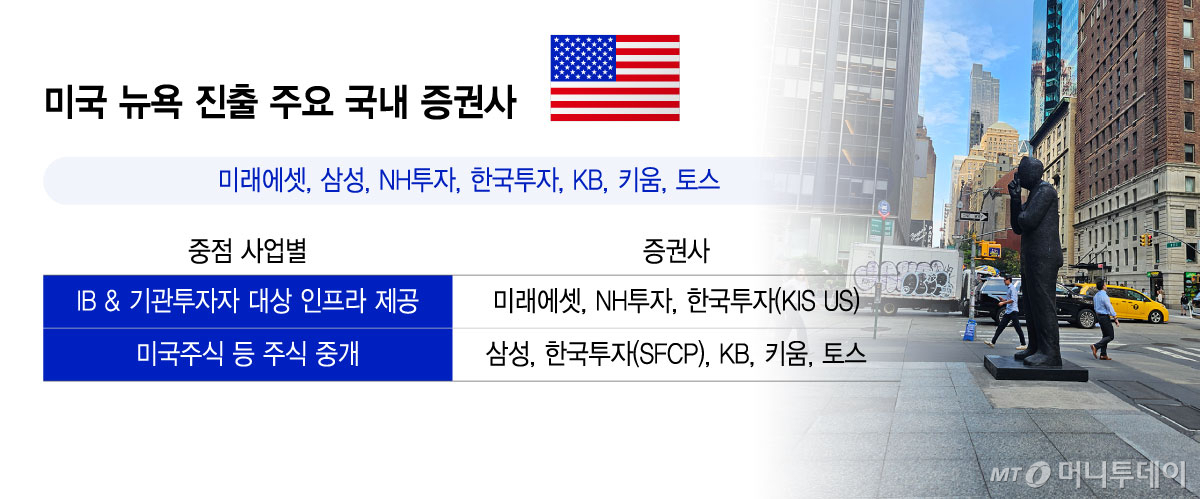
As the stature of Korea's capital market rises, domestic securities firms that have expanded into New York are also using this year as a new turning point to broaden their business scope. KIS US, the investment banking subsidiary of Korea Investment & Securities, has entered the structured finance market, including asset-backed securities (ABS), in addition to acquisition financing. The New York branch of Kiwoom Securities, which completed the U.S. regulatory approval process in June this year, is set to launch a direct brokerage service for U.S. stocks by October.

 in STOCK

