

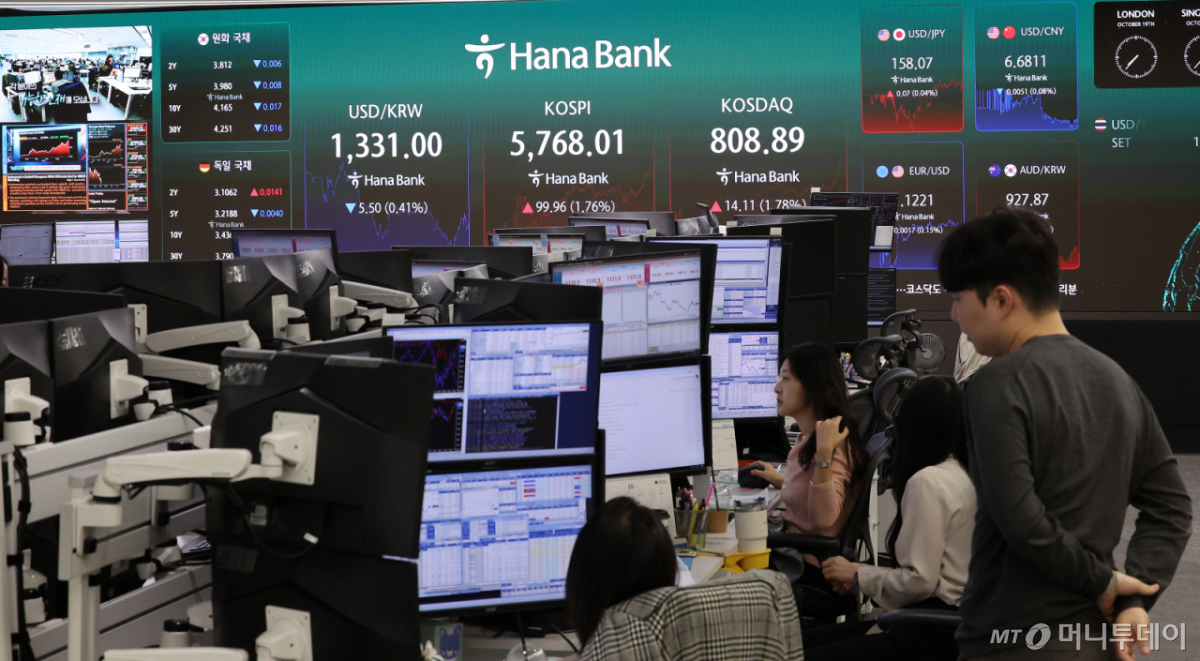
KOSPI rose for the second consecutive trading day, driven by net buying from institutional investors and a moderation in foreign selling. Although negative outlooks on the AI (artificial intelligence) industry persisted, causing AI and semiconductor stocks to plunge in the New York stock market, some low-price buying flowed into domestic semiconductor stocks, and rotation trades occurred in sectors such as secondary batteries. However, securities firms recommended that investors remain cautious of volatility and diversify their investments, given that supply and demand conditions are still unstable.
On the 19th, KOSPI ended trading at 5768.01, up 99.96 points (1.76%) from the previous trading day. On this day, KOSPI opened with a gap down of 179.64 points (3.17%) from the previous close to 5488.41, but narrowed its decline during intraday trading due to net buying by institutional investors before reversing into positive territory.
In the KOSPI market, institutional investors made provisional net purchases of 574.6 billion won based on Korea Exchange (KRX) data, while other corporations bought a net 549.4 billion won. Retail investors sold a net 1 trillion 86.2 billion won, and foreign investors sold a net 36.4 billion won. Including the alternative exchange NextTrade (NXT), foreign investors purchased a net 624.3 billion won, institutional investors bought a net 880.9 billion won, and other corporations bought a net 427.6 billion won, while retail investors sold a net 1 trillion 931.2 billion won.
By sector, pharmaceuticals rose in the 5th% range, metals and entertainment/culture in the 4th% range, chemicals in the 3rd% range, insurance, IT services, transportation equipment/parts, machinery/equipment, and general services by 2%, while transportation/warehousing, manufacturing, securities, electricity/gas, electronics, finance, non-metals, distribution, food/beverage/tobacco, and construction rose in the 1st% range. Real estate and telecommunications were slightly up, paper/wood and textiles/apparel were slightly down, and medical/precision instruments fell in the 2nd% range.
Among top market capitalization stocks, Samsung SDI rose in the 11th% range and LG Energy Solution in the 7th% range, showing strength in secondary battery stocks. Samsung Biologics rose in the 9th% range, Kia in the 5th% range, Hyundai Motor in the 4th% range, Samsung Life Insurance in the 2nd% range, while Celltrion, Hanwha Aerospace, KB Financial Group, and Samsung Electronics rose in the 1st% range. SK Hynix was slightly up, SK Square and Samsung C&T were slightly down, and Samsung Electro-Mechanics fell in the 1st% range.
Securities firms advised that while the market is still in an extreme oversold zone, it is too early to actively make additional purchases. They noted that because foreign investors remain net sellers, supply and demand are still unstable, making it difficult to predict what variables may emerge.
Researcher Kang Jin-hyuk of Shinhan Investment Corp emphasized, "Since supply and demand conditions are still unstable, momentum recovery is necessary for the rebound to not be temporary." Researcher Kang added, "As Jensen Huang, CEO of NVIDIA, is scheduled to deliver a keynote speech at GTC Berlin in Berlin, Germany, from the 20th to the 22nd, the market will watch whether AI capital constraints and profitability are further resolved," explaining that "starting with Meta (formerly Facebook) on the 21st (local time), attention in Big Tech earnings is expected to expand to CAPEX (capital expenditure) guidance as well as actual FCF (free cash flow) and credit conditions."
Researcher Lee Sang-yeon of Shin Young Securities also stated, "While it is positive that foreign net buying of futures has expanded in the derivatives market, the trend of foreign selling continues in the spot market, and it is difficult to rule out the possibility that the net futures buying represents a cover-up of existing short positions." He added, "As VKOSPI (KOSPI 200 Volatility Index) has also risen again to around 50, the possibility of increased short-term volatility remains." He further recommended, "Until the sustainability of AI investment is confirmed through major Big Tech earnings, it is advisable to check for simultaneous improvements in the continuity of foreign futures buying and spot supply and demand, rather than expecting a rapid rebound in the index."
KOSDAQ closed at 808.89, up 14.11 points (1.78%) from the previous trading day.
In the KOSDAQ market, based on KRX data, retail investors made net purchases of 64 billion won, institutional investors bought a net 66.9 billion won, and other corporations bought a net 14.3 billion won, while foreign investors sold a net 143.7 billion won.
By sector, finance rose in the 7th% range, metals in the 4th% range, paper/wood and transportation equipment/parts in the 3rd% range, entertainment/culture and general services in the 2nd% range, while chemicals, pharmaceuticals, electronics, IT services, publishing/media, manufacturing, other manufacturing, and food/beverage/tobacco rose in the 1st% range. Textiles/apparel, machinery/equipment, medical/precision instruments, construction, transportation/warehousing, and distribution were slightly up, telecommunications was slightly down, and non-metals fell in the 1st% range.
Among top market capitalization stocks, EcoPro rose in the 11th% range, EcoPro BM in the 8th% range, Rainbow Robotics in the 7th% range, HLB in the 3rd% range, while Samchundang Pharm and Alteogen rose in the 2nd% range. Simmtech was slightly up, Wonik IPS and Jusung Engineering were slightly down. Lino Industrial fell in the 1st% range, Iotech and HPSP in the 2nd% range, and PSK Holdings in the 3rd% range.
In the Seoul foreign exchange market, the won/dollar exchange rate ended daily trading at 1,330.3 won, down 1.1 won.

 in STOCK
