

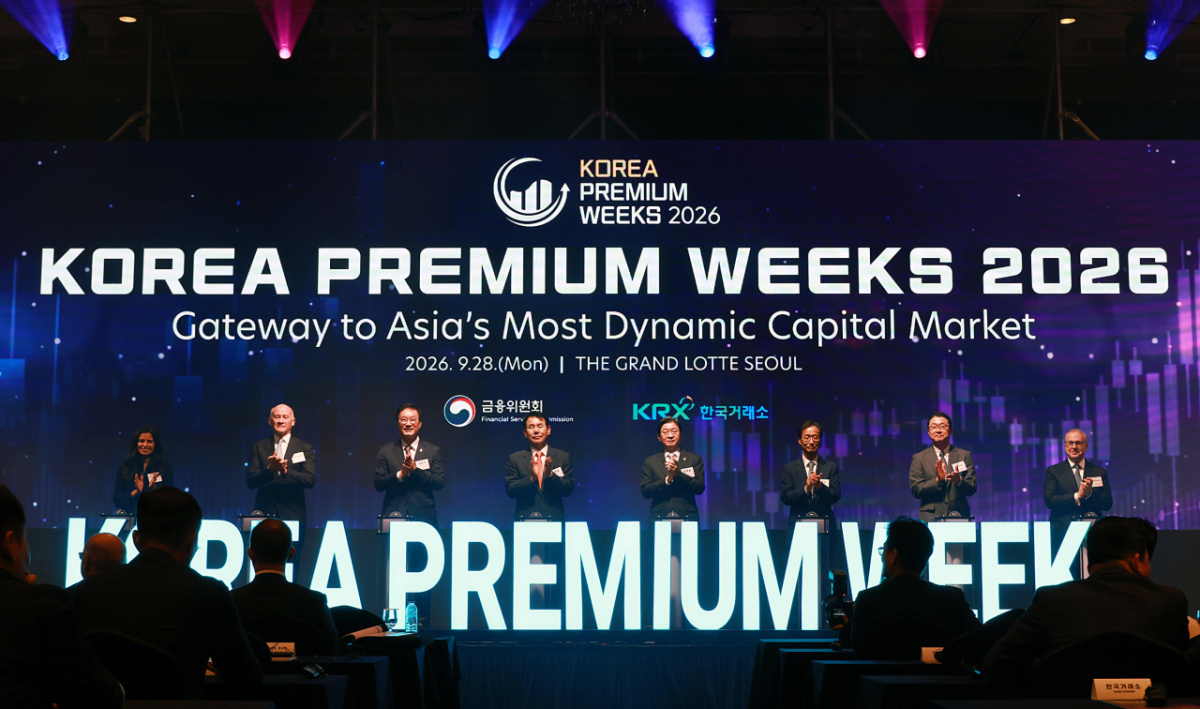
Experts have advised that for the Korean stock market to achieve the 'Korea Premium,' consistent regulation, robust market infrastructure, and substantive improvements in corporate governance must be supported together. Overseas experts unanimously expressed positive opinions on shortening the stock settlement period from the current T (trading day) + 2 days to T+1.
At the first session of the second day of 'Korea Premium Weeks 2026,' held at The Grand Lotte Seoul in Jung-gu, Seoul on the 29th, domestic and international experts discussed key challenges for advancing the Korean stock market. Simon Williams, Director at global asset management firm BlackRock, emphasized during a panel discussion that "for the Korean market to succeed, the authorities' reform intentions must translate into scalable and useful policies that investors can actually feel," adding that "regulatory consistency and predictability are important."
The opinion was raised that only when regulatory consistency by the authorities is guaranteed can investors trust and invest in the Korean market. Williams stated, "A consistent and predictable regulatory environment builds investor confidence," and noted, "While policy enforcement for market soundness is important, proportionality must be maintained in accordance with the intent of the policies during this process."
Proposals were also made that the authorities should continuously communicate with the market, including the securities industry and investors. Williams said, "Over the past year and a half, the authorities have actively communicated to understand investor demands, which helps in setting priorities," and argued, "If the authorities resolve issues in a timely manner through working groups composed of various experts, they can accelerate reform while maintaining stability in market operations."
Voices also emerged calling for improved efficiency of market infrastructure. Peter Stein, President of ASIFMA (Association of Securities Industry and Financial Markets in Asia), diagnosed that it is an important time to ensure that Korea's capital market policies work well in practice. Stein stated, "It is important whether Korea's existing market infrastructure is functioning well enough to handle increasing trading volumes," and pointed out, "Market infrastructure needs to be checked so that all procedures operate normally without leakage when more investors enter."
Stein specifically mentioned the increase in collateral posting due to surging trading volumes. He explained, "There were unexpected settlement issues where securities firms had to post significantly more collateral with the Korea Exchange and the depository than before due to the surge in trading volume, and duplicate collateral requirements also arose," adding that while it is a technical issue, it can be an element that hinders market functions and investor transactions.
System errors that occurred during the detection of illegal short selling were also cited as a reason why infrastructure checks are needed. Stein mentioned, "A new system was introduced to detect illegal naked short selling, but there were technical errors where normal trades were detected as 'regulatory violations' due to system errors," and noted, "There is also complexity arising from the introduction of institutional investor registration certificates alongside the existing investment registration certificate system."
Generally positive reactions emerged regarding the shortening of the settlement period to T+1. Stein stated, "Shortening to T+1 is joining the global trend," but proposed, "However, T+1 should be introduced only after first resolving existing infrastructure issues." Williams also said, "Shortening the settlement period is an opportunity to accelerate capital market reform tasks," and added, "Unnecessary procedures should be improved and duplicate requirements reduced during the introduction of T+1."
Domestic experts mentioned the need for the value-up program policy and improvements in corporate governance. Kim Hak-gyun, Head of the Research Center at Shin Young Securities, stated, "It is difficult to see meaningful changes in corporate governance from large corporations that are Han Guk-eul (CEO)," diagnosing, "Recently, a lot of money has gone only into passive ETFs (Exchange-Traded Funds), creating a structural handicap in seriously exercising voting rights and improving corporate governance."
Center Head Kim emphasized that more meaningful changes must emerge in shareholder actions and corporate governance improvements, taking the revision of the Commercial Act as an opportunity. He said, "So-called owners have inheritance tax burdens, so there are positive changes where dividends are utilized as a resource to align the interests of controlling shareholders and minority shareholders, but Korea Discount can only be resolved if shareholder actions and changes in corporate governance appear."
A diagnosis was also made that for the market to move toward the Korea Premium, corporate information and analysis must become more active, centered on the KOSDAQ market. Kim Nam-jong, Head of the Capital Market Research Division at the Korea Institute for Financial Industry, stated, "Information production regarding companies must become more active and quality must improve," pointing out, "In KOSDAQ, less than 40% of all companies had corporate analysis reports published in 2025." This means that to attract institutional investor funds, corporate information must be produced and shared more actively.
The fact that analyst reports are skewed toward 'buy' recommendations was also mentioned as an area for improvement. Division Head Kim argued, "Analysts produce many high-quality reports, but since they tend to focus on the 'buy' side, a phenomenon occurs where expectations concentrate," and stated, "It is necessary to further guarantee analyst independence and design incentive structures differently."
Voices also emerged that strengthening investor stewardship, such as exercising voting rights, can contribute to increasing the attractiveness of the Korean market. Kim Jung-young, Ji Won-bon-bu (SVP) at Korea Exchange, said, "The stewardship implementation check items to be implemented in the second half of this year include activities to enhance corporate valuation, which will promote participation by institutional investors," and added, "The exchange will mitigate information asymmetry between companies and investors through the value-up program to increase accessibility for global investors."

 in STOCK
