

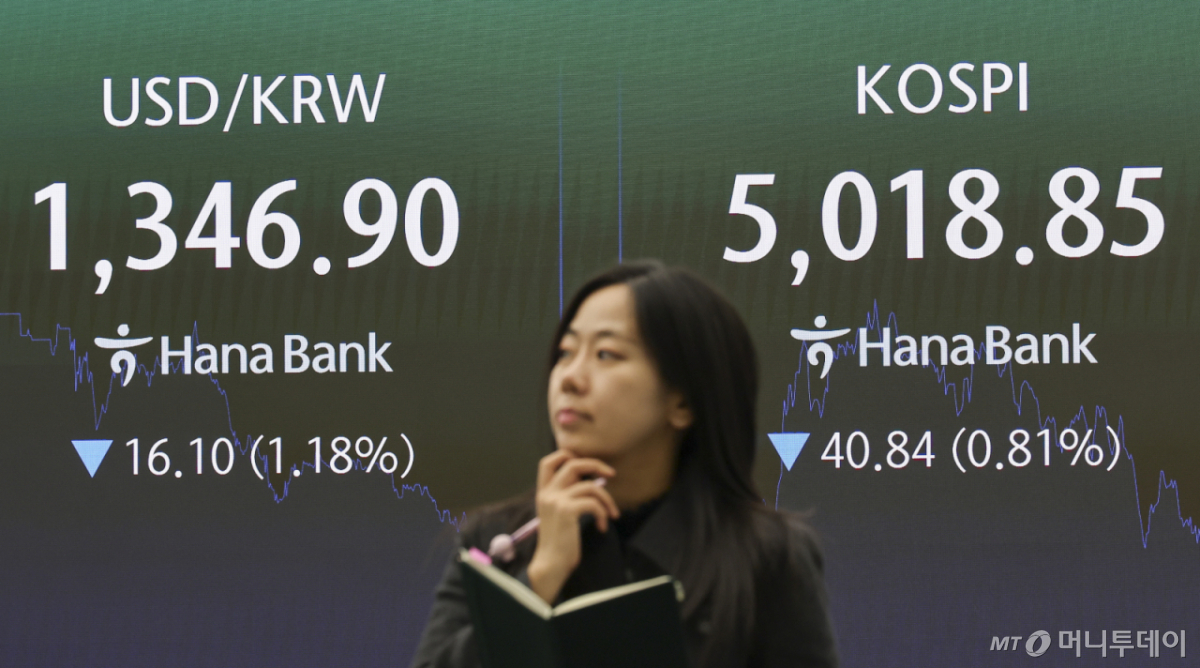
The two major indices attempted a rebound driven by inflows of bargain hunting, but they gave back their gains in the latter half of the session and closed lower together. Amidst China’s PPI (producer price index) recording its highest rate of increase in over four years, the United States is also set to release its inflation data. Adding to this, an affair scandal involving NVIDIA CEO Jensen Huang has emerged, prolonging market uncertainty.
On the 9th, the KOSPI closed at 5,018.85, down 40.84 points (0.81%) from the previous trading session. The index opened lower and slipped to 4,990.66 in early trading before reversing into positive territory to reach 5,172.94, only to turn downward again in the afternoon.
Institutional investors made net purchases of 720.3 billion won, while retail and foreign investors made net sales of 488.6 billion won and 692.5 billion won, respectively. Among institutional investors, financial investment firms, where ETF (exchange-traded fund) trading is reflected, recorded net purchases of 1 trillion 111.2 billion won. Other corporations, which reflect corporate share buybacks, also made net purchases of 461.3 billion won, interpreted as being influenced by SK hynix’s 2 trillion won share buyback program. On this day, other corporations’ net purchases of SK hynix amounted to 413.4 billion won.
By sector, paper and wood products rose in the 2% range, while medical and precision equipment rose in the 1% range. Conversely, electricity and gas, textiles and apparel, distribution, general services, machinery and equipment, telecommunications, entertainment and culture, and construction fell in the 1% range; chemicals and metals fell in the 2% range; food and tobacco, transportation equipment and parts, transportation and warehousing, and securities fell in the 3% range.
Among top market capitalization stocks, Samsung Life Insurance rose in the 1% range, while Samsung C&T fell in the 1% range, Hyundai Motor fell in the 2% range, and Samsung Electro-Mechanics and Kia fell in the 3% range. Samsung Electronics and SK hynix closed in a narrow range near flat. Samsung Electronics at one point rose by 3.55% during the session to recover the 200,000 won level, while SK hynix rose by 5.39% to 1,193,000 won, aiming to reclaim the 1.2 million won level. However, in the final moments of trading, retail and foreign investors expanded their selling, causing the gains to be given back. Secondary battery stocks generally showed weakness, with Samsung SDI falling in the 11% range and LG Energy Solution falling in the 5% range.
The securities industry advised caution regarding the volatility of semiconductor stocks exposed to NVIDIA risks. With CEO Jensen Huang admitting on the 8th (local time) to an affair with a woman suspected of being a Chinese spy, the issue has emerged as a variable that could shake NVIDIA’s corporate governance and the broader U.S. AI market. Semiconductor stocks account for half of the KOSPI’s market capitalization and are determining the direction of the stock market.
Research analysts Im Jeong-eun and Tae Yoon-seon from KB Securities pointed out, “Until the 2028 U.S. presidential election, the Democratic Party’s AI (artificial intelligence) data center policy is likely to lean more toward conditional regulation than comprehensive construction restrictions, but the issue involving CEO Jensen Huang has expanded related uncertainties as NVIDIA’s board of directors has launched an independent investigation.”
Research analyst Im added, “With U.S. non-farm payrolls for October exceeding expectations, interest rate burdens have also expanded. Attention should be paid to major events such as the U.S. CPI (consumer price index) for October and key corporate earnings both domestically and abroad, scheduled for release on the 10th (local time).”
Chinese inflation has also emerged as a variable. China’s PPI for October, released in the afternoon on this day, rose by 5.7% year-on-year, marking its highest level in four years and four months. This is attributed to rising raw material prices due to geopolitical tensions in the Middle East and significant increases in producer prices driven by expanded investment in AI data centers.
Conversely, due to sluggish domestic demand, companies have been unable to pass on cost increases to consumers, resulting in a CPI increase of just 0.7%, down 0.2 percentage points from the previous month. Bloomberg analyzed that “with PPI rising and CPI slowing simultaneously, deflationary pressure in China is persisting.”
The KOSDAQ closed at 638.97, down 5.30 points (0.82%) from the previous trading session. On this day, the KOSDAQ opened lower by 5.45 points (0.85%) at 638.82 and at one point rebounded to 658.66, but closed lower as retail investors turned to selling in the afternoon.
In the KOSDAQ market, institutional investors made net purchases of 107.5 billion won, while retail and foreign investors made net sales of 39.6 billion won and 75.9 billion won, respectively.
By sector, non-metals rose in the 3% range, and construction rose in the 1% range. Conversely, paper and wood products, transportation and warehousing, chemicals, and pharmaceuticals fell in the 1% range, while general services and finance fell in the 4% range.
Among top market capitalization stocks, Simmtech, Jusung Engineering, and IOTECH rose in the 6% range, while HPSP and ISC rose in the 3% range. HLB fell in the 3% range, Rainbow Robotics fell in the 5% range, Robotis fell in the 7% range, and Ecopro and Ecopro BM fell in the 8% range. Alteogen plunged in the 16% range due to issues related to strengthened U.S. regulations.
In the Seoul foreign exchange market, the won/dollar exchange rate closed interbank trading at 1,347.1 won, down 9.5 won from the previous trading session.

 in STOCK
