

Exchange-traded funds (ETFs) investing in U.S. space companies are continuing to post sluggish returns. Attention is now turning to whether U.S. space ETFs can rebound following SpaceX’s large spacecraft, the Starship, successfully entering Earth orbit for the first time.
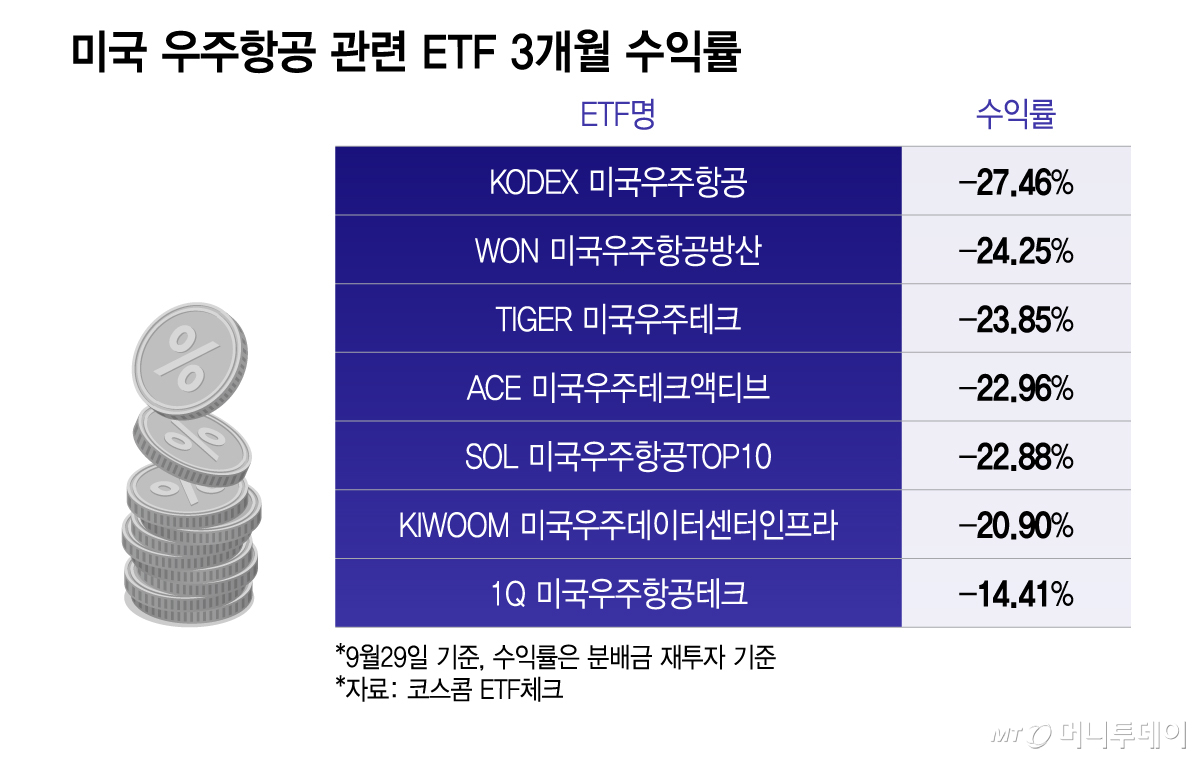
According to KOSCOM ETF Check on the 29th, the three-month return (based on reinvestment of distributions) for the 'KODEX US Aerospace' as of that day was recorded at -27.46%.
The returns for other funds are also negative, including △'WON US Aerospace Defense' (-24.25%), △'TIGER US Space Tech' (-23.85%), △'ACE US Space Tech Active' (-22.96%), △'SOL US Aerospace TOP10' (-22.88%), △'KIWOOM US Space Data Center Infrastructure' (-20.90%), and △'1Q US Aerospace Tech' (-14.41%).
Capital is also flowing out. As of the previous day, 271.8 billion won was net outflow from TIGER US Space Tech over the past three months. Outflows of 62.2 billion won, 50.8 billion won, and 47.3 billion won were recorded from KODEX US Aerospace, '1Q US Aerospace Tech,' and ACE US Space Tech Active, respectively.
The volatility in U.S. space ETFs is due to the lack of events capable of boosting stock prices since SpaceX’s listing in June. Additionally, rising interest rates have created an unfavorable environment for growth stocks. In particular, concerns have grown that while investment in next-generation launch vehicles is increasing, the timing for profitability improvements remains uncertain, leading to declines in related ETFs.
Amid this backdrop, SpaceX’s Starship successfully entered Earth orbit for the first time on the 28th (local time). Although one of the six 'Raptor' engines shut down earlier than planned during liftoff, the flight succeeded in placing 26 next-generation 'Starlink V3' satellites into orbit.
Experts in the financial investment industry analyzed that this success is significant as it demonstrates the commercialization potential of Starship. Jung Ji-su, a researcher at Meritz Securities, stated, "The fact that satellites were successfully deployed in actual orbit this time is the first case proving that Starship can function as an orbital cargo transport vehicle."
However, whether U.S. space ETFs will rebound following this success remains uncertain. This is because challenges remain to be solved, such as engine malfunctions occurring during this flight. The high-interest-rate environment also continues to be a burden.
Nevertheless, advice is emerging that U.S. space ETFs should be watched in the medium to long term, considering factors such as Starship’s commercialization potential and the growth prospects of the space industry.
Park Su-min, head of the ETF Product Strategy Team at Shinhan Asset Management, said, "The commercialization of Starship could become an important inflection point for the entire space industry," adding, "If repeated launch successes and reusability stability of Starship are proven in the future, it can develop into a momentum supporting full-scale industrial growth and stock price rebounds."
He continued, "Ultimately, Starship’s success will lower launch costs and improve access to space in the long run," noting, "Considering that new businesses and markets through space can open up on a large scale, it is necessary to continue paying attention to the space industry next year as well."

 in STOCK
