

With the initial public offering (IPO) push by SK Hynix's U.S. grandchild company, Solidigm, halted, attention is turning to the future moves of major domestic conglomerates that are considering listing their overseas subsidiaries.
It is predicted that the strategies of companies aiming to raise investment funds through overseas stock market listings and strengthen competitiveness in new business areas may also undergo changes.
On Friday, SK Hynix announced via public disclosure that it had decided to halt its review of pre-IPO fundraising and an IPO for its U.S. grandchild company, Solidigm.
SK Hynix had been considering a listing on the U.S. stock market as one of the funding options to expand Solidigm's production capacity and enhance its competitiveness. However, concerns grew that a separate listing of the subsidiary could undermine the parent company's shareholder value, leading to widespread controversy and drawing attention from the political sphere.
While SK Hynix said that it withdrew the listing decision after comprehensively considering capital market conditions, there are suggestions that the controversy over shareholder value surrounding Solidigm's listing and the financial authorities' moves to strengthen regulations on duplicate listings may have acted as a burden.
The market views this decision as likely to impact the overseas subsidiary IPO strategies of other major conglomerates. A representative company is the Hyundai Motor Group. Boston Dynamics, the U.S. robotics firm under the Hyundai Motor Group, has consistently been mentioned as a potential candidate for a NASDAQ listing.
Boston Dynamics holds its equity through HMG Global, a U.S. entity in which Hyundai Motor, Kia, and Hyundai Mobis have invested. In terms of controlling a grandchild company through an overseas intermediate entity, it shares similarities with SK Hynix's Solidigm.
A specific listing schedule for Boston Dynamics has not been confirmed. However, if the IPO process intensifies in the future, how to protect the interests of existing shareholders, including Hyundai Motor, is likely to emerge as a major issue.
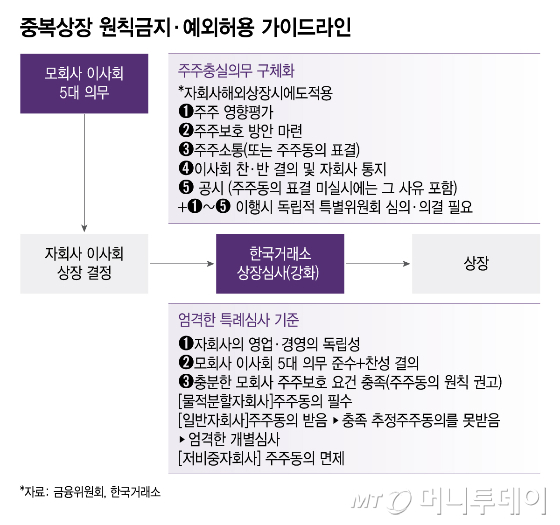
Since the government has already prepared guidelines on duplicate listings to protect the rights and interests of general shareholders, it is expected that the impact on shareholder value during the listing push will be carefully reviewed.
Other major conglomerates face similar situations. LG Electronics' U.S. robotics subsidiary, Bear Robotics, is reportedly pushing for a pre-IPO. Doosan Group's U.S. hydrogen and fuel cell subsidiary, Hyexium, and CJ Logistics' Indian logistics subsidiary, Das Logistics, are also cited as companies pursuing overseas stock market listings.
Attention is focused on how Solidigm's withdrawal of its listing will affect the future fundraising strategies of these companies.
The securities industry predicts that this incident may change the criteria for companies' decisions regarding overseas subsidiary IPOs. While overseas listings have previously attracted attention in terms of securing local investment funds and re-evaluating corporate valuation, there is now a greater need to specifically present the economic benefits that will return to the parent company's shareholders after the listing.
Moves by the political sphere and financial authorities are also variables. The issue of Solidigm's U.S. listing was addressed as a major topic during this month's National Audit by the Political Affairs Committee of the National Assembly.
At the time, both Financial Services Commission Chairman Lee Eui-won and Financial Supervisory Service Chairman Lee Chan-jin responded in the sense that Solidigm's U.S. listing would constitute a duplicate listing when questioned by National Assembly members about whether it fell under the category of duplicate listings. Interpretations also emerge that such statements from the authorities may have influenced SK Hynix's decision to withdraw its listing.
However, overseas subsidiary listings are not uniformly restricted. Judgments may vary depending on the purpose of the listing, the corporate governance structure, and the impact on the parent company's shareholder value.
Companies now face the task of finding a balance point between securing investment funds for overseas business expansion and protecting the rights and interests of existing shareholders.
Researcher Park Se-yeon of Hanwha Investment & Securities said, "While overseas listings are not subject to Korea Exchange review, the authorities maintain that they will apply duplicate listing regulations. Groups considering overseas subsidiary listings must take this into account."

 in STOCK
