

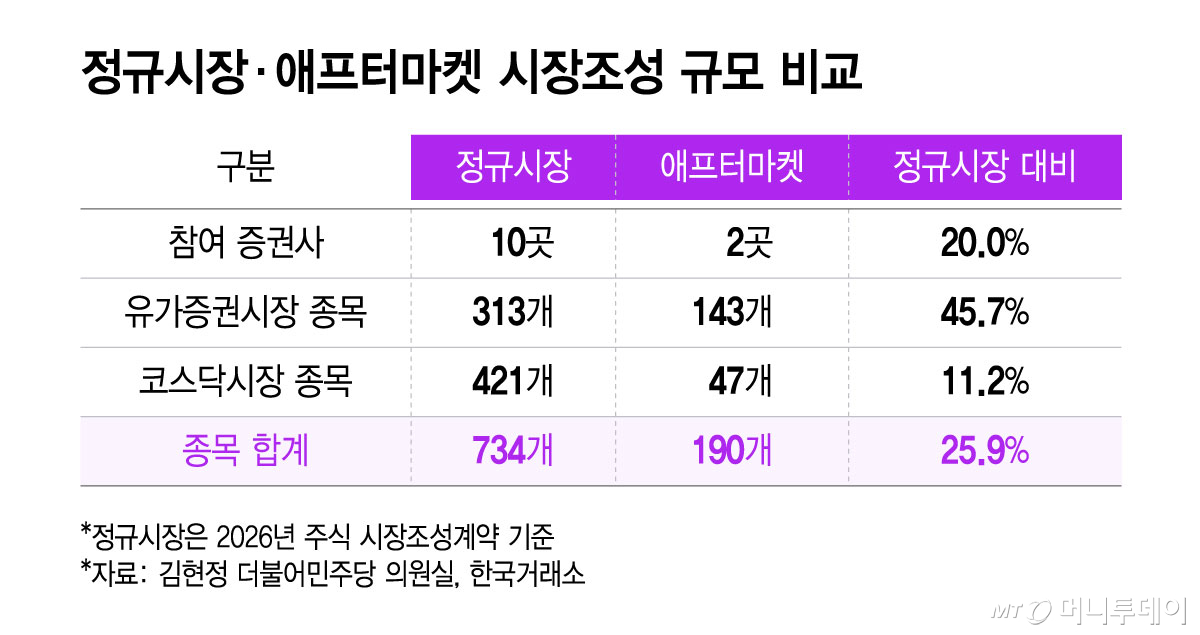
As volatility in the Korea Exchange (KRX) after-hours market has come under scrutiny, it was revealed that only two brokerages are providing liquidity to the market as market makers. Analysts note that participation is inevitably low because market makers must hedge price fluctuation risks—incurred by placing bids and offers on both sides of the order book—using instruments such as futures or exchange-traded funds (ETFs), yet adequate hedging tools are lacking in the after-hours session.
According to documents submitted by the Korea Exchange to Kim Hyeon-jung, a Democratic Party of Korea lawmaker on the Political Affairs Committee, on the 7th, only two brokerages—Meritz Securities and Daol Investment Securities—participated in after-hours market-making. Meritz Securities and Daol Investment Securities handle KOSPI, while Meritz Securities handles KOSDAQ. The number of stocks under market-making contracts is 143 for KOSPI and 47 for KOSDAQ, totaling 190 stocks.
This contrasts with the regular trading session, where 10 brokerages are responsible for market-making. The number of stocks in the after-hours market is also only one-quarter of that in the regular session. In the regular session, 10 brokerages handle market-making for a total of 734 stocks, including 313 KOSPI and 421 KOSDAQ listings.
The low participation of brokerages in after-hours market-making is due to the lack of adequate hedging tools. Market makers hedge price fluctuation risks arising from supplying bids and offers on both sides using futures or ETFs, but options for doing so are limited during after-hours trading hours.
First, ETFs and exchange-traded notes (ETNs) are excluded from trading in the after-hours market. The regular derivatives market closes at 3:45 p.m., while the night derivatives market opens at 6:00 p.m. As a result, index futures cannot be traded during the first two hours of the after-hours session. The 10 products available in the night market do not include individual stock futures. Additionally, the uptick rule (requiring sell orders to be placed at or above the previous transaction price when short selling) applies equally to market-making orders as it does to general orders.
In a situation where methods to offset risk are limited, brokerages find it difficult to readily step forward to provide liquidity by placing orders. It is also pointed out that if the structure lacking hedging tools remains unchanged, the number of participating brokerages and stocks cannot increase.
Kim (Rep.) stated, “The exchange explained that trading volume was low because it did not evaluate market-making obligations for more than two weeks after the launch of the most unstable after-hours market,” adding, “In effect, it welcomed investors while essentially turning off liquidity supply mechanisms.”
He continued, “It was foreseeable that brokerage participation would be low during hours when even hedging tools are unavailable, yet the exchange, pressured by competition with alternative trading systems, was only rushed to meet the launch date,” and added, “In addition to implementing Q4 market-making obligation evaluations without issue, it must present liquidity measures including expanded hedging options and incentives for participation.”

 in STOCK
