

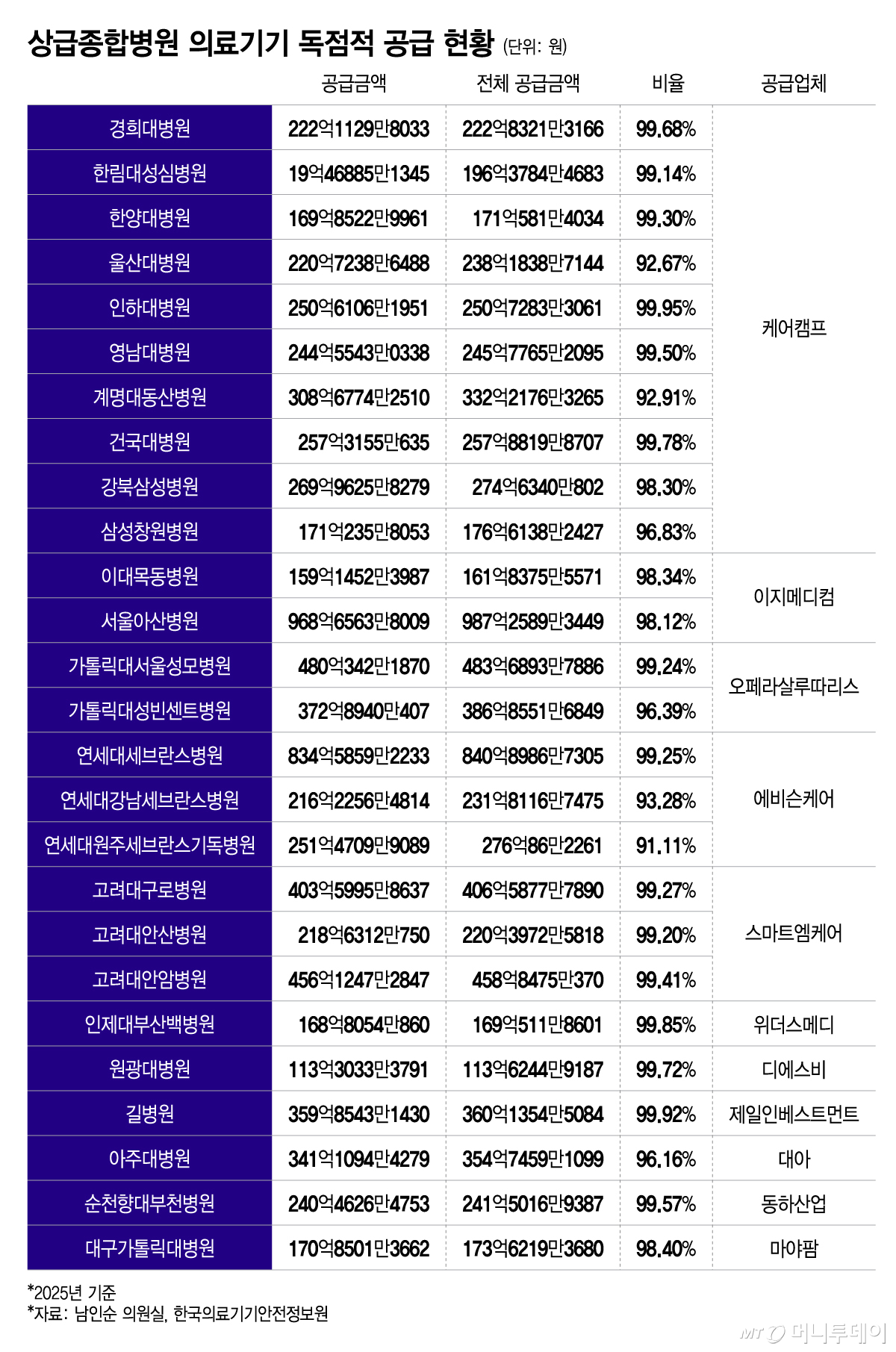
It was confirmed that 26 out of the 47th largest tertiary general hospitals in South Korea, which use the most surgical and treatment materials due to their scale, receive more than 90% of their products from a specific medical device sales company (indirect supplier, hereinafter referred to as "indirect supplier"). All of these are private university hospitals, and among them were cases where 99% of products were supplied by an indirect supplier owned by the school foundation that operates the university hospital.
According to the "Supply Status of Medical Device Sales Companies for Covered Medical Services" received from the Korea Medical Device Safety Information Service by Nam In-soon, a Democratic Party of Korea lawmaker on the National Assembly's Health and Welfare Committee, on the 7th, it was found that a significant number of indirect suppliers with special relationships to school foundations supplied medical devices to their affiliated hospitals in an overwhelming proportion last year.
Avision Care is an indirect supplier established in 2021 through full capital contribution by Yonsei University School Foundation. Last year, the company supplied Severeance Hospital with 83.5 billion won worth of medical devices, accounting for 99.25% of the total supply amount. It also supplied Gangnam Severance Hospital and Wonju Severance Christian Hospital with 21.6 billion won (93.28%) and 25.1 billion won (91.11%), respectively.
Opera Salute, in which Catholic School Foundation is the ultimate controlling shareholder, sold products worth 52.6 billion won, accounting for 99.72% of the medical device supply amount to Seoul St. Mary's Hospital in 2023. In 2024, it recorded 69.5 billion won (99.43%), and in 2025, it supplied 48 billion won (99.24%). St. Vincent Hospital also accounted for 96% of the total supply amount with 37.3 billion won.
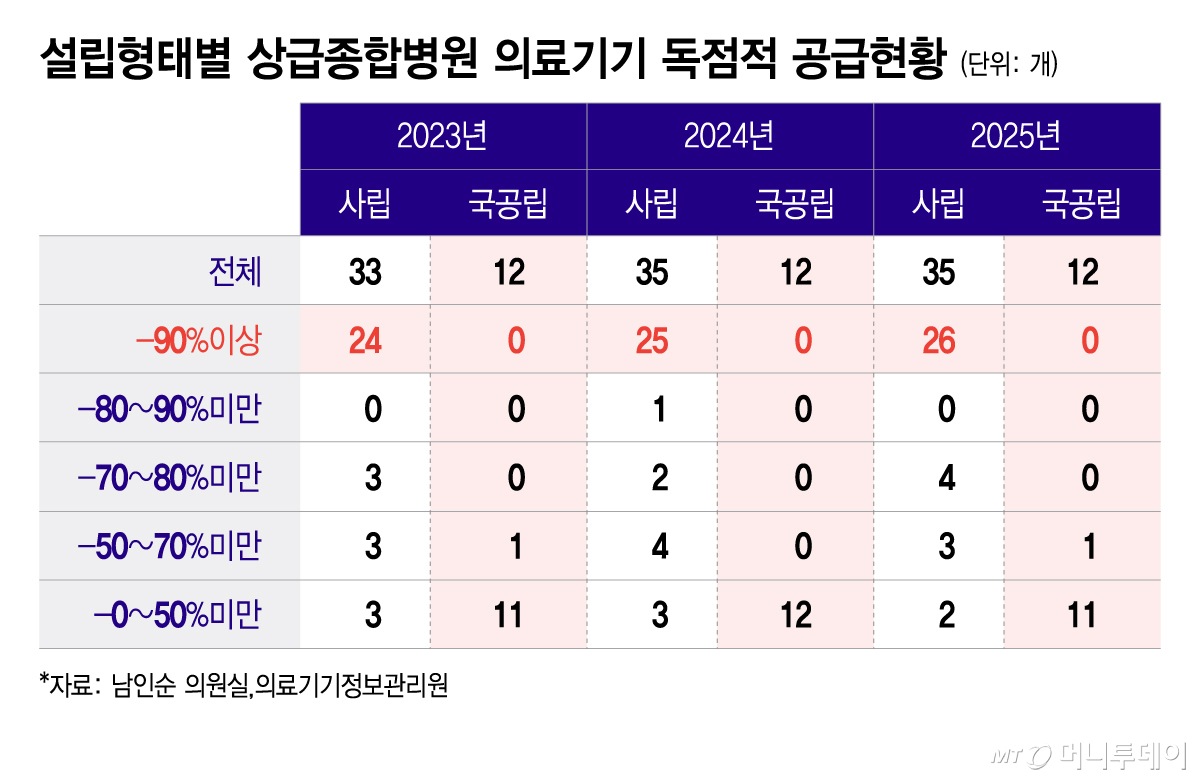
Suncheon Hyangdae Bucheon Hospital also had a high dependence on an indirectly related supplier. Dongha Industrial, in which Dong-eun School Foundation holds 100% equity, supplied Suncheon Hyangdae Bucheon Hospital with products worth 24 billion won last year, accounting for 99.57% of the total amount. Daeha, owned 100% by Daewoo School Foundation, supplied 96.16% (34.1 billion won) of the total medical device amount for Ajou University Hospital, an affiliated hospital of the school foundation. Gil Hospital (Jeil Investment) and Inje University Busan Paik Hospital (Withers Medi), in which school foundations (foundations) hold direct or indirect equity stakes, also conducted transactions with indirect suppliers worth 36 billion won (99.92%) and 16.9 billion won (99.85%), respectively.
Indirect suppliers with special legal relationships donated a significant portion of their operating profit to school foundations. As of last year, Avision Care made a donation of 21.9 billion won to Yonsei University School Foundation. Opera Salute donated 9 billion won to Catholic School Foundation, while Dong-eun School Foundation and Daeha also donated 5 billion won and 8.7 billion won to their respective school foundations.
Yonsei University School Foundation explained regarding its transactions with Avision Care that they were "the result of concluding contracts through multi-faceted evaluation based on bidding in compliance with relevant regulations, followed by delivery." It stated that the donations were not payments made under pressure from the school or as consideration for medical device sales, but rather normal and reasonable management procedures where a subsidiary returns profits to its parent foundation in accordance with laws such as the Special Tax Restriction Act. It also revealed that, due to amendments to the Medical Device Act limiting the equity stake of indirect suppliers established by related parties to less than 50%, 51% of Avision Care's shares were sold to independent institutional investor E-Medicom in February.
Nam In-sun (Rep.) pointed out, "The presence of indirect suppliers between hospitals and supply companies for medical devices such as medical consumables and treatment materials is fostering various unreasonable practices, including transactions without contracts, delays in payment settlement, demands for excessive discount rates, and the shifting of responsibility for losses and missing items to Yangsan." They added, "While it cannot be definitively concluded that there were unfair price transactions solely based on the fact that a specific indirect supplier effectively monopolized supply to affiliated hospitals, given that medical device purchases worth hundreds of billions of won are concentrated among indirectly related suppliers, the actual purchase prices, hospital supply prices, and indirect supplier margins must be examined together."
The Ministry of Health and Welfare stated, "We are promoting a survey on the status of special relationships of indirect suppliers and unfair practices," adding, "However, in cases where there is no violation under the current Medical Device Act, separate measures are difficult, so institutional improvements and sanction regulations must be established in the future."
※ Indirect Supplier (Indirect Supplier) = A company that receives medical devices from medical device suppliers and delivers them to medical institutional investors. Suppliers can only conduct transactions through indirect suppliers designated by hospitals. The definition is not explicitly stated in the Medical Device Act, and they are often registered as medical device sales companies.

 in THEBIO

