

As the shortening of the stock settlement cycle is set for next year, sale proceeds collateral loans at major securities firms have surged 293% in one year. New loans issued by the top 10 securities firms reached 67 trillion won in a single month. Sale proceeds collateral loans are ultra-short-term loans where securities firms lend money using the sale proceeds as collateral until the funds from selling stocks arrive (two business days).
Since limits vary by securities firm, there are calls to re-examine the limit and interest rate system for sale proceeds collateral loans, given that interest rates have been sharply lowered in the second half. It is also criticized that although securities firms voluntarily lowered loan interest rates in the second half, new loan amounts decreased, limiting the perceived effect for customers.
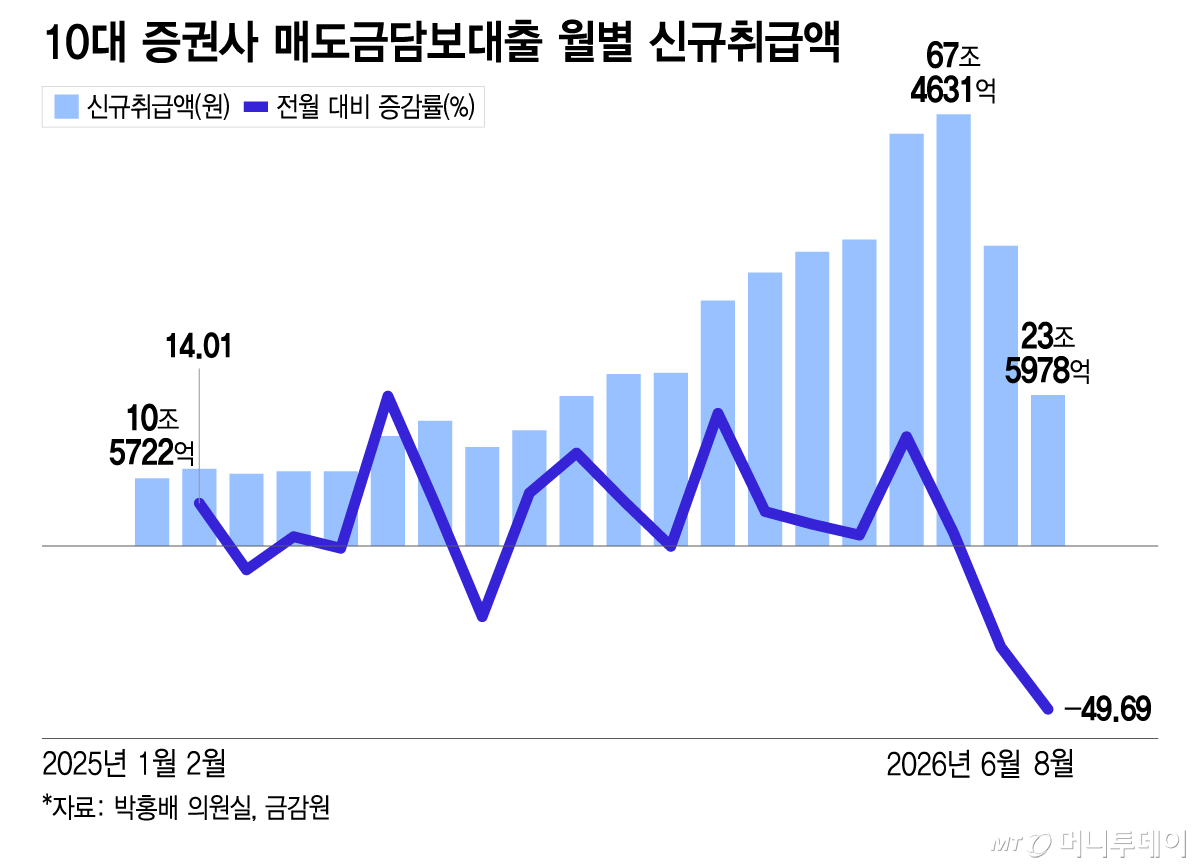
According to documents submitted on the 12th by the Financial Supervisory Service to the office of Democratic Party of Korea lawmaker Park Hong-bae, a member of the National Assembly's Political Affairs Committee, sale proceeds collateral loans newly handled by the top 10 securities firms in June this year were approximately 67.4631 trillion won, surging by 50.2803 trillion won (293%) compared to a year ago (17.1828 trillion won). The new handling amount of sale proceeds collateral loans, which remained in the 10th trillion won range on average per month in the first half of last year, swelled to the 23rd trillion won range in October last year, riding on the rise in the KOSPI index.
In particular, sale proceeds collateral loans rose vertically this year. The new handling amount in January was 38.3544 trillion won, a 41.80% increase from the previous month, and it surged by 34.57% between April (47.8653 trillion won) and May (64.4104 trillion won). In the second half, due to complex influences such as the decline in the KOSPI index and weakened investor sentiment, sale proceeds collateral loans decreased by 30% in July and were halved from the previous month in August.
Sale proceeds collateral loans are a type of loan that arises under the current stock settlement cycle (T+2) system, and President Lee Jae-myung also pointed out the issue. The surge in sale proceeds collateral loans means that there was significant demand for investors to quickly cash out their stock sale proceeds. These funds are often used as investment capital for buying other stocks or for living expenses.
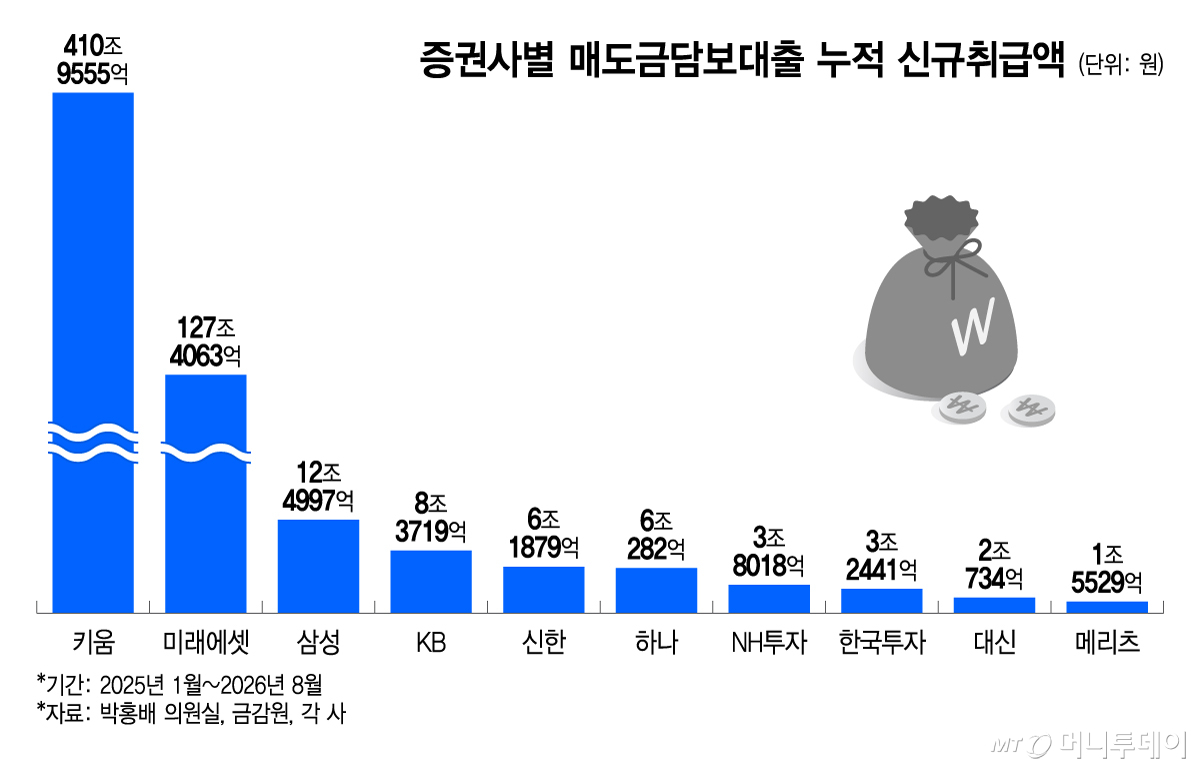
Amid the surge in sale proceeds collateral loans, management of loan interest rates and limits by securities firms varied widely. Kiwoom Securities, which had the highest new handling amount of approximately 411 trillion won from January last year to August this year, allows sale proceeds collateral loans up to 7 billion won per account. Kiwoom Securities raised its loan limit, previously 3 billion won, starting in June this year. Mirae Asset Securities, which newly handled approximately 127 trillion won in sale proceeds collateral loans over one year and eight months, has a maximum limit of 3 billion won, a difference of 4 billion won from Kiwoom Securities.
While some securities firms do not set a maximum limit, others restrict it to 500 million won, showing significant differences between companies. KB Securities sets a maximum limit of 3 billion won per account, and Hana Securities sets one at 2 billion won. NH Investment & Securities sets the customer limit at 500 million won, which is only 7% of Kiwoom Securities' maximum limit. At Korea Investment & Securities, loans can be taken up to 98% of the sale proceeds settled on the previous day and current day without a separate maximum limit.
Loan interest rates also vary significantly by securities firm, and as they have been sharply lowered in the second half, criticism is emerging regarding securities firms' "interest rate business." The interest rate for sale proceeds collateral loans at securities firms, which was around 7.5% to 10% annually in January this year, dropped to around 5% to 8% annually as of August, a decrease of about 2 to 3 percentage points. This is due to the influence of each firm voluntarily lowering sale proceeds collateral loan interest rates in the second half. Mirae Asset Securities lowered its rate from 9% to 7.95% annually last July and decided to apply an additional 2 percentage point reduction to 5.95% for usage amounts of 3 billion won or less starting November 2.
The issue is that sale proceeds collateral loans have plummeted since the second half when securities firms lowered interest rates, and a balloon effect may occur. The new handling amount of sale proceeds collateral loans in August this year was approximately 23.5978 trillion won, a 50% sharp decrease in one month, making the perceived effect of interest rate cuts limited. There are also concerns about a balloon effect, such as investors moving to securities firms offering lower rates due to voluntary interest rate cut competition or seeking places with higher limits.
Doubts are also being raised about the interest rate calculation system for sale proceeds collateral loans. It is pointed out that if a 5% range could have been applied from the start, why high interest rates in the 9th% range were charged by adding a margin to the base rate until now.
President Lee also directly expressed concern about sale proceeds collateral loans and has called for shortening the settlement cycle. At a cabinet meeting on June 23, President Lee stated, "From the perspective of stock market participants, it may be hard to accept that it takes two days to get back the money from selling stocks in these times," adding, "It seems the relevant securities firms are getting quite a benefit by using this fund in the meantime. There is an aspect where this is not quite fair, so I hope you will shorten (the implementation period)."
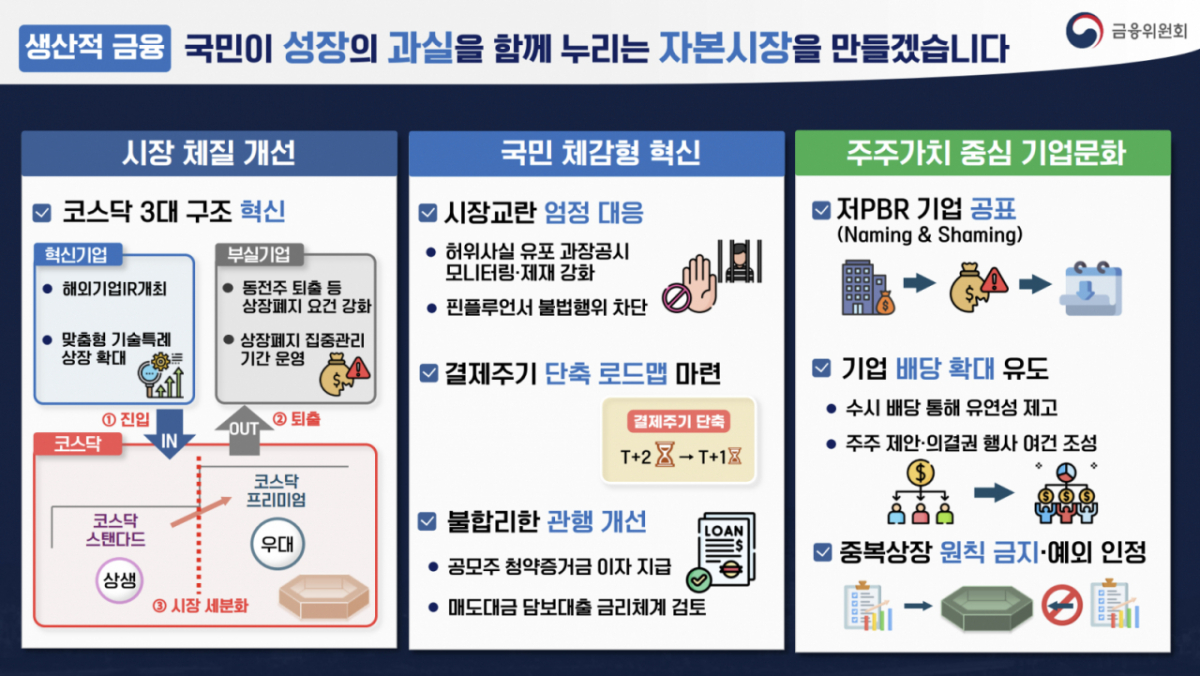
The financial authorities are operating a task force (TF) with Korea Exchange, the Korea Financial Investment Association, and others, aiming to release a roadmap for shortening the settlement cycle this month. The Financial Services Commission stated in its second-half business report that it would check whether there are any issues with the interest rate calculation system for sale proceeds collateral loans.
Suggestions have also emerged from the National Assembly that the status of investor protection related to sale proceeds collateral loans should be reviewed. Park (Rep.) emphasized, "Amid the surge in sale proceeds collateral loans, interest rates and loan limits vary by securities firm, and there are concerns about the burden on users due to delinquency or non-repayment," adding, "The financial authorities should check the transparency of interest rate calculation and the status of investor protection, and also promote the shortening of the T+1 settlement cycle without any problems."

 in STOCK


