

The gold price, which had been rising after hitting a low, is sliding again. International gold futures prices have fallen 21% from their peak and dropped 4% over the past month. The returns of related exchange-traded funds (ETFs) are also in negative territory. However, as forecasts suggest that gold prices will rise again within the year, funds continue to flow steadily into ETFs.
Domestic gold spot prices show a similar trend. According to Korea Exchange, the closing price for gold spot on this day was 179,970 won per gram, down 5.86% from one month ago and down 33.3% from the peak of 269,810 won recorded on January 29.
The decline in gold prices is attributed to persistently high interest rates and forecasts that the Federal Reserve System (Federal Reserve/Fed) will raise its base rate once more within the year. Gold, a representative safe-haven asset and inflation hedge, tends to perform well during rate-cutting cycles and weakly during rate-hiking cycles.
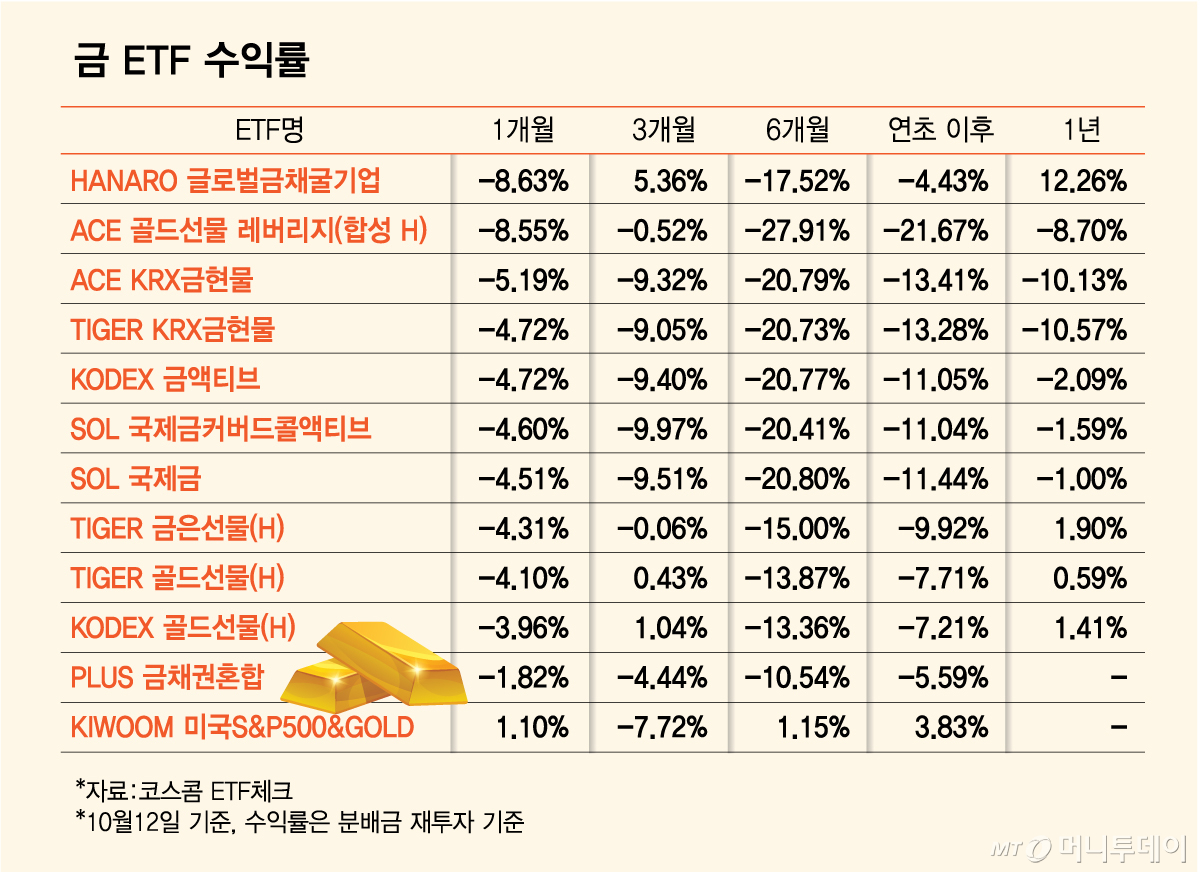
Returns on gold-related ETFs are also in a negative streak. According to KOSCOM ETF Check, as of this day, the one-month return (based on reinvestment of distributions) for "HANARO Global Gold Mining Companies" was -8.63%.
The returns for ACE Gold Futures Leveraged (Synthetic H) (-8.55%), ACE KRX Gold Spot (-5.19%), TIGER KRX Gold Spot (-4.72%), and KODEX Gold ETN (-4.72%) are also negative.
Despite the poor performance of gold ETF returns, funds are flowing into them. As of the 8th, a net inflow of 10.3 billion won was recorded in ACE KRX Gold Spot over the past month. Funds also poured into TIGER KRX Gold Spot (inflow of 3.7 billion won), KODEX Gold ETN (1.6 billion won), TIGER Gold Futures (H) (3.8 billion won), and SOL International Gold (2.4 billion won).
The inflow of funds is driven by the prevailing view that gold prices will rise again. Experts in the financial investment industry believe, first and foremost, that gold prices have secured downside rigidity at the $4,000-per-ounce level.
Hwang Byung-jin, a researcher at NH Investment & Securities, stated, "The massive fiscal deficit of the U.S. federal government, policy uncertainty, and the trend of global central banks expanding their gold reserves support the downside rigidity of gold prices," adding, "We expect low-price buying to flow in every time there is an inevitable price correction."
The net purchase volume of gold by central banks increased from 57 tons in the first quarter to 289 tons in the second quarter. The Bank of Korea also joined the ranks of central bank gold buyers, announcing its intention to purchase export-oriented spot gold produced by refiners using Busan materials for the first time in 13 years.
The interest rate futures market has already priced in an additional 3.4 rate hikes by the end of next year. While concerns over tightening may cause gold prices to stall, analysts note that there is no alternative risk-avoidance means other than gold.
Baek Jae-seung, a researcher at Samsung Securities, predicted, "Generally, gold prices tend to rebound three months after Federal Reserve rate hikes," adding, "If the Iran war also ends, the decline in energy prices will be reflected in price indicators, and gold prices will likely trace a gradual rebound trajectory from year-end."
Securities firms differ on the timing of the rebound. NH Investment & Securities forecasts that gold futures prices will recover to the $5,000 line within the year. Samsung Securities expects gold prices to move between $3,900 and $4,600 in the fourth quarter of this year and to rise to $4,900 within the next 12 months.

 in STOCK
