

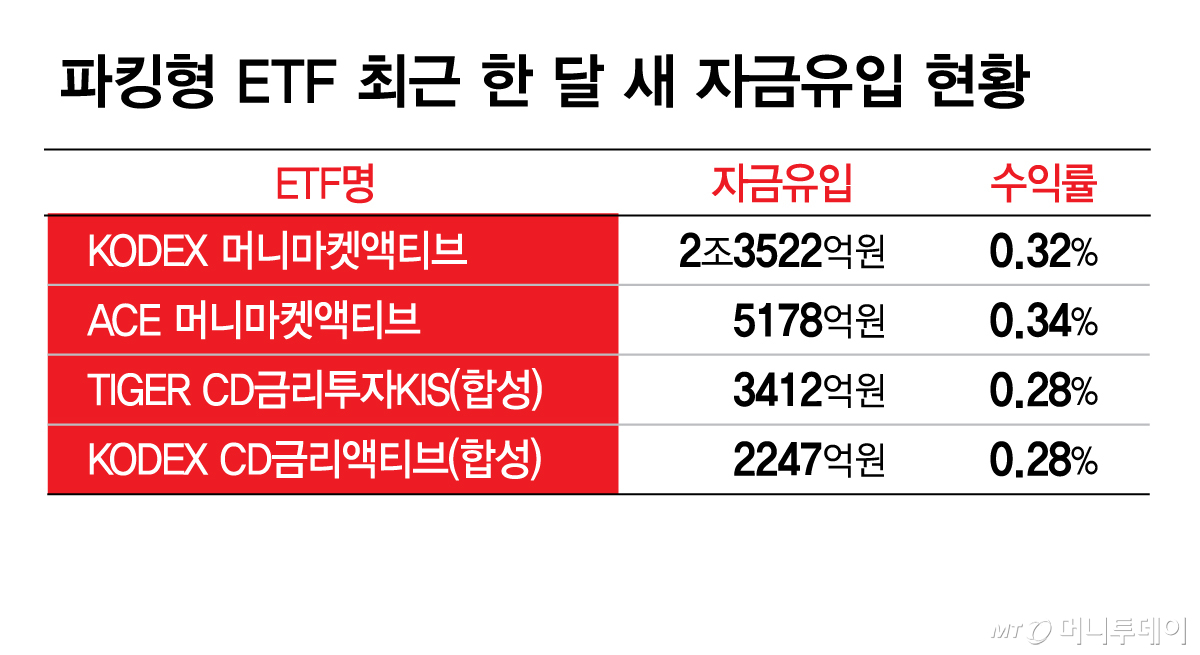
As the KOSPI index has remained confined to a box range between 6,000 and 7,000 for two consecutive months, investors fatigued by the domestic stock market are flocking to parking-type ETFs (Exchange-Traded Funds) and short-term bond ETFs. Over the past month, more than 4 trillion won has flowed into parking-type and short-term bond ETFs, while the balance of MMFs (Money Market Funds) has once again surpassed 260 trillion won. Although the earnings season has begun with Samsung Electronics’ preliminary earnings release, conservative strategies are also considered valid as foreign selling continues.
According to financial investment industry sources on the 12th, approximately 3.6 trillion won was net inflow into interest-rate-linked ETFs, such as money market ETFs and CD (Certificate of Deposit) yield ETFs, over the past month. The largest inflow of 2.3522 trillion won went to KODEX Money Market Active, followed by 517.8 billion won into ACE Money Market Active. Additionally, 341.2 billion won and 224.7 billion won flowed into TIGER CD Yield Investment KIS (Synthetic) and KODEX CD Yield Active (Synthetic), respectively.
Funds are also pouring into short-term bond ETFs that invest in bonds with maturities of less than one year. Over the past month, approximately 650 billion won was net inflow into short-term bond ETFs, including 377.4 billion won into KODEX Short-Term Bonds, 91.4 billion won into KODEX Short-Term Bonds PLUS, and 84.3 billion won into TIGER US Dollar Short-Term Bond Active.
Demand has increased for placing idle investment funds in these products, which offer low risk of loss, interest income, and high liquidity, as the domestic stock market has remained sluggish for two months. Park Woo-yeol, a researcher at Shinhan Investment Corp, explained, “Money market ETFs and short-term bonds have frequently appeared in the top ranks of fund inflows over the past month,” adding, “Doubts about the market’s upward trend have led to increased trading in inverse ETFs, while investors who have lost direction are parking their funds.”
During this period, the KOSPI index repeatedly failed to settle above the 7,000 mark, forming a box range in the high 6,000s. It briefly recovered the 7,000 level at the beginning of this month but has continued to weaken since then. On the 12th, it closed down 3.65% at 6,384.24, marking a fourth consecutive trading day of decline. The domestic stock market is under pressure as US Treasury yields surge, with the 30th-year US Treasury yield exceeding 5.7% intraday to record its highest level since 2002, and geopolitical risks remain persistent.
In particular, despite Samsung Electronics reporting its highest-ever earnings, foreign selling continues, preventing the index from escaping its downward trend. During this period, foreigners made net sales of 26 trillion won in the domestic stock market. It is pointed out that a change in foreign supply and demand is necessary for the stock market to rebound. Kim Du-yeon, a researcher at Hana Securities, stated, “(Samsung Electronics’) record earnings could not overcome the selling pressure from foreigners,” adding, “For improved earnings to translate into an index rise, supporting buying power is needed, which requires the easing of foreign selling pressure.”

 in STOCK
