

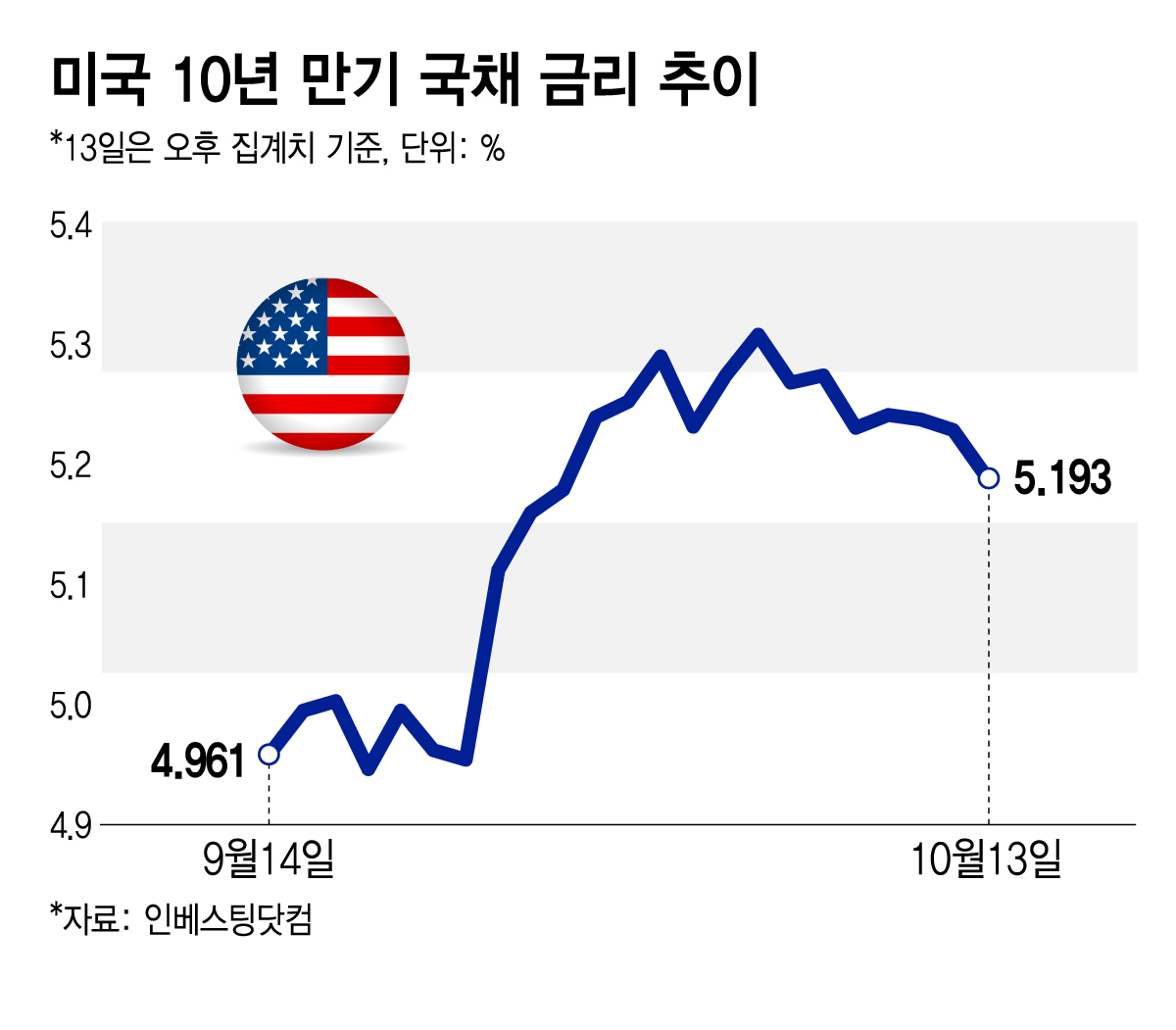
With the upward trend in U.S. and domestic government bond yields easing, attention is turning to whether investment funds will return to the stock market. Following the Hangul Day holiday, domestic interest rates fell for a second consecutive day, somewhat alleviating the high-interest-rate burden that had been weighing on the stock market. However, falling rates indicate a resurgence in demand from bond investors expecting price appreciation, suggesting that the stock and bond markets are likely to compete for investment funds.
At 10:00 a.m. on the 13th, the yield on 10-year government bonds stood at 4.245%, down 6.1bp (1bp = 0.01 percentage points) from the previous day. It had fallen by 15.0bp over two trading days from 4.395% on the 8th. The yield on 3-year government bonds was 3.875%, down 4.6bp. Compared with 3.983% on the 8th, it had declined by 10.8bp over two trading days.
The decline in government bond yields is a phenomenon occurring as U.S. long-term rates have come off recent highs. According to Investing.com data, the yield on 10-year U.S. Treasuries fell by 11.8bp from 5.311% on the 5th to 5.193%, based on figures collected in the afternoon of the 13th. However, compared with 4.955% on the 22nd of last month, it remains at a high level.
Government bond yields serve as a benchmark for gauging the investment appeal of stocks. If investors can secure high returns from relatively safe government bonds, they demand higher returns from equities. When rates fall, the required return threshold for stocks decreases, and the valuation—calculated by discounting future corporate earnings to present value—rises.
However, the easing of interest rate burdens has not immediately translated into a recovery in stock buying pressure. The KOSPI index closed at 6,384.24 on the previous day, down 241.69 points (3.65%) from the prior trading session. On the 13th, it fell an additional 6% intraday, triggering a sell-side sidecar (futures market circuit breaker) (temporary suspension of program trading effectiveness) for the first time in about two months.
![[Suwon = NEWSIS] Reporter Hwang Jun-sun = Visitors tour the Samsung Electronics booth at the "2026 Next-Generation Semiconductor Packaging Industry Exhibition" held on the 26th at the Suwon Convention Center in Suwon, Gyeonggi Province. August 26, 2026. hwang@newsis.com / Photo by Hwang Jun-sun](https://thumb.mt.co.kr/cdn-cgi/image/f=avif/21/2026/10/2026101313561723534_2.jpg)
In effect, bond demand driven by expectations of price appreciation is outpacing demand in the stock market. Yuanta Securities cited the calming of the U.S. long-term rate uptrend and foreign net purchases of government bond futures as factors behind the recent drop in domestic rates. The decline in yields widened as foreigners made large-scale net purchases of 3-year and 10-year government bond futures. Foreign net buying of 3-year government bond futures was the second largest on record.
Corporate funding costs are also affected. At 10:00 a.m. on the 13th, the yield on AA-rated 3-year corporate bonds fell by 2.9bp to 4.573%, from 4.602% the previous day. If new issuance and refinancing rates decline, corporate interest burdens may decrease.
In the stock market, the key question is whether corporate earnings outlooks can reverse investor sentiment. Samsung Electronics announced on the 8th that its preliminary operating profit for the third quarter was 107.4 trillion won, up 782.5% year-on-year, but its share price trended lower. Analysts assess that concerns over the profitability of global artificial intelligence (AI) infrastructure investment and theories that AI has reached a peak are acting as selling pressure on semiconductor stocks, which form the core axis of domestic and international stock markets.
The future direction of interest rates is also cited as a variable that will affect the overall market. Shin Young Securities analyzed that U.S. Treasury yields have approached their theoretical ceiling, while in Korea, reduced government bond issuance due to strong tax revenue and exchange rate stability are supporting supply and demand in the bond market. However, securities industry observers predict that the Bank of Korea will raise its base rate again in November and make a final hike in February or April 2027, lifting it to 3.50%.
Kim Ji-na, a researcher at Eugene Investment & Securities, said, "U.S. interest rates, which had been on a high-flying trajectory, are showing signs of slowing." She added, "There are no special (price) bullish factors, but this is because there is a perception that most exposed bearish factors have already been priced in, and at current levels, it is historically attractive."
Researcher Kim stated, "Nevertheless, uncertainty factors remain rather than a trend toward sustained rate declines, so we maintain our risk (danger) management outlook while paying attention to weekly volatility," adding that she holds a similar view on domestic bonds.

 in STOCK

