

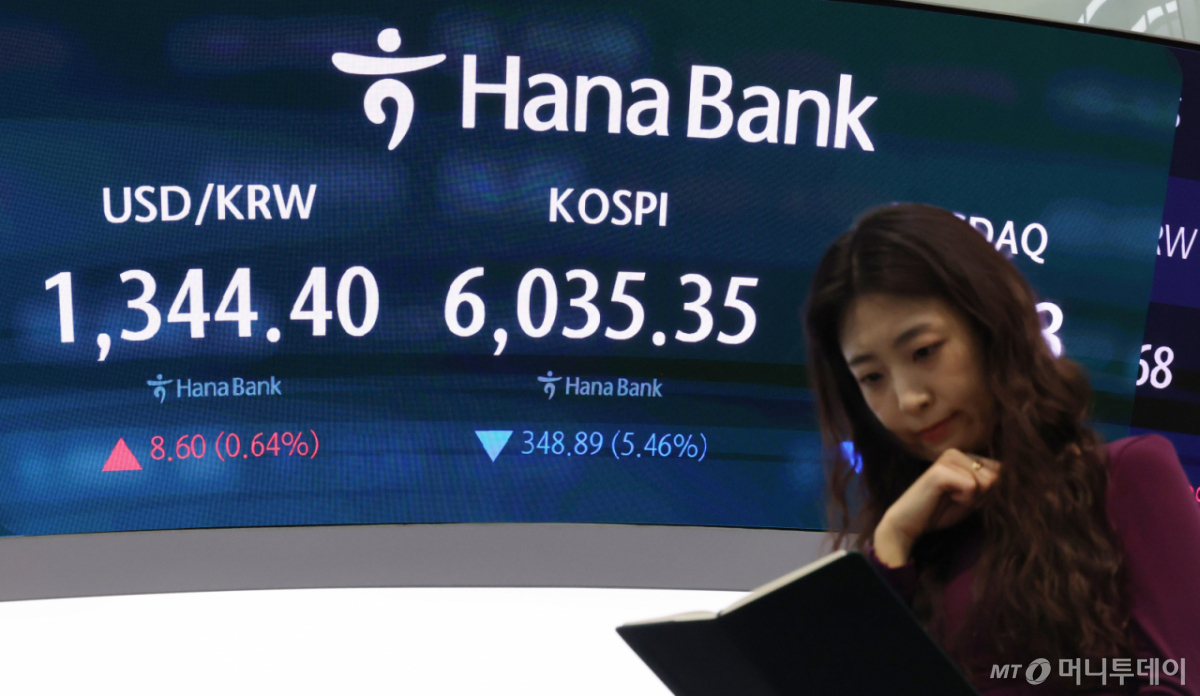
The sidecar (futures market circuit breaker), which had remained dormant for nearly two months, was triggered again. This followed a significant shake-up in the KOSPI, which had been moving within a box range amid reduced volatility, due to reports of semiconductor supply from China, causing it to fall below the 6,000 mark. The VKOSPI (KOSPI 200 Volatility Index) also spiked.
According to the Korea Exchange's disclosure system (KIND) on the 13th, a sell-side sidecar (futures market circuit breaker) (temporary suspension of the validity of program trading sell orders) was triggered in the KOSPI market on this day. This marks the 50th KOSPI sidecar (futures market circuit breaker) and the 26th sell-side sidecar (futures market circuit breaker) of the year. It is the first time a KOSPI sidecar (futures market circuit breaker) has been triggered in 34 trading days since August 20.
The sidecar (futures market circuit breaker) is a market stabilization mechanism that suspends the validity of program trading orders for five minutes. The KOSPI sidecar (futures market circuit breaker) is triggered when the price of KOSPI 200 futures rises or falls by more than 5% compared to the previous day's closing price for at least one minute. In the KOSDAQ market, it is triggered when the price of KOSDAQ150 futures rises or falls by more than 6% compared to the previous day's closing price for at least one minute.
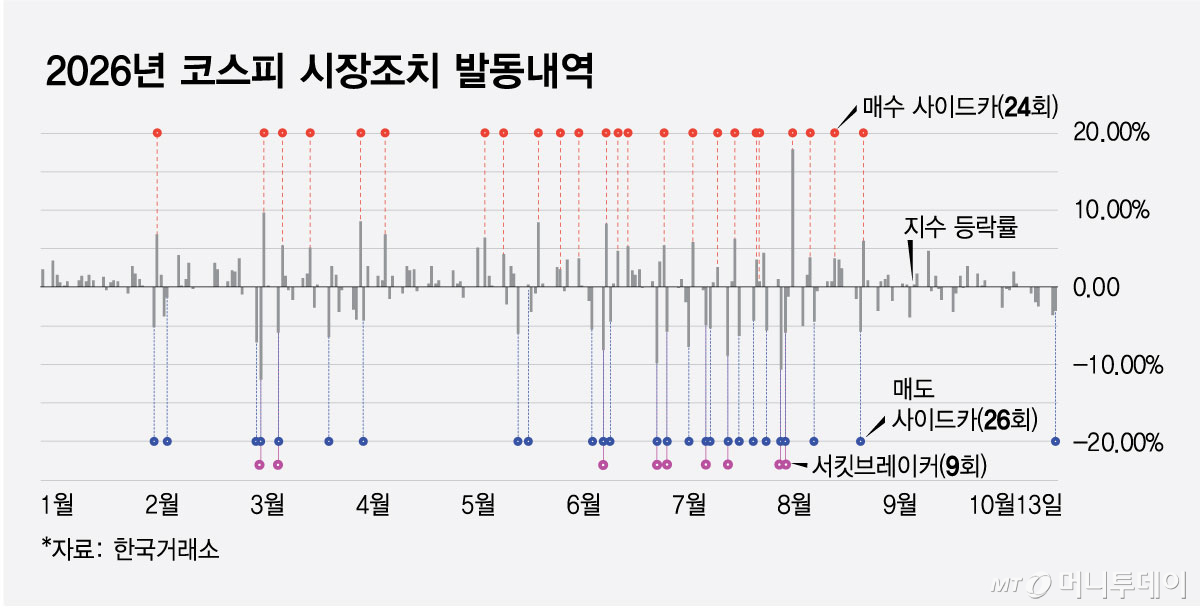
Until last August, the domestic stock market faced a sidecar (futures market circuit breaker) almost every other day. After the first sidecar (futures market circuit breaker) was triggered in the KOSDAQ market on February 2 and in the KOSPI market on the 3rd of the same month, there were no days without warning lights in the domestic stock market. Geopolitical crises intensified due to the U.S.-Iran war, and repeated sharp rises and falls amid the semiconductor rally led to a phenomenon where buy-side and sell-side sidecars (futures market circuit breakers) were triggered alternately. The circuit breaker was also triggered nine times.
Subsequently, the stock market regained stability as Situations Awareness Capital, a major U.S. hedge fund that had shaken semiconductor supply and demand through massive leveraged investments, was liquidated, and large-cap semiconductor stocks initiated share buybacks. With the KOSPI on August 20 and the KOSDAQ on August 21 being the last instances, the sidecar (futures market circuit breaker) disappeared from the domestic stock market.
However, when China's CXMT (Changxin Memory Technologies) unveiled next-generation DRAM technology, Samsung Electronics and SK Hynix plunged. The KOSPI fell by more than 6%, dropping below the 6,000 mark for the first time in over two months and breaking below the 200th-day moving average line. Samsung Electronics also fell by more than 8% on this day, while SK Hynix dropped by more than 10%.
The VKOSPI also surged. The VKOSPI, which was 37.94 in the previous trading session, recorded 49.28 as of 2:03 p.m. on this day, up 20.99%. It briefly spiked to 51.57. This level is comparable to that seen in late August, when the sidecar (futures market circuit breaker) was last triggered. Typically, a VKOSPI above 40 is considered an overheated zone.
The securities industry expects that investors will have to endure a volatile market for the time being. Han Ji-young, a researcher at Kiwoom Securities, interpreted the situation by stating, "Investor sentiment has become extremely fragile and trading volume has dried up, making price resistance against selling pressure appear weak."
She added, "Technically, we have entered an oversold phase on the RSI (Relative Strength Index) that was not reached even during the crash in July, and the decline is excessive enough to break below the 200th-day line," analyzing that "a reversal of sentiment can be sought through the October earnings season, including the release of U.S. CPI (consumer price index)."
The RSI is an indicator that shows the strength of buying and selling pressure by comparing recent stock price gains and losses. A drop below 30 indicates an oversold zone, while a rise above 70 indicates an overbought zone. According to Investing.com, the KOSPI RSI fell to 23.685, entering the oversold zone.
Kim Dae-jun, a researcher at Korea Investment & Securities, predicted, "Even without valuation burdens, the recovery of investor sentiment and supply and demand is delayed, so a rapid rebound will be limited." He added, "A sideways market will continue until the confirmed earnings releases of SK Hynix and Samsung Electronics scheduled for the 27th and 29th, respectively, and semiconductors need to weather short-term corrections."

 in STOCK

