

Domestic stock markets faced 'Black Tuesday' amid fierce selling by foreign investors. Despite expectations for earnings growth at major companies such as Samsung Electronics and SK Hynix, the outflow of foreign capital continues, amplifying market instability. Experts cite confidence in artificial intelligence (AI) demand and the mitigation of geopolitical risks as key conditions for a shift in foreign supply and demand.
According to the Korea Exchange on the 13th, the KOSPI fell by more than 7% during trading hours compared to the previous close. The sell sidecar (futures market circuit breaker), which temporarily suspends the validity of program trading sell orders, was also triggered for the first time in about two months.
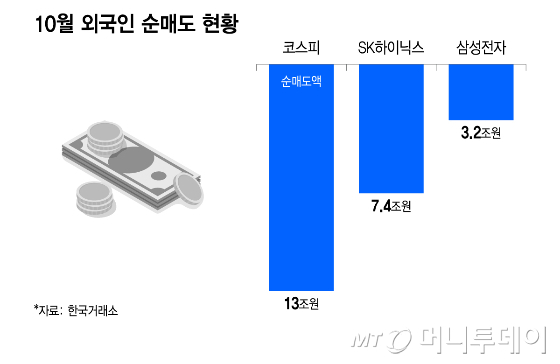
The KOSPI had surpassed the 7,000 mark again on a closing price basis at 7,037.4 on the 2nd of this month, but it plunged, losing even the 6,000 line in just over ten days. The contraction in investor sentiment among foreign investors, who have made net sales of approximately 1.3 trillion won so far this month, is identified as a major cause of the sharp decline.
Corporate earnings are showing strong performance. In its preliminary third-quarter earnings released on the 8th, Samsung Electronics recorded quarterly operating profit of 107 trillion won, an all-time high. Exports from the 1st to the 10th of this month also doubled year-on-year to $26.1 billion. However, analysis suggests that doubts about the sustainability of AI and semiconductor demand are hindering a recovery in investor sentiment.
Lee Kyung-min, Head of the FICC Division at Daishin Securities, said, "The end of net buying by other entities for Samsung Electronics has weakened the buyer base capable of absorbing foreign selling volume, which is also lowering downside support for the index."
Geopolitical tensions originating from the Middle East are also a burden. This is because if rising energy prices, such as international oil prices, due to concerns over conflict escalation persist in the long term, inflationary pressure could intensify again.
The securities industry believes that confidence in the medium- and long-term growth potential of the semiconductor industry is necessary for foreign investors to return. Whether U.S. big tech companies will continue their AI infrastructure investments and the profitability relative to investment are key variables.
Kim Jae-seung, a researcher at Hyundai Motor Securities, said, "The reason stock prices are not reacting despite high profit growth at the top two domestic semiconductor firms is that investors have doubts about future profits after 2028, rather than current ones," adding, "Domestic semiconductors can only receive upward momentum if confidence in 2028 forecasts increases."
The market is watching what happens after November. Since the initial public offering (IPO) of AI model developer Anthropic is scheduled for mid-next month, there are first and foremost discussions about the possibility that investor funds that had withdrawn will return after the listing. Expectations also arise that foreign supply and demand could shift if U.S. big tech companies' third-quarter earnings reports conclude around the same time and the results of AI investments are confirmed.
The calming of global risks is also cited as an essential condition for the return of foreign investors. Kim Du-yeon, a researcher at Hana Securities, said, "We maintain our outlook for an upward trend in the Korean stock market," adding, "The easing of inflation and interest rate burdens due to the Russia-Ukraine energy ceasefire, along with manufacturing recovery and won stability, is key to leading to sustained net spot buying."
Experts advise responding selectively while monitoring foreign supply and demand and changes in corporate earnings estimates for the time being. The strategy involves maintaining core semiconductor stocks while broadening the investment scope to AI infrastructure-related sectors.
Lee Jae-won, a researcher at Yuanta Securities, said, "A strategy of broadening the response scope to materials, components and equipment (so-bu-gang) in semiconductors and secondary battery ESS (energy storage system) related stocks is effective until the end of October," adding, "Once the slowdown in foreign net selling is confirmed, it is sufficient to increase the semiconductor allocation."

 in STOCK
