

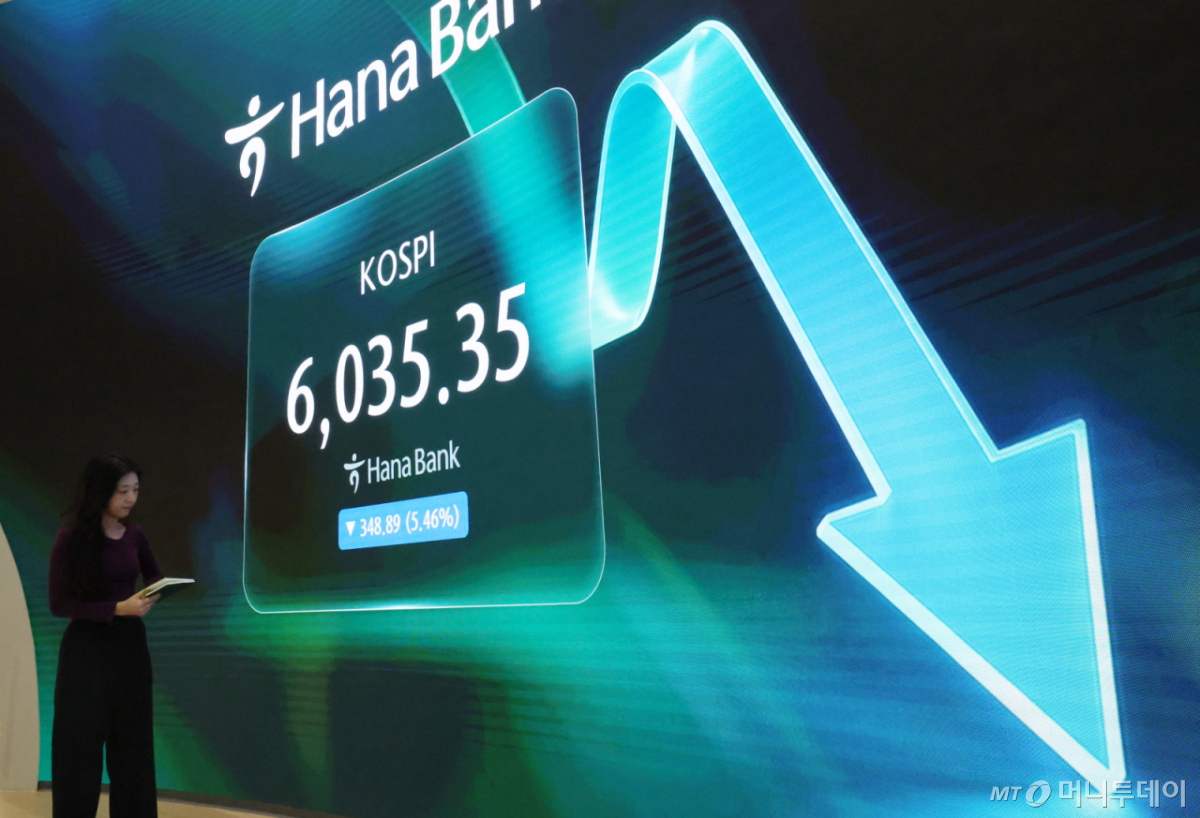
The KOSPI plunged by more than 13% over five trading days, falling to the 6,000 level. The index even broke below 6,000 during intraday trading. This was due to a combination of concerns over memory supply from China, controversies over AI (artificial intelligence) profitability, and supply-demand gaps. Given that the high oil price and high interest rate environment is continuing, forecasts suggest it will take time for a trending rebound.
On the 13th, the KOSPI ended trading at 6035.35, down 348.89 points (5.46%) from the previous day. The selling sidecar (futures market circuit breaker) was triggered early in the session, and the decline subsequently widened as the index dropped to 5911.11. This marked the first time since July 31 that the KOSPI fell below the 6,000 level intraday, a span of 74 days. The index barely recovered above 6,000 just before the close.
The KOSPI has fallen for five consecutive trading days since the 6th. During this period alone, it dropped by 968.39 points.
Researcher Kim Min-gyu at KB Securities stated, "The causes are deteriorating investment sentiment in the semiconductor sector, supply-demand gaps in the stock market, and the persistence of an unstable macro environment," adding, "Net selling by foreign investors continues, centered on the semiconductor sector."
Following news that Chinese memory semiconductor company ChangXin Memory Technologies (CXMT) will release server semiconductors within the year, shares of Samsung Electronics and SK Hynix slid 7.29% and 10.09%, respectively, on this day.
The controversy over OpenAI's annualized recurring revenue (ARR) was revealed to be due to differences in aggregation methods, yet it continues to act as a negative factor. The external environment is also unfavorable. As international oil prices rise and caution grows ahead of the release of the U.S. September CPI (consumer price index) on the 14th (local time), foreign investors' risk appetite is weakening.
Supply-demand gaps are also emerging as share buybacks by Samsung Electronics and SK Hynix enter their final stages. On this day, foreign investors made net sales of 453.3 billion won in the KOSPI market. Retail investors and institutional investors made net purchases of 223.61 billion won and 168.84 billion won, respectively.
Many forecasts suggest it will take time for a trending rebound. This is because it is difficult to quickly resolve the negative external environment and doubts regarding AI and semiconductors.
Researcher Kim Seok-hwan at Mirae Asset Securities said, "Unlike before, it may take time for a rebound," adding, "For a rebound to occur, changes in foreign supply-demand, a decline in U.S. long-term interest rates, and upward revisions to next year's semiconductor profit estimates must materialize."
Experts predict that investors should wait until the end of this month, when earnings and guidance announcements from semiconductor companies and big tech firms are expected to intensify. Following this week's U.S. CPI release, earnings from ASML and TSMC will be released. The increasing likelihood that the base rate will be held steady at the October U.S. Federal Open Market Committee (FOMC) meeting is also a positive factor. Next month's U.S. midterm elections could also influence the direction of the stock market.
Advice is also emerging against hastily engaging in panic selling. Researcher Lee Sang-yeon at Shin Young Securities stated, "Rather than reacting to daily fluctuations, one should observe the situation until the end of this month," adding, "Given the possibility that the base rate may be held steady at the October FOMC, I believe a wait-and-see strategy is more appropriate than formulating strategies based on current market prices."
There are also recommendations to engage in split buying if the KOSPI drops to the 5,000 range. Researcher Jeong Da-eun at LS Securities said, "We judge that a split-buying approach is valid in the KOSPI 5,000 range," adding, "A split-buying approach is valid, considering factors such as gradual interest rate stabilization, U.S. midterm elections that could alleviate fiscal concerns, and the KOSPI index level approaching the all-time low (5593.56 on a closing price basis)."

 in STOCK
