

The domestic stock market is being shaken by supply-demand imbalances. As foreign investors dump shares, no clear buyer has emerged to absorb the selling pressure. Retail investors, who had previously absorbed foreign selling, have seen their buying capacity weaken due to margin trading burdens and deteriorating investor sentiment. Additionally, the 'breakwater' provided by share buybacks from Samsung Electronics and SK Hynix has disappeared. The KOSPI index fell to the 5,400 level for the first time since July, while the KOSPI 200 Volatility Index (V-KOSPI) crossed the fear zone threshold of 50 on the 15th, marking the first time it had breached this level since late August.
According to the Korea Financial Investment Association on the 17th, investor deposits stood at 96.9121 trillion won on the 15th. Deposits had fallen below 100 trillion won for the first time since the 21st of last month, reaching 97.4280 trillion won on the 14th. Investor deposits represent cash remaining in securities accounts and are considered 'ammunition' for stock investment. In contrast, the outstanding balance of margin loans was recorded at 32.7499 trillion won. This figure had decreased to the 27th trillion won range on August 4 but has been on an upward trend, surpassing 34 trillion won on the 13th of this month. Consequently, standby funds in the stock market are decreasing while leverage investment burdens are increasing.
The expansion of margin trading is a kind of 'time bomb' because it can lead to forced liquidations when stock prices plummet. If stock prices fall and the collateral value decreases, securities firms demand additional collateral from investors. If investors fail to meet this requirement within the specified deadline, their held shares may be forcibly sold. This process can trigger a vicious cycle where a flood of selling pressure in the market further drives down stock prices.
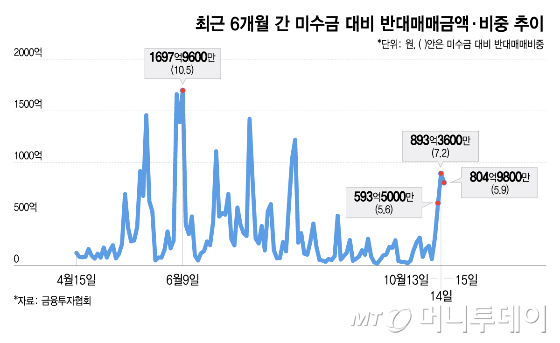
Forced liquidation movements were prominent for three trading days starting from the 13th, when the KOSPI market sell-side sidecar (futures market circuit breaker) was triggered. Both the amount and share of forced liquidations relative to unsettled margin balances surged sharply. Unsettled margin balances refer to amounts that investors have failed to pay by the settlement date after purchasing stocks. The forced liquidation amounts (shares) were 59.4 billion won (5.6%) on the 13th, 89.3 billion won (7.2%) on the 14th, and 80.5 billion won (5.9%) on the 15th. This marked the first time since late July that forced liquidation amounts and shares exceeded 80 billion won and 7%, respectively.
Lee Jun-young, a researcher at Eugene Investment & Securities, stated, "The average buying price for retail investors was formed in the range of the high 6,000s to the low 7,000s on the KOSPI index. However, with recent sharp declines causing the KOSPI index to drop by approximately 15-20%, it appears that liquidations have reached their largest scale since late July." He added, "Margin trading investors may face continued demands for additional collateral and forced liquidations if their maintenance margin ratios fall below the standard due to falling stock prices."
Although forced liquidations also increased significantly in May and June, this contrasts with the recent period because aggressive buying by retail investors was present at that time. From early May, foreign investors made net sales for 24 consecutive trading days, selling a total of 76 trillion won worth of shares. During the same period, retail investors made net purchases of 60 trillion won, defending the index. Investor enthusiasm had risen due to high expectations for semiconductor stock gains and the launch of single-stock leverage ETFs.
In contrast, investor sentiment in AI (artificial intelligence) technology stocks, including semiconductors, has frozen rapidly recently due to factors such as the new product launch by China's Changxin Memory and concerns over the financial soundness of cloud company CoreWeave.
Supply-side support from share buybacks by Samsung Electronics and SK Hynix has also decreased. Samsung Electronics completed its share buyback on the 6th, and SK Hynix is in the final stages. Pension funds, which have played a role as buyers during downturns, are finding it difficult to step up purchases due to delays in rebalancing (adjusting asset weights). This explains why there are concerns that there is no appropriate entity to absorb foreign selling pressure.
Opinions suggest that the circuit breaker triggered in the KOSPI market on the 15th was influenced more by the absence of buyers than by damage to fundamentals. Lee Jae-won, a researcher at Yuanta Securities, analyzed, "While 80-90% of cumulative foreign net sales since the beginning of the year has been concentrated in Samsung Electronics and SK Hynix, share buybacks that had supported the index bottom last month decreased sharply after Samsung Electronics ended its purchases." He added, "Retail investors, who made net purchases of over 100 trillion won since the beginning of the year, have seen their deposit growth stall, and pension funds' capacity to defend supply-demand is limited."
The researcher added, "In the absence of a buyer to absorb foreign panic selling, a vicious cycle of selling similar to the leverage liquidations in late July is repeating itself." He concluded, "For supply-demand to recover, it must be preceded by a calming of AI credit risks and a restoration of confidence in semiconductor profit outlooks."

 in STOCK
