

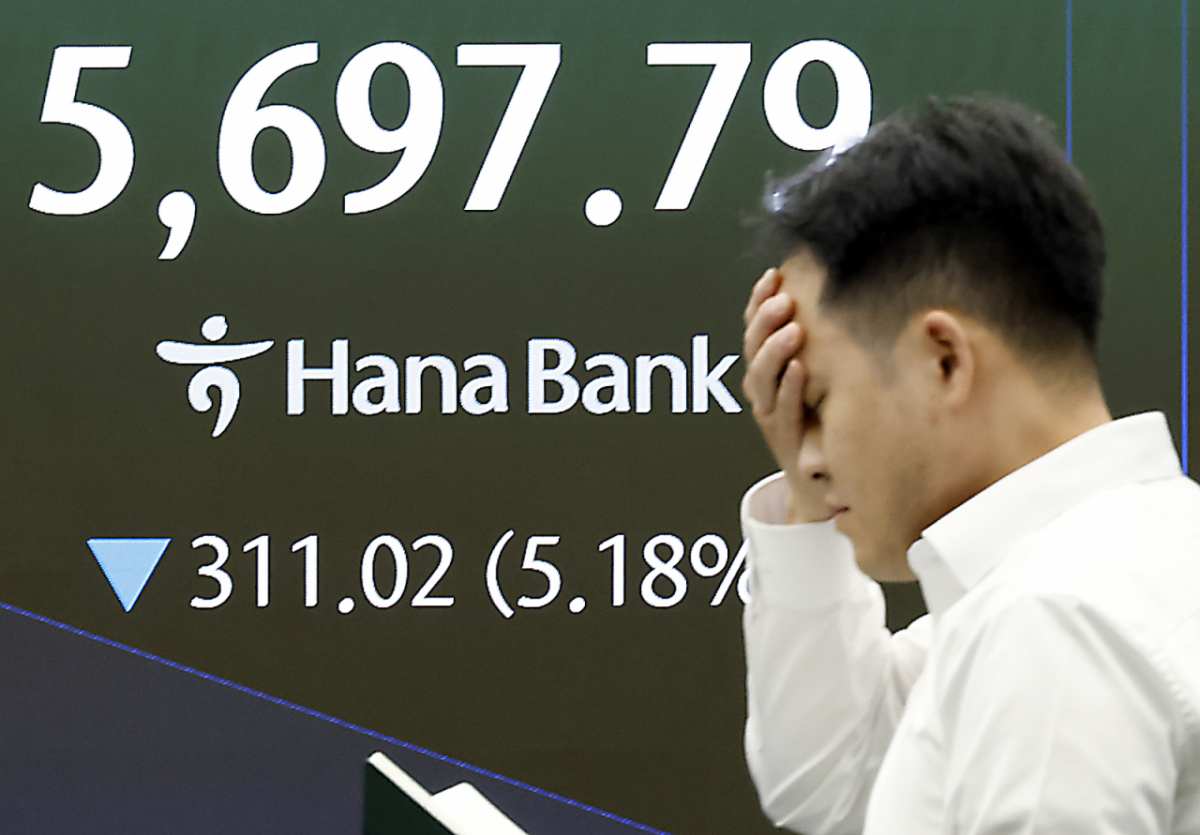
With the shock of US inflation indicators and weakness in semiconductor stocks overlapping, sell-side sidecars (futures market circuit breakers) were simultaneously triggered in both the KOSPI and KOSDAQ markets for the first time in two and a half months. Major semiconductor stocks are particularly weak, with Samsung Electronics and SK Hynix falling by 6% and 8%, respectively.
As of 9:18 a.m. on the 15th, the KOSPI stood at 5633.44, down 375.37 points (6.25%) from the previous trading day. The KOSPI opened at 5673.01, down 5.59%, and has been widening its decline.
At the same time, the KOSDAQ stood at 771.01, down 52.87 points (6.42%). The KOSDAQ also opened at 784.45, down 4.79%, before falling to the 6th% range.
Futures indices for both major markets fell in tandem from the start of trading, triggering sell-side sidecars for the first time since July 29, about two and a half months ago. Sidecars were triggered at 9:07 a.m. for the KOSPI and at 9:12 a.m. for the KOSDAQ, respectively, halting program trading effectiveness for five minutes.
In the KOSPI, foreign investors made net sales while institutional investors made net purchases, with retail investors turning to net buying as of 9:19 a.m. As of 9:24 a.m., according to the Korea Exchange, institutional investors made net purchases of 702.7 billion won and retail investors made net purchases of 11 billion won, while foreign investors sold off 759 billion won.
In the KOSDAQ, low-price buying by foreign investors and institutional investors is flowing in. Retail investors made net sales of 56.9 billion won, but foreign investors made net purchases of 44.8 billion won and institutional investors made net purchases of 14 billion won, respectively.
Looking at top market capitalization stocks, major semiconductor stocks show particular weakness. Samsung Electronics is trading at 216,500 won, down 15,500 won (6.68%) from the previous trading day. SK Hynix is trading at 1,294,000 won, down 125,000 won (8.81%). SK Square plunged in the 9th% range, and Samsung Electro-Mechanics plunged in the 12th% range. LG Energy Solution, Hyundai Motor, and Samsung Life Insurance fell in the 3rd% range, while Samsung SDI fell in the 5th% range and Samsung C&T fell in the 6th% range.
Samsung Electro-Mechanics, considered a leading stock among semiconductor substrate makers, plunged in the 12th% range, ceding its fourth place in market capitalization to LG Energy Solution.
In the KOSDAQ market as well, semiconductor-related stocks are falling across the board. Jusung Engineering fell in the 12th% range, while Simmtech and HPSP plunged in the 10th% range. Among top KOSDAQ market capitalization stocks, Ecopro BM fell in the 8th% range, RAINBOW Robotics and Iotech in the 7th% range, and Lino Industrial in the 6th% range. With Alteogen and Samchundang Pharm falling in the 4th% range, all top market cap stocks are showing red.
In the KOSPI, all industries/sectors fell except for food, beverage & tobacco which was up in the 1st% range, and pharmaceuticals and entertainment/culture which were slightly flat. In particular, medical/precision instruments fell in the 8th% range, and electrical/electronics fell in the 7th% range.
In the KOSDAQ, all industries/sectors fell except for publishing/media which surged in the 12th% range, and entertainment/culture which was slightly flat. Machinery/equipment and non-metals fell in the 9th% range, electrical/electronics fell in the 8th% range, and pharmaceuticals were weak in the 3rd% range.
The weakness in major semiconductor stocks is interpreted as being influenced by US inflation indicators and the overnight weakness of AI/semiconductor stocks in the New York stock market. The US September CPI (consumer price index) rose 3.7% year-on-year, slightly exceeding market expectations (3.6%). Core CPI rose 2.6% year-on-year and 0.3% month-on-month, both exceeding market forecasts.
As US inflation indicators exceeded expectations, raising the outlook for base rate hikes, AI/semiconductor stocks were weak in the New York stock market amid concerns over AI investment debt. Micron Technology fell in the 3rd% range, while AMD fell in the 5th% range, and Intel and SanDisk fell in the 4th% range.
Han Ji-young, a researcher at Kiwoom Securities, stated, "The market's evaluation criteria for the AI investment cycle are shifting from the scale of CAPEX (capital expenditure) expansion to the profitability of invested capital and the stability of funding," adding, "The Q3 big tech earnings season will be a test proving how much more profit and cash flow AI investment can generate compared to the previous quarter."
Forecasts emerged that the domestic stock market would narrow its decline during trading after opening lower. Researcher Han Ji-young analyzed, "Inflow of technical buying following seven consecutive trading days of sharp declines, along with digesting the TSMC earnings event scheduled for release in the latter half of the session, will lead to a narrowing of the decline," adding, "In the short term, whether the KOSPI, including semiconductors, can hold its all-time low amid unfavorable foreign investor supply and demand conditions is the main issue."
On this day in the Seoul foreign exchange market, the won/dollar exchange rate traded at 1339.5 won, up 1.2 won from the previous trading day's closing price.

 in STOCK
