

As demand for AI computing grows, the importance of components essential for operating related data centers is increasing. Initial market focus remained on memory semiconductors before expanding to MLCCs (multilayer ceramic capacitors), substrates, and other areas. The asset management industry has quickly responded to this trend by launching related ETFs (exchange-traded funds).
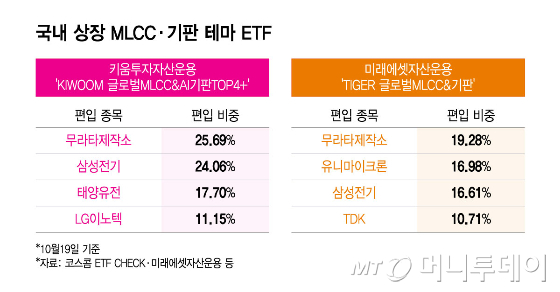
On the 19th, Mirae Asset Global Investments announced via a web seminar that it would newly list the 'TIGER Global MLCC & Substrate' ETF on the 20th. This ETF is a product that invests in MLCC and substrate manufacturers in South Korea, Japan, and Taiwan.
It plans to include a total of 13 stocks, centered on Japan's Murata (19%), Taiwan's Unimicron (17%), and South Korea's Samsung Electro-Mechanics (17%). A key feature is that it invests in core components supporting AI hardware power stability and semiconductor packaging as a whole, rather than being limited to specific parts or countries.
Jung Hye-hyun, Head of the ETF Management Division at Mirae Asset Global Investments, stated, "The investment points for MLCCs and substrates are that the AI bottleneck phenomenon is spreading to MLCCs and substrates, and a cycle in which both prices and sales volumes rise simultaneously is arriving." He added, "Companies leading these markets in South Korea, Japan, and Taiwan may benefit the most."
The asset management industry forecasts that demand for MLCCs and substrate stocks will surge within the AI hardware value chain. It is also continuously attempting to launch ETFs investing in related fields. MLCCs play a role in supplying power stably, while substrates, including FC-BGA (flip-chip ball grid array), function to densely pack multiple chips in limited spaces and protect them. As computing within AI servers has exploded, increasing power consumption and data throughput have also heightened the importance of these components.
Previously, on the 13th, Kiwoom Investment Asset Management newly listed the 'KIWOOM Global MLCC & AI Substrate TOP4+' ETF. This product selects 10 global MLCC and substrate-related companies and concentrates 80% of its total investment in four stocks. It holds Murata Manufacturing and Samsung Electro-Mechanics at 25% each, and TAIYO YUDEN and LG Innotek at 15% each.
Lee Kyung-jun, Head of the ETF Management Division at Kiwoom Investment Asset Management, said, "While existing AI investment products are centered on semiconductor companies such as GPUs and memory, this product is the first in the domestic ETF market to present MLCCs and AI substrates as core investment themes." He added, "It was designed to expand the scope of AI investment from semiconductors to core components, allowing investors to invest in major companies in South Korea and Japan at once."
The securities industry also views profit growth for MLCC and substrate stocks optimistically. According to financial information provider FnGuide, Samsung Electro-Mechanics' third-quarter operating profit consensus estimate is 526.9 billion won. This figure represents a sharp increase of 134% compared to the same period last year. Revenue is projected at 3.8264 trillion won, a 34% increase. Samsung Electro-Mechanics produces both MLCCs and substrates and is considered a representative company in the related industry.
It is widely expected that stock prices will also trend upward in line with increased operating profits. As of the closing price on this day, Samsung Electro-Mechanics ended trading at 1,174,000 won. The target price has been set in the range of 2.41 million won, indicating significant room for the stock price to rise.
Hwang Jun-tae, a research analyst at Korea Investment & Securities, analyzed, "High-end components for AI servers with high technical difficulty form an oligopolistic market that only Samsung Electro-Mechanics and a very small number of leading Japanese companies can respond to, and the company has signed long-term supply contracts with 10 global top hyperscalers (large-scale data centers) and semiconductor companies." He added, "We are passing through the early stages of a cycle where both price (P) and sales volume (Q) increase amid an industry environment where selling prices for high-value-added products rise and demand outpaces supply."

 in STOCK
