

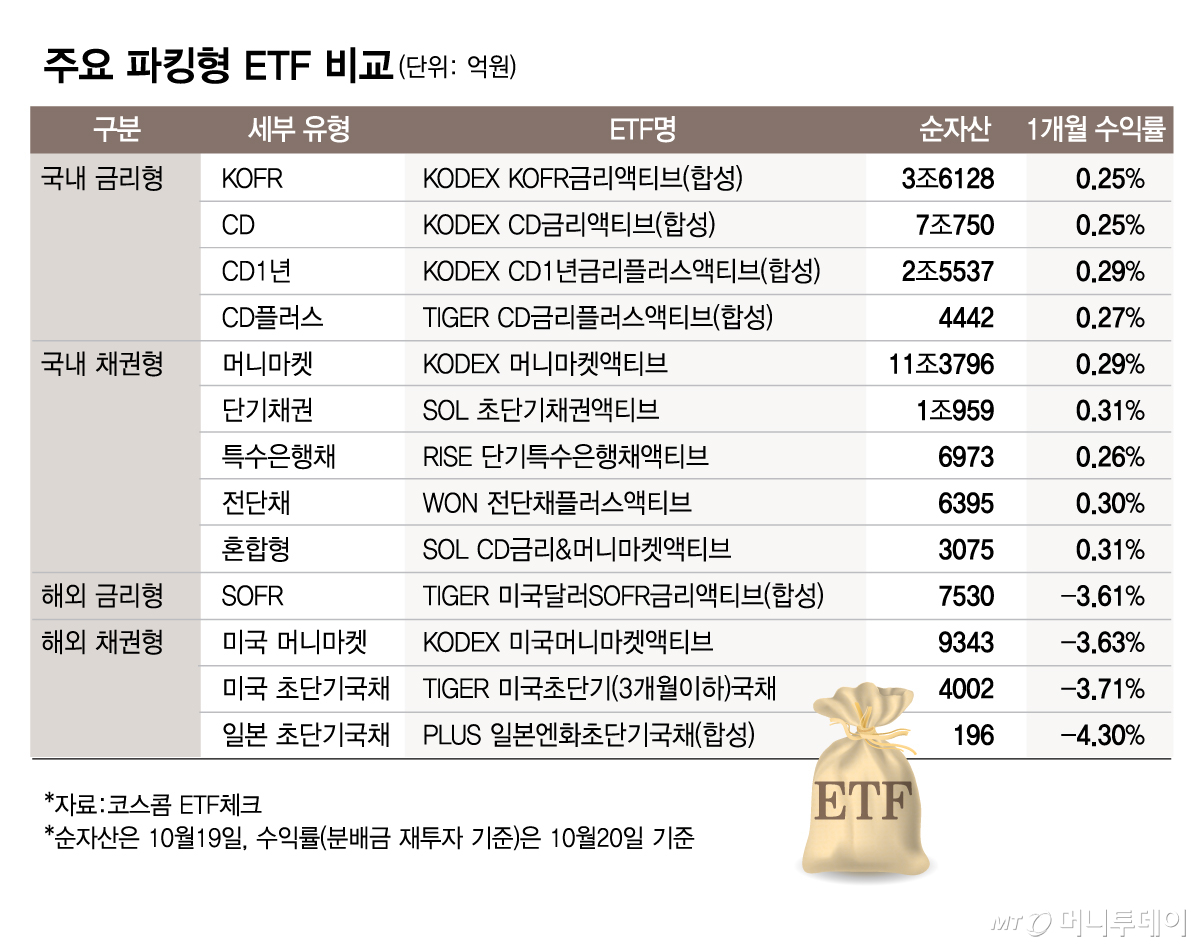
As domestic and global stock markets have shown a downward trend, parking-type ETFs (Exchange-Traded Funds), which allow investors to park short-term funds, are gaining popularity. This is because parking-type ETFs offer the advantage of earning a fixed interest rate even if funds are deposited for just one day. However, it was found that since the underlying indices of parking-type ETFs vary widely, choosing the wrong one could actually result in a loss of principal.
According to KOSCOM ETF Check on the 22nd, there are 40 parking-type ETFs listed domestically. Parking-type ETFs use KOFR (Korea Overnight Financing Rate), SOFR (Secured Overnight Financing Rate), and CDs (Certificates of Deposit) as underlying assets, allowing investors to earn interest based on short-term rates even if they deposit funds for just one day. Similar to a savings account, but unlike stocks, they can be freely bought and sold.
Since parking-type ETFs are not principal-guaranteed products, their returns can record negative values. In fact, as of the previous day, the one-month return (based on reinvestment of distributions) for 'PLUS Japanese Yen Ultra-Short-Term Government Bonds (Synthetic)' was -4.3%.
Parking-type ETFs investing in U.S. bonds or dollar rates, such as TIGER U.S. Ultra-Short-Term (3 months or less) Government Bonds (-3.71%), KODEX U.S. Money Market Active (-3.63%), and KODEX U.S. Dollar SOFR Rate Active (Synthetic) (-3.62%), also recorded negative returns. This is due to the recent decline in the prices of the yen and the dollar.
Since returns vary depending on the underlying assets even among parking-type ETFs, experts in the financial investment industry advise investors to check the underlying assets, net asset value, trading volume, total expense ratio, etc., before selecting a product.
Park Seong-cheol, Head of the ETF Management Team 1 at Samsung Asset Management, stated, "In the case of parking-type ETFs, investors who seek to pursue interest income more smartly even for just one day utilize them, so it is necessary to pay attention to products whose past performance has been proven." He explained, "Since these are products with on-demand deposits and withdrawals, it is better to invest in products with large net asset values and abundant trading volumes."
Dividing the 40th parking-type ETFs by type, there are △13 domestic interest-rate types, △18 domestic bond types, △6 overseas interest-rate types, and △3 overseas bond types. By specific sub-types, domestic interest-rate types include KOFR, CD, CD 1-year, and CD Plus, while domestic bond types include Money Market, Short-Term Treasury Bills, and Short-Term Bond types. Overseas interest-rate and bond types are also divided into categories such as SOFR, U.S. Money Market, and Ultra-Short-Term Government Bonds.
KOFR is an indicator rate calculated based on the actual rates applied when institutional investors borrow or lend money for one day using government bonds or treasury bills as collateral. Because the maturity is short at one day and safe assets such as government bonds are used as collateral, it is considered a low-risk rate. Among ETFs tracking this, the product with the largest net asset value is 'KODEX KOFR Rate Active (Synthetic)', which had a net asset value of 3.6128 trillion won as of the 19th.
CD rate products are ETFs where interest income accumulates daily at the CD 91-day rate, and the ETF with the largest net asset size is 'KODEX CD Rate Active (Synthetic)' (net asset value of 7.075 trillion won).
Looking at the ETFs with the largest net asset values by type, they include △Money Market 'KODEX Money Market Active' (11.3796 trillion won), △Short-Term Bonds 'SOL Ultra-Short-Term Bond Active' (1.0959 trillion won), △SOFR 'TIGER U.S. Dollar SOFR Rate Active (Synthetic)' (753 billion won), △U.S. Money Market 'KODEX U.S. Money Market Active' (934.3 billion won), and △U.S. Ultra-Short-Term Government Bonds 'TIGER U.S. Ultra-Short-Term (3 months or less) Government Bonds' (400.2 billion won).
Among parking-type ETFs, the product with the highest one-month return is 'PLUS Government Bond Money Market Active', which recorded 0.34%. Generally, the returns of domestic money market ETFs were higher than those of interest-rate type ETFs.
Kim Dong-myung, Head of the Bond ETF Management Division at Mirae Asset Global Investments, stated, "Interest-rate types track secured ultra-short-term rates and have high stability, while CD rate types and money market types reflect short-term credit from banks and corporations, so their returns may be slightly higher." He added, "Since parking-type products are ultra-stable with limited returns, if choosing within the same type, one should check the total expense ratio and actual burden costs."
The average total expense ratio for parking-type ETFs is 0.05%. The products with the lowest total expense ratios are 'TIGER CD 1-Year Rate Active (Synthetic)', 'RISE Short-Term Special Bank Bond Active', and 'TIGER CD Rate Plus Active (Synthetic)', all at 0.01%.


 in STOCK

