

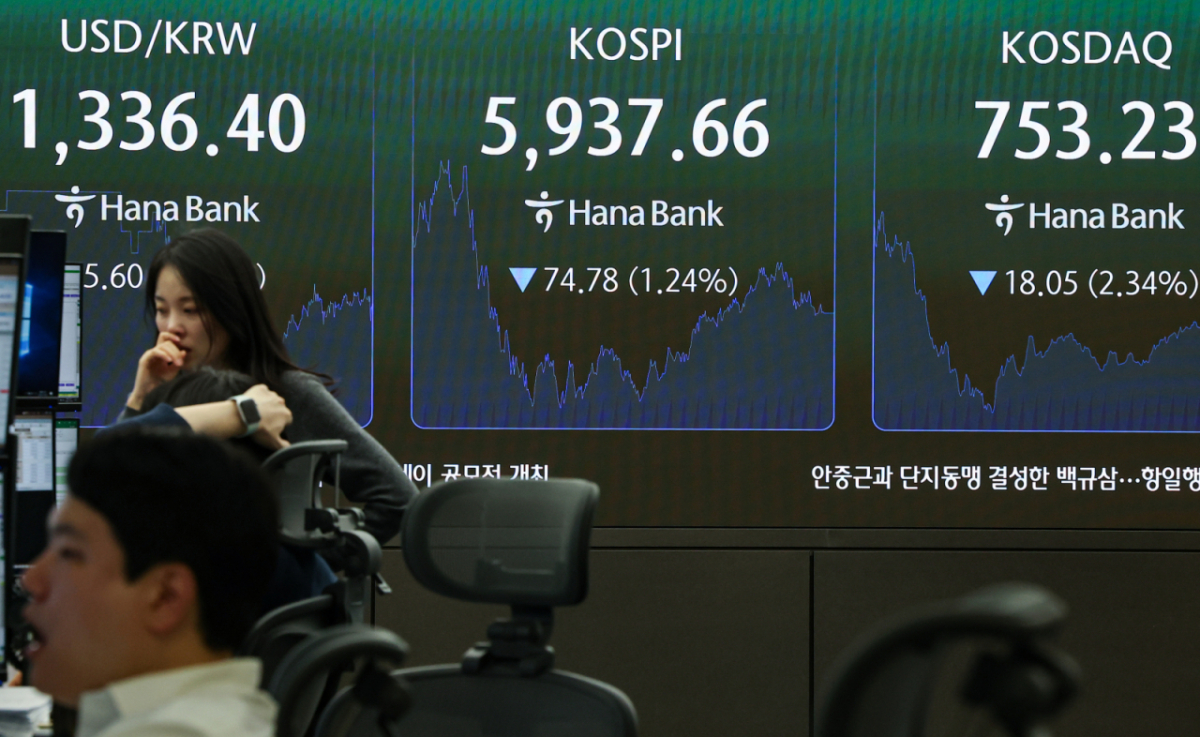
Global investment bank UBS lowered its target for the KOSPI index to 7,500, a 6% reduction from its previous level. Regarding the current level of the KOSPI, UBS said that "risk-averse sentiment has reached an extreme" and forecasted a recovery trend next year.
In a report on the Korean market strategy released on Thursday, UBS adjusted its 12-month KOSPI target downward to 7,500. Commenting on the KOSPI outlook, UBS noted that "concerns over the sustainability of AI (artificial intelligence) spending are a major risk factor."
It added that "in 2027, it will show a slow but recovering trend driven by strong EPS (earnings per share) growth, improved shareholder returns, easing year-end liquidity constraints, and the resolution of U.S. presidential election uncertainty."
UBS explained that the current downward revision in EPS is due to adjustments resulting from the strengthening won. "The approximately 15% appreciation of the won since June could lower projected EPS for 2026 and 2027 by 1% and 10%, respectively, all else being equal," UBS stated, adding that "other factors will partially offset this."
Sectors facing the largest downward adjustments due to the stronger won were identified as chemicals, entertainment, defense, securities, and durable goods. Conversely, the energy, transportation, construction, and insurance sectors were cited as those receiving upward adjustments.
UBS noted that foreign selling had eased and that foreigners had actually shifted to net buying this week. Regarding supply and demand trends this month, UBS observed that "foreign net selling has been dominant, with share buybacks (9.9 trillion won), retail investors (5.8 trillion won), and institutional investors (3.2 trillion won) absorbing the pressure."
It said that "foreign supply and demand shifted to net buying this week, and SK hynix is expected to serve as a support pillar by resuming its share buybacks."
Considering the already lowered foreign ownership ratios of Samsung Electronics and SK hynix, UBS forecasted that additional foreign-led selling pressure would gradually become limited.
Additionally, UBS pointed out that the KOSPI's forward PBR (price-to-book ratio) may be somewhat undervalued when excluding Samsung Electronics and SK hynix. The 12-month forward PER for the index excluding these two stocks is 6.6 times, which has not yet reflected the stronger won, suggesting potential undervaluation.
UBS presented its preferred sectors as follows: △Memory value stocks (Samsung Electronics, SK hynix) △Cyclical industrials (Samsung Electro-Mechanics, Hyosung Heavy Industries, Hyundai E&C, LG Energy Solution) △Shareholder return stocks (Hanssem, KT, Coway) △Macroeconomic beneficiaries (S-Oil, Shinhan Financial Group). KEPCO, Krafton, Naver, Mirae Asset Securities, and battery material stocks, which are exposed to macroeconomic risks, were designated as non-preferred sectors.

 in STOCK
