

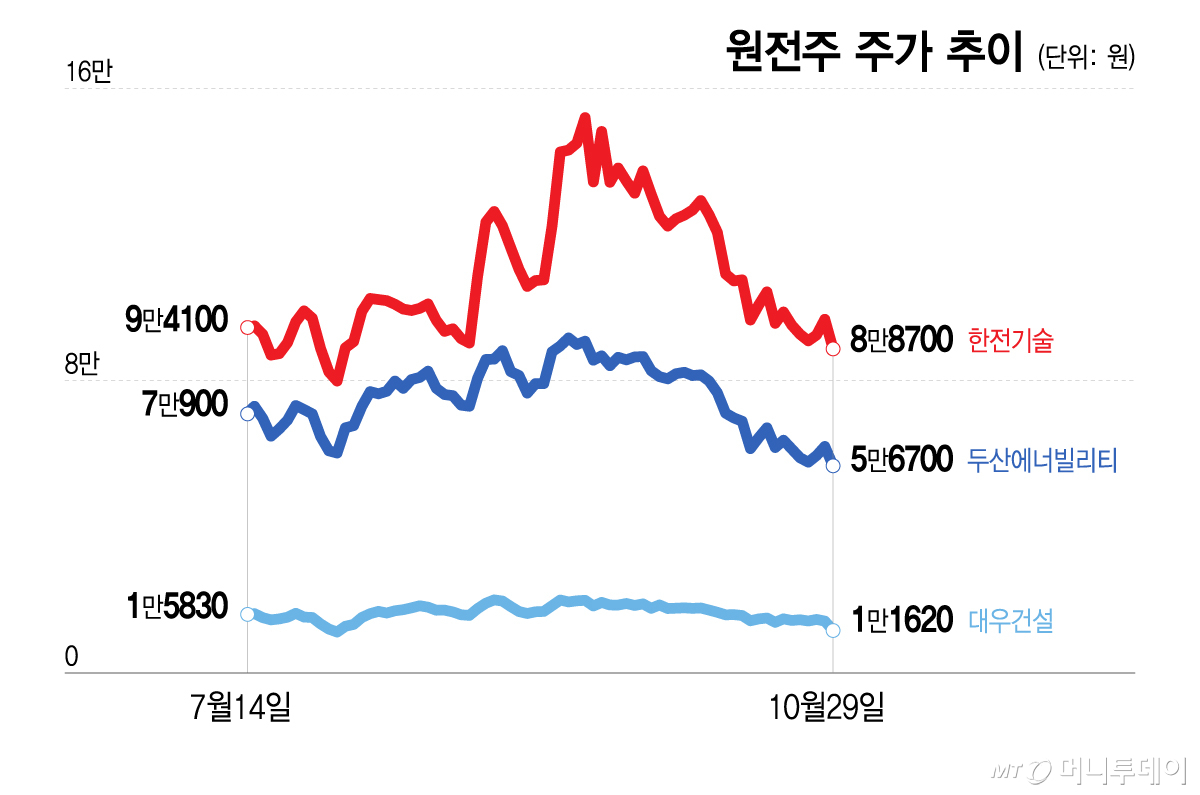
A rebound for shipbuilding, defense, and nuclear-related stocks, which had led the rise in the domestic stock market in the first half of the year alongside semiconductor stocks, remains elusive.
Disappointing earnings, concerns over a stronger won, and ongoing noise surrounding orders have prolonged the slump. However, given market demand and the competitiveness of major domestic companies, expectations for medium- to long-term growth persist, prompting securities firms to advise investors to view recent declines as an opportunity to increase their holdings.
On the 29th, Doosan Enerbility closed trading at 56,500 won, down 7.98% from the previous day. This represents a 59.4% drop from its 52-week high recorded in May. Daewoo E&C also closed at 11,640 won, down 18.43%, marking a 71.15% decline from its all-time high. Korea Electric Power Corporation Technology ended the session down 7.8%.
The drop was driven by Korea Hydro & Nuclear Power’s announcement that it had terminated construction contract negotiations with the Daewoo E&C and Doosan Enerbility consortium (the contractor) for the Dukovany nuclear power plant construction project in the Czech Republic.
The market interpreted this as raising questions about the economic viability of the nuclear business, freezing investor sentiment toward nuclear-related stocks. Kim Ki-ryong, a research analyst at Mirae Asset Securities, assessed that it is difficult to deny that conditions such as securing appropriate profitability through expanding global nuclear demand and a limited participation structure among construction players, as well as expanding nuclear exports led by Team Korea, have been compromised. He added that doubts have emerged regarding overseas nuclear momentum.
However, some expect the current issue to be merely about replacing the contractor, with no problems for the project’s progress. It is also noted that demand in markets such as the United States remains robust beyond the Czech Republic. Jeong Hye-jung, a research analyst at KB Securities, diagnosed that the decline in nuclear-related stock prices reflects excessive concern.
She stated that the Czech nuclear construction project appears unlikely to see major changes and that the U.S. nuclear market pipeline, including nuclear projects agreed upon in investment negotiations with the United States, remains solid.
The sluggishness of shipbuilding and defense stocks is also dragging down the domestic stock market alongside nuclear-related shares. HD Hyundai Heavy Industries closed trading at 272,000 won on the day, down 4.7%. Hanwha Ocean fell 3.8%, and HDHD Hyundai Heavy Industries dropped 3.5%. Hanwha Aerospace and LIG Defense & Aerospace declined by 3.4% and 4.7%, respectively, while Hanwha Systems also fell in the 2% range. These stocks have dropped more than 50% from their highs recorded in the first half of the year.
These stocks, grouped under the acronym 'Jo-Bang-Won' (Shipbuilding, Defense, and Nuclear), had continued a high-flying stock price run through the first half of the year. Orders increased due to expanding global end-market demand and strengthened competitiveness of domestic companies, with earnings expectations reflected in stock prices. However, since peaking in May, they have been on a downward trend for nearly six months due to the burden of elevated valuations, gaps in large-scale orders, and concerns over a stronger won.
In particular, as the third-quarter earnings season approaches, the impact of the stronger won is being reflected in results, causing investor sentiment to cool rapidly. Shipbuilding stocks that have released earnings, such as HDHD Hyundai Heavy Industries and HD Hyundai Heavy Industries, saw their net income decrease as foreign currency-related losses increased.
Nevertheless, securities firms maintain a positive outlook, noting that global demand continues and order performance is being sustained.
Seo Jae-ho, a research analyst at DB Securities, stated regarding the defense sector that while stock prices have been adjusted due to the convergence of exchange rate concerns, gaps in large-scale orders, and individual company setbacks, "the trend of increasing global defense budgets remains unchanged." He predicted that there will be rebound momentum when considering state visit schedules and expectations for contracts from existing potential pipelines.

 in STOCK
