


The cornerstone investor system, which allocates part of an IPO's shares to institutional investors in advance on the condition that they hold the shares for a specified period, and the pre-IPO book-building system, which gauges market demand for offering prices and share volumes before a securities registration statement is filed, will officially take effect on Nov. 13.
The measures are expected to help stabilize the IPO market by curbing excessive short-term profit seeking and improving the rationality of IPO pricing.
The Financial Services Commission said Tuesday that the Cabinet had approved revisions to the Enforcement Decree of the Capital Markets Act, which set out detailed rules for the two systems delegated under the law.
Under the cornerstone investor system, a portion of IPO shares is allocated in advance to institutional investors on the condition that they remain locked up for at least six months. The system is expected to secure stable, long-term institutional investors ahead of an IPO, boost investor confidence and help address the problem of IPO stocks plunging sharply immediately after listing.
The revised decree staggers the lockup periods for shares allocated to cornerstone investors: 50 percent will be subject to a six-month lockup, 30 percent to an eight-month lockup and 20 percent to a 10-month lockup. The staggered schedule is designed to prevent a surge in selling that could occur if all lockups expire on the same day.
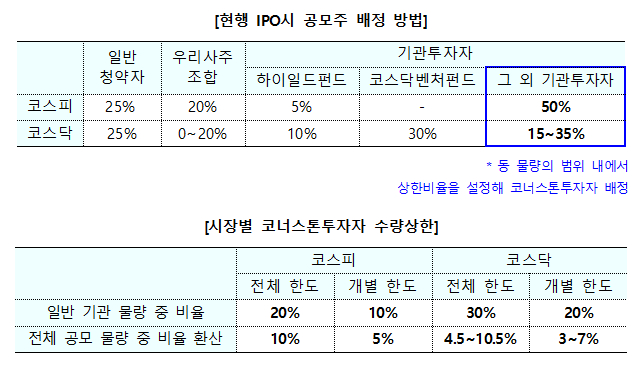
The cap on advance allocations to cornerstone investors will differ between the main KOSPI and secondary KOSDAQ markets. The government took into account the smaller size of KOSDAQ offerings and the larger share of allocations reserved for policy funds, which could otherwise discourage institutional investors from participating.
Of the shares allocated to institutional investors, excluding portions reserved for retail investors, employee stock ownership associations and policy funds, the overall cap will be 30 percent for KOSDAQ offerings, with an individual investor limit of 20 percent. For KOSPI offerings, the overall cap will be 20 percent and the individual limit 10 percent, both 10 percentage points lower than those for KOSDAQ.
The revised decree also introduces minimum equity capital and asset requirements to ensure that only institutional investors capable of bearing stock price volatility qualify as cornerstone investors. They must have equity capital or assets under management worth at least 20 times the value of the IPO shares they seek to subscribe to in advance.
The requirement is based on a relative rather than an absolute amount, reflecting the wide variation in the size of individual IPOs. This is expected to give not only large institutions but also smaller and mid-sized investors an opportunity to participate.
To prevent conflicts of interest, institutions with ties to the issuer, including major shareholders and their affiliates, will be prohibited from entering into cornerstone investor agreements.
The measure is intended to prevent practices such as preferentially allocating shares to affiliates in highly competitive IPOs or using advance allocations to affiliates to make an undersubscribed offering appear more popular while shifting investment risks to them.
The revised rules also prohibit institutions from providing or receiving direct or indirect benefits in exchange for entering into cornerstone investor agreements, effectively blocking undisclosed side deals tied to advance share allocations.
Pre-demand forecasting is a system that allows lead underwriters to gauge institutional investor demand before the desired public offering price range is finalized through the disclosure of the securities registration statement during an IPO.
By assessing and reflecting market demand from the initial stage of setting the desired public offering price range, lead underwriters can determine the public offering price more rationally.
According to the amended enforcement decree, after preparing a corporate due diligence report, lead underwriters and others may provide company information (securities registration statement disclosure information) to institutional investors who meet eligibility requirements and inquire about their demand, such as desired purchase prices or volumes.
Since the information provided at this stage has not yet been disclosed, confidentiality agreements must be signed. Violating a confidentiality agreement by allowing third parties to use such information may constitute misuse of undisclosed material information.
The asset size requirement for professional investors participating in pre-demand forecasting is set the same as the current eligibility requirements for demand forecasting participation.
Among existing regulations, only the requirement that "general private fund managers and investment discretionary managers must have total entrusted assets of 30 billion won or more" will be applied; the relaxed provision lowering this threshold to 5 billion won after two years of registration will not be applied.
In addition, additional eligibility requirements, such as recent participation records in IPO demand forecasting and mandatory holding commitments, will be established under the regulations of the Korea Financial Investment Association to verify capabilities in corporate valuation assessment and internal management of undisclosed information.

 in STOCK

