

Concerns are emerging that volatility in the domestic stock market will expand from the first trading day of November, driven by the sharp decline in U.S.-listed semiconductor stocks. However, some analysts argue that market concerns are excessive, as there have been no changes to fundamentals such as semiconductor profitability. Instead, it was analyzed that the recent stock price correction has actually enhanced medium- and long-term investment appeal. Nevertheless, experts pointed out that a race against time is necessary until the first half of next year, when improvements in the macroeconomic environment, including inflation and interest rates, are expected. This is because supply-demand instability, one of the core causes of volatility, is difficult to resolve in the short term.
On the 1st, securities industry analysts forecast that it would be difficult for the domestic stock market to immediately escape the impact of the sharp decline in U.S. markets. The KOSPI index had already fallen by 3.48% on the 30th of last month, and supply-demand gaps emerged as foreign investors made net sales of 1.6173 trillion won. In October alone, foreign investors recorded net sales of 12.237 trillion won in the KOSPI market.
This is due to the impact of deteriorating foreign investor sentiment amid an unstable macroeconomic environment. With the foreign ownership ratio in the KOSPI rising to around 40%, profit-taking selling surged as risk appetite declined in a high-interest-rate and high-inflation environment.
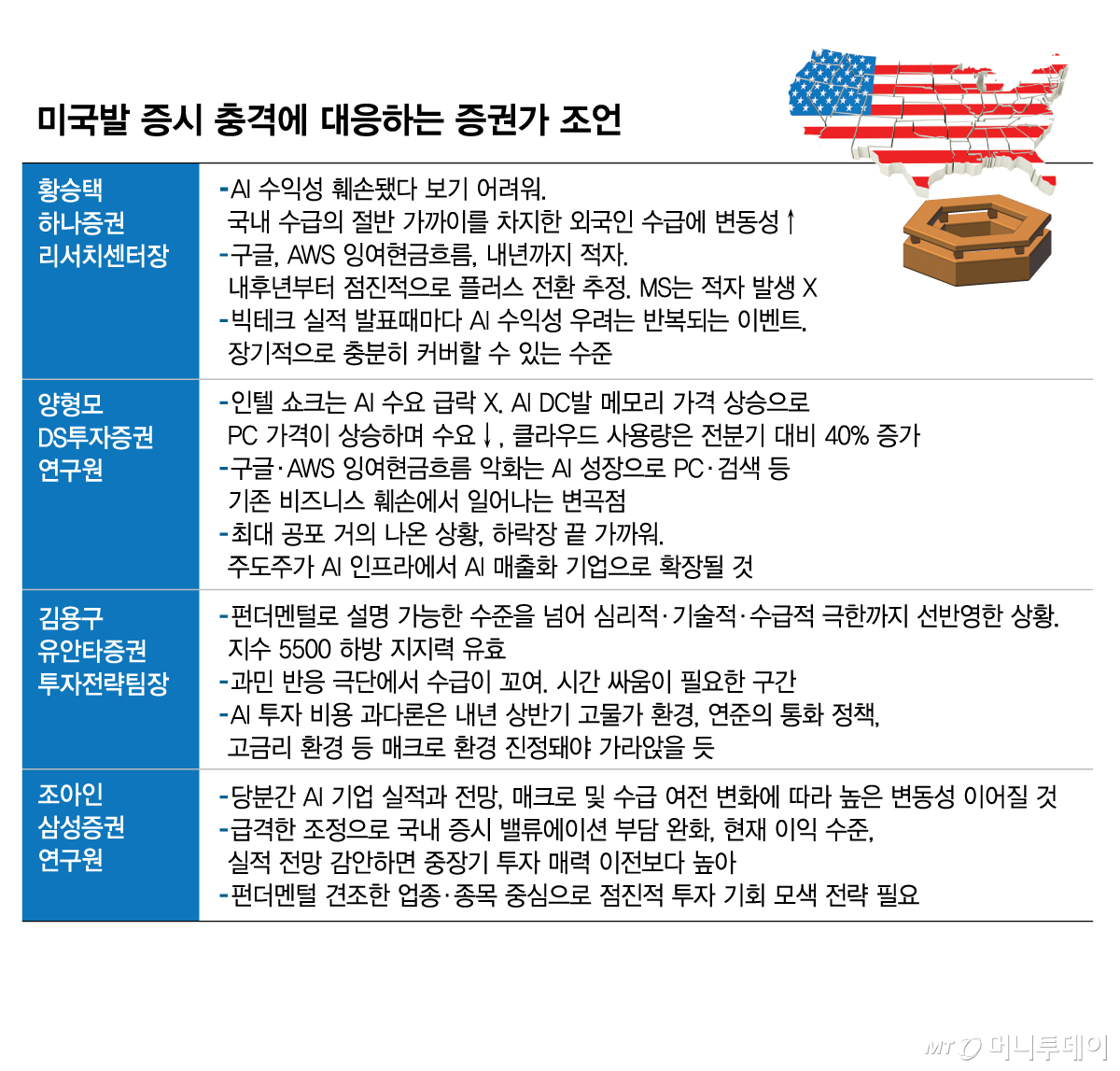
Hwang Seung-tak, head of the Research Center at Hana Securities, explained, "The domestic stock market has become one that moves according to foreign supply and demand dynamics." He added, "Unlike the Taiwan stock market, which carries a large weighting in foundry stocks, the Korean market has a higher proportion of memory semiconductors, which are subject to significant cyclical fluctuations. As a result, psychological factors are reflected more strongly."
The VKOSPI (KOSPI 200 volatility index) also fell into the 30s in September, but it rose in mid-October and has since exceeded 50 again. When the VKOSPI surpasses 40, market volatility concerns are typically assessed to be at a very high level.
Kim Yong-goo, head of the investment strategy team at Yuanta Securities, stated, “The recent correction in the domestic stock market has gone beyond what can be explained by corporate fundamentals, and investors’ psychological anxiety, technical selling pressure, and deteriorating supply and demand conditions have been fully priced into stock prices to an extreme degree.” He added, “Given that supply and demand dynamics are also tangled up, this is a period during which the market must endure until it finds stability.” However, Kim noted that “the downside support at the KOSPI 5,500 level remains valid.”
While short-term volatility is difficult to avoid, analysts note that the investment appeal of domestic stocks has increased in the medium to long term, as there are no changes to the fundamentals underpinning the market's memory semiconductor sector. Samsung Electronics and SK hynix demonstrated record-high profitability in their third-quarter earnings reports, and the upward trend in memory semiconductor demand driven by AI infrastructure investments continues. The demand base is also assessed as solid, with a significant portion of future supply volumes secured in advance through long-term agreements (LTAs).
Some analysts argue that the shock to Google, Amazon, and Intel in the U.S. stock market is unlikely to worsen the domestic semiconductor industry outlook. Yang Hyeong-mo, a researcher at DS Investment & Securities, explained, "The Intel shock, which saw its stock price drop by 29% in a single day, is not evidence of a sharp decline in AI demand. Rather, it occurred because memory semiconductors intended for PCs were absorbed by AI data centers, driving up PC prices and subsequently reducing demand." He added, "The deterioration in free cash flow (FCF) for GCP (Google Cloud Platform) or AWS (Amazon Web Services) is merely an inflection point where existing businesses are being eroded as hegemony shifts toward AI."
Center Director Hwang also stated, “We estimate that Google’s and Amazon’s free cash flow (FCF) will remain in the red through next year but gradually turn positive the year after,” adding, “Cloud usage is growing every quarter, and Microsoft (MS) Azure has not even posted an FCF deficit.”
Market volatility may persist through the first half of next year. This is because easing concerns over artificial intelligence investment costs requires not only strong corporate earnings but also improvements in the macroeconomic environment, including inflation and interest rates.
Team Leader Kim said, "The debate over excessive AI investment costs will only subside once the macro environment, including the U.S. Federal Reserve's monetary policy and the high-inflation, high-interest-rate conditions, stabilizes." This implies that rather than expecting a trend reversal in the short term, investors should endure until the market finds stability.
Some analysts also advise that short-term volatility could present an opportunity for medium- to long-term investors who can tolerate such fluctuations. Cho A-in, a research analyst at Samsung Securities, stated, "The recent sharp correction has significantly alleviated valuation pressures in the domestic stock market." She added, "While volatility may persist in the short term, investment appeal remains high given current earnings levels and performance outlooks. Therefore, it is appropriate to adopt a strategy of gradually seeking investment opportunities centered on sectors and stocks with solid fundamentals."

 in STOCK
