

Doosan Fuelcell has raised 400 billion won through perpetual bonds, but questions remain over whether the sell-down will attract enough demand. Securities firms that fully underwrote the bonds are seeking to offload their holdings to smaller and mid-sized brokerages through funds.
However, differing views among potential buyers could prolong the sell-down beyond initial expectations. Analysts say investment decisions are difficult because the stock is trading well below the conversion price and brokerages have widely varying earnings forecasts.
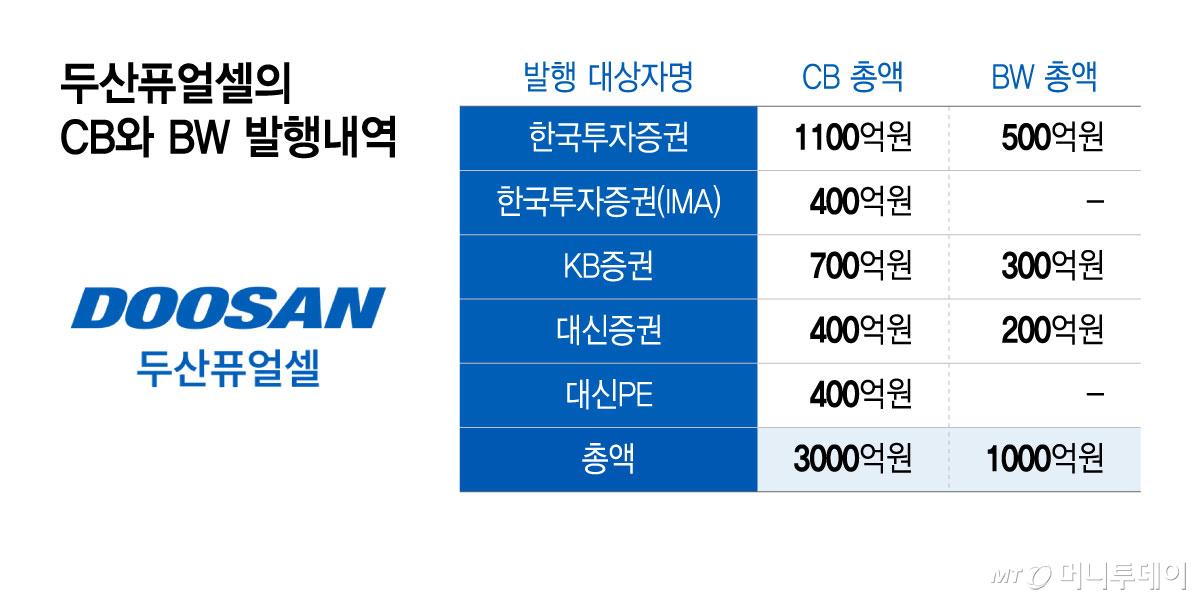
According to investment banking (IB) industry sources on the 3rd, Korea Investment & Securities, KB Securities, and Daishin Securities, which underwrote Doosan Fuelcell's 300 billion won perpetual convertible bonds (CBs) and 100 billion won perpetual bonds with warrants (BWs) on an all-in basis, are proceeding with the sell-down. The structure involves asset management companies establishing project funds to provide investment capital.
Korea Investment & Securities underwrote 110 billion won of Doosan Fuelcell's CBs and 50 billion won of BWs. Separately, it purchased an additional 40 billion won of CBs through its Integrated Account (IMA). KB Securities underwrote 70 billion won of CBs and 30 billion won of BWs, while Daishin Securities underwrote 40 billion won of CBs and 20 billion won of BWs. Daishin PE (Private Equity) also purchased 40 billion won of CBs.
The project funds that will take over Doosan Fuelcell's CBs and BWs are currently being designed by asset management companies such as Orion Asset Management and Soosung Asset Management, it was understood. Small and mid-sized securities firms are expected to participate in the project funds as limited partners (LPs). However, because LPs overlap and share the volume, it appears that finalizing the sell-down will take longer than anticipated.
Views on Doosan Fuelcell are also divided among the small and mid-sized securities firms participating in the sell-down. This is because if a large portion of the bonds is converted into shares, the stock price could be diluted, while if conversion does not occur, the burden of debt may increase. Doosan Fuelcell's stock price reached an all-time high of 108,900 won in May last year but has since fluctuated and declined to trade below the 30,000 won mark. The conversion and exercise prices for both the CBs and BWs are 43,704 won, which is more than 40% higher than the current stock price.
The financial investment industry views this funding round as having merely postponed the point at which Doosan Fuelcell's burden will materialize. The bonds have a maturity of 30 years and a maturity interest rate of 2%. The coupon rate is 0% for the first three years and then adjusts to 5% annually thereafter. Additionally, an additional margin of 1 percentage point is added each year. By simple calculation, starting from November 2029, the interest burden will increase by 4 billion won annually, on top of 20 billion won per year (5% of 400 billion won).
Profitability forecasts for Doosan Fuelcell released by the securities market also vary widely. According to recently published securities firm reports, next year's operating profit forecasts for Doosan Fuelcell are 88.9 billion won from DS Investment & Securities, 38.6 billion won from NH Investment & Securities, 35.4 billion won from Mirae Asset Securities, 24.4 billion won from Hana Securities, 21.6 billion won from Meritz Securities, and 18 billion won from Eugene Investment & Securities, among others.
The key issue is cash generation capability. Doosan Fuel Cell recorded a cash outflow of 51.6 billion won from operating activities on a standalone basis in the first half of this year. According to NICE Credit Rating, Doosan Fuelcell's free cash flow for the same period was minus (–) 58.7 billion won. Total debt as of the end of June was 666.9 billion won, the highest level in the past five years. The debt dependency ratio was 49.7%, and the debt-to-equity ratio was 336.2%. NICE Credit Rating and Korea Ratings maintained Doosan Fuelcell's credit rating at 'BBB' during their regular evaluations for the first half of this year, but lowered the rating outlook from 'stable' to 'negative'.
An IB industry official said, "With small and mid-sized securities firms split evenly on their stance toward investing in Doosan Fuelcell, it remains to be seen whether the sell-down will be successful," adding, "I understand that views are clashing between those who see this funding round as merely delaying cash pressure and those who view it as a momentum for growth."

 in STOCK
